



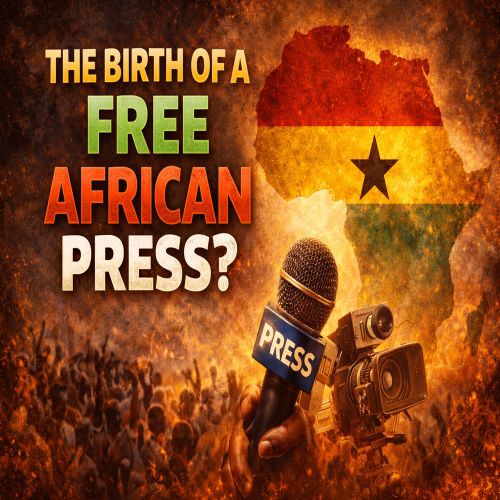
The question of whether independence in 1957 marked the true birth of a free African press in the Gold Coast—now Ghana—is both historically complex and deeply debated. While Ghana’s independence symbolized political liberation from colonial rule, the evolution of press freedom was far more gradual and contested. Newspapers had played a crucial role in anti-colonial activism, and many journalists believed independence would usher in an era of unrestricted expression. However, the transition from colonial censorship to post-colonial state control revealed that the concept of a “free press” involved ongoing struggles rather than an immediate transformation.
The Colonial Press Environment
Before independence, the Gold Coast already had a vibrant but tightly regulated newspaper culture. From the late nineteenth century onward, African-owned newspapers emerged as powerful voices advocating political reform and social justice.
Despite this growth, colonial authorities imposed strict press laws designed to suppress dissent. Editors faced licensing requirements, sedition laws, and the threat of closure for publishing material critical of the colonial government.
As a result, many nationalist journalists viewed independence as an opportunity to break free from these constraints and establish a genuinely independent press system.
Newspapers as Instruments of Nationalism
During the struggle for independence in the 1940s and 1950s, newspapers functioned as central tools of political mobilization. Nationalist leaders relied heavily on the press to communicate with the public, organize protests, and challenge colonial narratives.
Publications associated with the Convention People’s Party (CPP) played particularly influential roles. Journalists portrayed independence not only as a political victory but also as a pathway to intellectual and media freedom.
This period created widespread public expectations that independence would guarantee unrestricted press activity.
Independence and the Promise of Press Freedom
When Ghana gained independence on March 6, 1957, many journalists celebrated what they believed to be the dawn of a free African press. Editorials emphasized the end of colonial censorship and the opportunity for African journalists to shape national discourse without external interference.
The new government initially encouraged press expansion. Newspapers flourished, and journalists explored topics related to development, social change, and national identity.
The atmosphere of optimism led many observers to describe the period as the beginning of a new era for African journalism.
Emerging Tensions Between State and Press
However, the relationship between the government and the press soon became more complicated. Leaders, particularly Kwame Nkrumah, viewed the media as essential tools for nation-building and political unity.
As a result, the government increasingly sought to influence newspaper content to ensure alignment with national development goals. Critics argued that this approach limited editorial independence and discouraged critical reporting.
State-owned newspapers began to dominate the media landscape, promoting official policies and highlighting government achievements.
Legal Restrictions and Political Control
During the early 1960s, press regulations tightened significantly. Laws were introduced that allowed the government to detain journalists, restrict publications, and control media ownership.
These measures were justified by authorities as necessary for maintaining national stability and preventing political fragmentation.
For many journalists, however, these developments contradicted the expectations of press freedom that had accompanied independence.
The tension between national unity and freedom of expression became a defining feature of Ghana’s early post-colonial media environment.
The Broader African Context
Ghana’s experience reflected wider patterns across newly independent African states. Many governments viewed the press as instruments of development rather than independent watchdogs.
As a result, state control of media became common throughout the continent, leading scholars to question whether independence truly marked the birth of a free African press.
Instead, historians often describe the period as a transition from colonial censorship to national political control.
The Role of Journalists in Defending Press Freedom
Despite these challenges, Ghanaian journalists continued to advocate for media independence. Professional associations, editorial debates, and public discussions emphasized the importance of free expression for democratic governance.
Over time, these efforts contributed to the gradual development of stronger press institutions and legal protections.
This ongoing struggle demonstrates that press freedom is not achieved through a single historical event but evolves through sustained political and social engagement.
Long-Term Legacy
Today, Ghana is widely regarded as having one of Africa’s most vibrant and independent media environments. This achievement reflects decades of institutional development, legal reforms, and journalistic advocacy.
The historical experience of the early independence period continues to shape contemporary debates about media responsibility, state regulation, and democratic accountability.
Conclusion
Independence in 1957 did not immediately create a fully free African press in Ghana, but it marked an important turning point in the struggle for media autonomy. While colonial censorship ended, new forms of political influence and regulation emerged, revealing the complexities of balancing press freedom with nation-building priorities.
Thus, the birth of a free African press in Ghana should be understood not as a single moment but as an evolving process shaped by historical challenges, political dynamics, and the enduring commitment of journalists to defend the principles of independent reporting.