





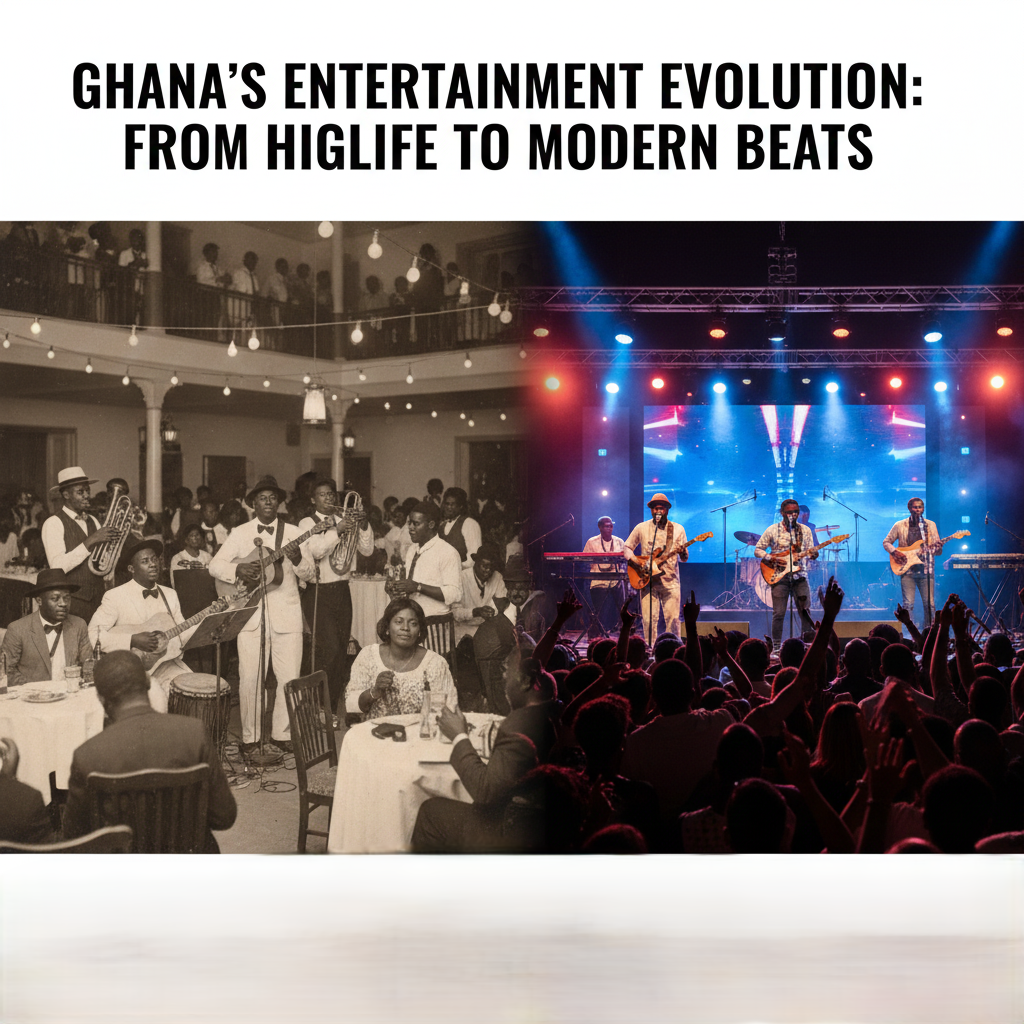
Long before Ghana had a film industry or digital streaming platforms, music was the country’s most powerful form of entertainment—and Highlife became its loudest voice. From colonial ballrooms to roadside bars and global stages, Highlife music has shaped Ghana’s cultural identity for more than a century.
The Birth of Highlife in the Gold Coast (1890s–1920s)
Highlife music emerged in the late 19th and early 20th centuries, during the Gold Coast era, as a fusion of traditional Akan rhythms, sea shanties, brass band music, and European ballroom dance styles.
The name “Highlife” came from the elite social clubs and dance halls in coastal cities such as Accra, Cape Coast, and Sekondi, where the African middle class gathered to dance to live bands. For ordinary people, hearing this music from outside the clubs symbolized “high life”—luxury and modernity.
By the 1920s, palm-wine guitar music spread Highlife beyond elite spaces, making it accessible to workers, farmers, and traders across the colony.
Highlife and National Consciousness (1930s–1950s)
During the 1930s–1950s, Highlife became more than entertainment—it became a tool for storytelling and social commentary. Musicians sang about love, hardship, colonial injustice, and African pride.
Bands like the Jazz Kings, Cape Coast Sugar Babies, and later E.T. Mensah and the Tempos popularized dance-band Highlife. E.T. Mensah, often called “The King of Highlife, rose to fame in the 1940s and 1950s, turning Highlife into a national sound.
As independence approached, Highlife music echoed the optimism and political awakening of the people, often performed at rallies and celebrations.
Independence and the Golden Age of Highlife (1957–1970s)
After Ghana gained independence on 6 March 1957, Highlife entered its golden age. The new nation embraced the music as a symbol of African modernity and unity.
The government supported cultural expression through:
- state-sponsored bands,
- radio broadcasts, and
- national cultural institutions.
Legendary artists such as E.T. Mensah, King Bruce, Nana Kwame Ampadu, and Osibisa carried Highlife beyond Ghana’s borders, influencing music across West Africa and the diaspora.
By the 1960s and 1970s, Highlife had become Ghana’s most important entertainment export.
Decline, Reinvention, and Survival (1980s–1990s)
Economic hardship and political instability in the 1980s affected live band music. Nightclubs closed, and many musicians emigrated.
However, Highlife survived by adapting. Electronic instruments and studio recordings gave rise to modern Highlife, keeping the genre alive on the radio and cassette tapes. Artists like Amakye Dede and Daddy Lumba dominated the airwaves during this period.
Highlife’s Legacy in Modern Entertainment (2000s–Present)
Today, Highlife remains the foundation of Ghana’s entertainment industry. Contemporary genres such as Hiplife and Afrobeats draw heavily from Highlife rhythms and storytelling traditions.
Modern stars continue to sample and honor Highlife legends, proving that the genre is not outdated—it is timeless.
Highlife’s influence can be heard in:
- popular Ghanaian films and soundtracks,
- festivals and national celebrations,
- global African music platforms.
Why Highlife Still Matters
Highlife is not just music; it is Ghana’s historical soundtrack. From the colonial Gold Coast to the digital age, it has recorded love, struggle, joy, politics, and identity. It remains Ghana’s most important entertainment legacy—one that connects generations and continues to evolve.
Key Historical Dates at a Glance
- 1890s – Early Highlife influences emerge
- 1920s – Palm-wine Highlife spreads nationwide
- 1940s–1950s – E.T. Mensah popularizes dance-band Highlife
- 1957 – Independence ushers in Highlife’s golden age
- 1970s – Highlife dominates Ghanaian entertainment
- 1980s – Modern Highlife emerges
- 2000s–present – Highlife influences Hiplife and Afrobeats
Sources & References
- Collins, J. (1994). Highlife Time. Anansesem Publications.
- Collins, J. (2006). Musicmakers of West Africa. Lynne Rienner Publishers.
- Shipley, J. W. (2013). Living the Hiplife. Duke University Press.
- National Archives of Ghana – Cultural and Broadcasting Records.
- Ghana Broadcasting Corporation (GBC) historical music archives.
Watch full video on YouTube – https://youtu.be/50lRdYX6Ayk