







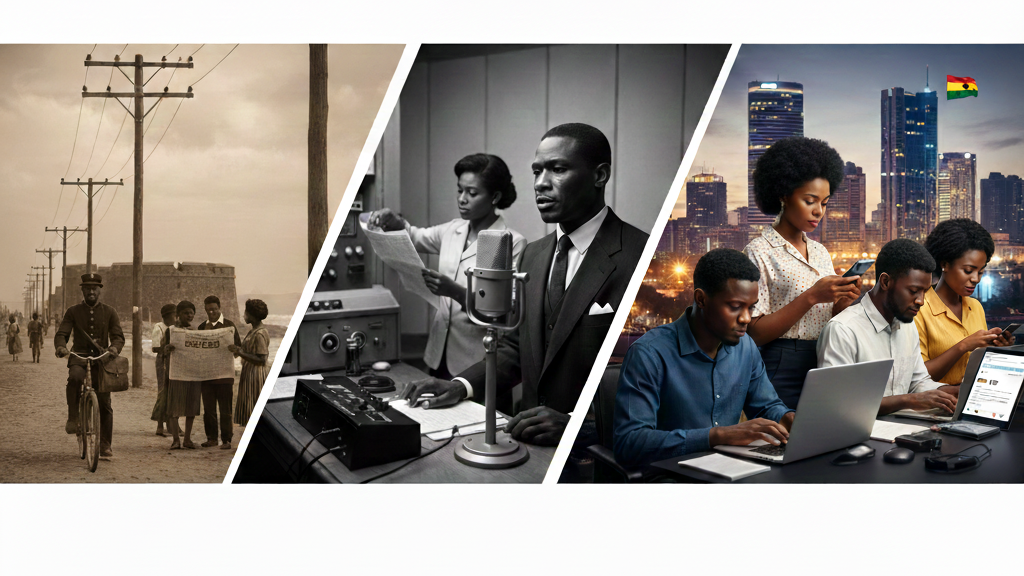
Few technological developments have reshaped Ghana as profoundly as the Advancement of communication technology. From the first telegraph lines laid by colonial authorities to today’s smartphones and internet-driven economy, communication has changed how Ghanaians trade, govern, organize, and connect with the world.
The Telegraph and Postal Revolution (1870s–1900s)
Modern communication in the Gold Coast began in the 1870s, when the British colonial administration introduced the telegraph system to link coastal forts with administrative centers inland. By 1881, telegraph lines connected Cape Coast to Elmina and Accra, primarily to support trade, military coordination, and governance.
Alongside the telegraph, the postal service expanded rapidly. Letters, newspapers, and official notices moved faster than ever before, enabling the rise of early journalism and nationalist debate. Though initially limited to colonial interests, these systems quietly laid the foundation for national communication.
Radio Broadcasting: Giving the Colony a Voice (1930s–1950s)
Radio emerged as a powerful technology in the 1930s, changing entertainment, information flow, and public education. In 1935, radio broadcasting was formally introduced in the Gold Coast through relay systems transmitting BBC content.
By 1954, the Gold Coast Broadcasting System (later renamed the Ghana Broadcasting Corporation – GBC) was established, providing local voices with airtime. Radio became a unifying force—bringing news, music, education, and political messages to urban and rural communities alike.
During the independence struggle, the radio played a crucial role in mobilizing public opinion and disseminating nationalist ideas.
Telecommunications and Nation Building (1957–1970s)
After independence in 1957, Ghana invested heavily in telecommunications as part of nation-building. Telephone exchanges expanded in major cities, and microwave transmission systems were installed to link regions.
In 1974, the creation of Ghana Posts and Telecommunications (P&T) marked a major step in institutionalizing the national communication infrastructure. For the first time, businesses, government agencies, and individuals could communicate more efficiently across long distances, boosting commerce and administration.
Mobile Phones and the Telecom Liberalization (1990s–2000s)
The 1990s marked a turning point. With economic reforms and liberalization, Ghana opened its telecom sector to private investment.
In 1996, mobile telephony was introduced, ending decades of limited access to fixed-line phones. The establishment of the National Communications Authority (NCA) in 1996 regulated the growing sector.
By the early 2000s, mobile phones had spread rapidly, transforming:
- small businesses and traders,
- agriculture and market pricing,
- banking and mobile money,
- social and political organization.
Communication was no longer a luxury—it became a necessity.
Internet, Digital Media, and the Tech Economy (2000s–Present)
Ghana was among the first African countries to gain full internet connectivity in the mid-1990s, but widespread use accelerated after 2005 with improved infrastructure.
Key milestones include:
- 2008 – landing of the SAT-3/WASC submarine cable
- 2010 – Main: One cable enhances broadband capacity
- Growth of digital media, fintech, e-commerce, and tech startups
Today, digital technology underpins Ghana’s economy—from online journalism and mobile banking to digital governance and creative industries.
Deep National Impact
Communication technology has:
- expanded access to education and information,
- strengthened democracy and media freedom,
- connected rural communities to markets,
- enabled youth entrepreneurship, and
- positioned Ghana as a West African digital hub.
What began as a colonial administrative tool has become a driver of empowerment and innovation.
Looking Ahead
As Ghana advances into artificial intelligence, data centers, and digital services, the country’s communication technology journey stands as proof that infrastructure, when democratized, can reshape a nation’s destiny.
Key Technology Milestones at a Glance
- 1870s – Telegraph introduced in the Gold Coast
- 1881 – Telegraph links major coastal towns
- 1935 – Radio broadcasting begins
- 1954 – Gold Coast Broadcasting System established
- 1957 – Independence and telecom expansion
- 1974 – Ghana Posts and Telecommunications formed
- 1996 – Mobile telephony and NCA established
- 2008–2010 – Submarine internet cables land in Ghana
The Digital Acceleration Era (2010–2026)
2010–2012 – The Dawn of Mass Internet Access
With the landing of submarine fibre-optic cables between 2008 and 2010, Ghana entered a new digital chapter. Internet speeds improved significantly, costs gradually reduced, and broadband access expanded beyond government institutions to businesses, schools, and homes. Cyber cafés flourished, and social media platforms such as Facebook began shaping communication among the youth.
This period marked Ghana’s transition from basic connectivity to digital participation.
2013 – Mobile Money Revolution Takes Hold
Although introduced earlier, mobile money became mainstream around 2013. Telecommunications companies expanded digital wallet services, enabling Ghanaians to send and receive money instantly using mobile phones. This innovation transformed financial inclusion, especially for the unbanked population, and laid the foundation for a cash-lite economy.
Mobile phones evolved from communication tools into financial instruments.
2014–2015 – Rise of Smartphones and Social Media
Affordable Android smartphones entered the Ghanaian market, accelerating internet adoption. Social media became central to business promotion, political discourse, journalism, and cultural expression. Online news portals, blogs, and YouTube channels emerged, changing how information was consumed and produced.
Technology began reshaping media, commerce, and public engagement.
2016 – Digital Governance and E-Services
The government intensified efforts to digitize public services. Platforms such as online passport applications, digital tax systems, and business registration portals were expanded. These initiatives aimed to reduce bureaucracy, improve transparency, and enhance service delivery.
Ghana took deliberate steps toward becoming a digital state.
2017 – National Digital Identity and FinTech Growth
The rollout of the Ghana Card marked a major milestone in national digital identification. The card enabled secure identity verification across banking, telecom, healthcare, and government services. At the same time, fintech startups emerged, offering digital payments, lending, and savings solutions tailored to local needs.
Technology began integrating identity, finance, and governance into a unified digital ecosystem.
2018 – Digital Addressing System Launched
Ghana introduced a nationwide digital addressing system, assigning unique digital addresses to homes and businesses. This innovation improved navigation, emergency response, e-commerce logistics, and service delivery, particularly in previously underserved areas.
Physical location became digitally accessible for the first time.
2019 – Expansion of 4G and Innovation Hubs
Telecom operators expanded 4G LTE coverage nationwide, improving mobile internet quality. Innovation hubs, tech incubators, and coding bootcamps grew, nurturing young entrepreneurs in software development, AI, agritech, and edtech.
Ghana’s youth emerged as drivers of digital innovation.
2020 – COVID-19 and Digital Dependency
The COVID-19 pandemic accelerated digital adoption. Remote work, online education, virtual church services, telemedicine, and e-commerce became essential. Government and businesses relied heavily on digital platforms to function during lockdowns.
Technology shifted from convenience to necessity.
2021 – E-Levy Debate and Digital Economy Awareness
The introduction and debate around the Electronic Transaction Levy (E-Levy) highlighted the scale of Ghana’s digital economy. Mobile money usage surged, and national conversations centered on balancing innovation, revenue generation, and financial inclusion.
Digital transactions became a central pillar of the national economy.
2022 – FinTech, EdTech, and Startup Expansion
Startups in education technology, health technology, and agritech expanded rapidly. Online learning platforms, digital farm advisory services, and mobile health solutions addressed local challenges using technology.
Innovation became increasingly problem-driven and locally relevant.
2023 – Artificial Intelligence and Automation Awareness
Discussions around artificial intelligence, data protection, and automation intensified. AI tools were adopted in media, customer service, marketing, and software development. Concerns about digital skills, cybersecurity, and data privacy gained prominence.
Ghana entered the era of intelligent technologies.
2024 – Cash-Lite Economy and Platform Growth
Digital payments dominated daily transactions. Ride-hailing apps, delivery services, online marketplaces, and content creation platforms expanded. Influencer marketing, streaming, and digital entrepreneurship became mainstream income sources.
Technology increasingly shapes livelihoods and culture.
2025 – 5G Expansion and Smart Solutions
5G trials and deployments expanded in major cities, enabling faster connectivity, smart infrastructure, IoT applications, and advanced digital services. Smart agriculture, smart transport, and digital health systems began in early implementation stages.
Connectivity evolved from speed to intelligence and efficiency.
2026 – Toward a Fully Digital Society
By 2026, Ghana will stand as a leading digital economy in West Africa. With integrated digital identity systems, mobile-first financial services, expanding AI adoption, and a tech-savvy youth population, technology has become deeply woven into governance, education, business, and daily life.
The nation continues its journey from telegraph wires to intelligent networks, driven by innovation, resilience, and digital transformation.
Key Technology Milestones (2010–2026) at a Glance
• 2010–2012 – Mass internet access expands
• 2013 – Mobile money becomes mainstream
• 2016 – Growth of digital government services
• 2017 – Ghana Card and fintech expansion
• 2018 – Digital addressing system launched
• 2019 – 4G expansion and innovation hubs grow
• 2020 – Digital platforms dominate during COVID-19
• 2021 – E-Levy debate highlights digital economy
• 2023 – AI and automation adoption rise
• 2025–2026 – 5G, smart systems, and AI integration
Sources & References
World Bank ICT Sector Reports on Ghana. dependence, and public service journalism, delivering timely news while maintaining the highest editorial standards.
Gadzekpo, A. (2011). Broadcasting and Democracy in Ghana.
Ansu-Kyeremeh, K. (2005). Indigenous Communication in Africa.
National Communications Authority (NCA) – Historical records.
Ghana Broadcasting Corporation (GBC) archives.
National Archives of Ghana – Colonial telegraph and postal records.
Watch Full video on YouTube – https://youtu.be/Go31f2q5Uvw