


In 1964, at just 22 years old, the newly crowned world heavyweight boxing champion Muhammad Ali stepped onto Ghanaian soil—and into African history.
Fresh from his stunning victory over Sonny Liston in Miami, the young champion—then newly renamed Muhammad Ali—embarked on a tour of Africa. One of the most memorable stops on that journey was Ghana, a nation only seven years into independence and blazing with Pan-African confidence.
A Hero’s Welcome in Accra
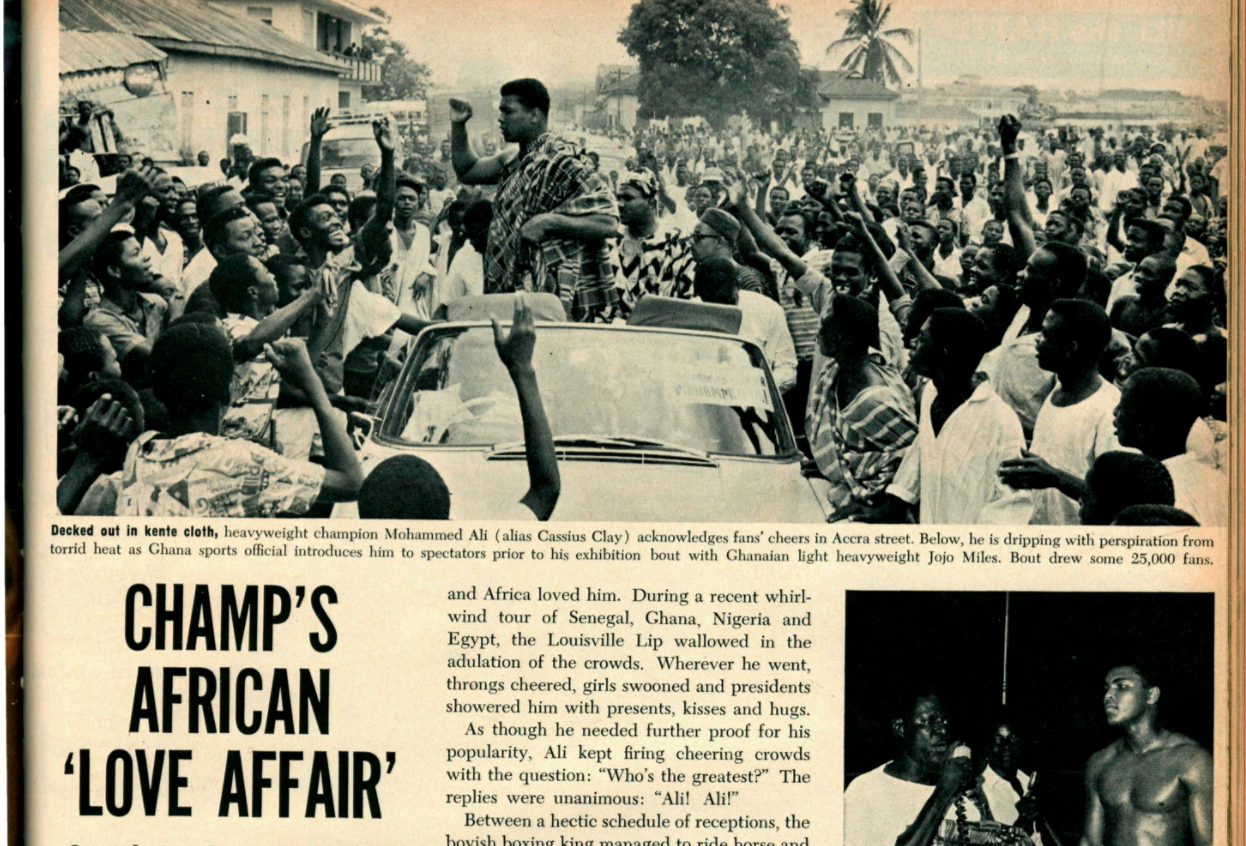
When Ali arrived in Accra, he was met not just as a sports figure but as a symbol. Crowds thronged the airport and lined the streets, eager to catch a glimpse of the charismatic champion whose brash poetry and lightning-fast fists had shaken the boxing world.
For many Ghanaians, Ali represented something larger than sport. He was a Black man who had defeated a seemingly invincible opponent and boldly proclaimed, “I am the greatest!” at a time when confidence in Black excellence was itself revolutionary.
Ali’s visit came during the presidency of Kwame Nkrumah, whose government promoted Pan-African unity and solidarity with the African diaspora. Ghana, the first sub-Saharan African country to gain independence from colonial rule in 1957, had become a beacon for people of African descent worldwide.
Ali’s presence reinforced that bridge between Africa and its diaspora.
“I’m Home”
During his stay, Ali visited schools, toured neighborhoods, and met ordinary citizens. Newspaper accounts from the period describe cheering students and community members who embraced him as one of their own.
Ali reportedly expressed deep emotion about being in Africa, often describing the continent as a spiritual home. Though American by birth, he understood his ancestry to be rooted in Africa, and his visit symbolized a kind of homecoming.
For Ghanaian youth especially, Ali’s visit was electrifying. Here was a global icon who was unapologetically Black, outspoken, and proud of his heritage. His confidence resonated in a newly independent nation still defining its place in the world.
Beyond Boxing
Ali’s 1964 visit also marked an important moment in the evolving relationship between African Americans and Africa during the civil rights era. His conversion to Islam and name change earlier that year had already sparked controversy in the United States. In Ghana, however, he was celebrated rather than criticized.
The visit predated his later global activism—his refusal to be drafted into the Vietnam War, his anti-war stance, and his transformation into an international humanitarian—but it hinted at the role he would come to play as more than just a boxer.
Ali returned to Africa several times in his life, but his first visit to Ghana remains especially significant. It took place at a moment when both he and Ghana were young, bold, and redefining what Black pride looked like on the global stage.
A Lasting Legacy
More than six decades later, stories of Ali’s visit still circulate in Ghanaian sporting and cultural memory. For those who witnessed it, it was not simply a celebrity appearance. It was a moment of affirmation.
In welcoming Muhammad Ali, Ghana was welcoming a son of Africa. And in standing before cheering crowds in Accra, Ali was not just “The Greatest” in the ring—he was a symbol of connection, courage, and continental pride.