







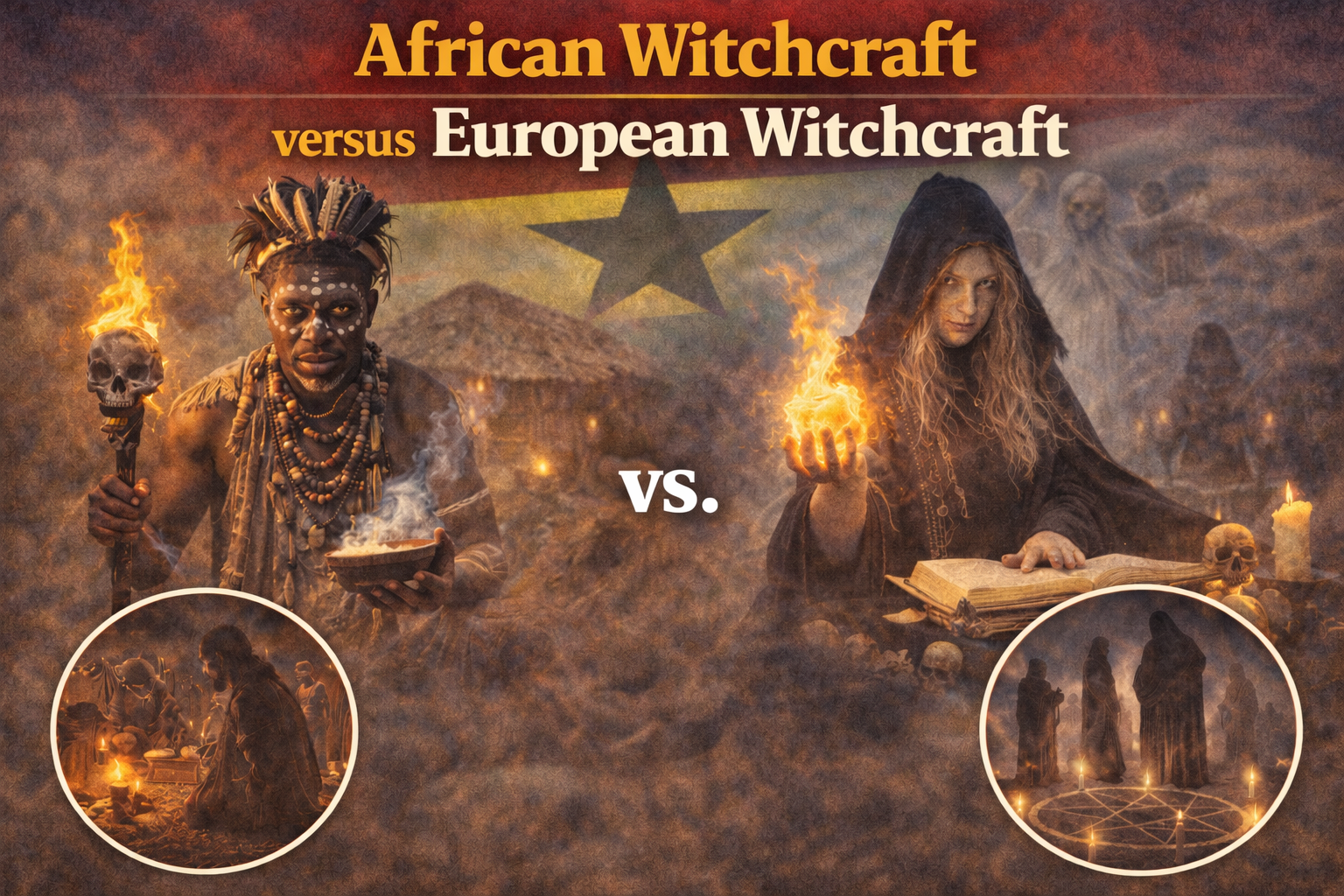
African witchcraft versus European witchcraft have been the focus of local discussions about witchcraft in Ghana for many years.
During the period of European colonization, westernization, and the early stages of modernization, people in the Gold Coast (now Ghana) struggled to explain the wide gap in development between Africans and Europeans. Many ordinary people asked a troubling question: Why were Europeans advancing so rapidly while Africans appeared to be lagging behind?
One popular explanation at the time was rooted in beliefs about witchcraft. Many people assumed that both Africans and Europeans possessed witchcraft, but that they used it in different ways. According to this view, Europeans used their witchcraft for development and progress, while Africans used theirs for destruction and harm.
In the Ghanaian understanding, witchcraft is believed to be a spiritual force possessed by a witch, enabling that person to influence their own life as well as the lives of others—both beneficiaries and victims. Within this framework, African witchcraft was often portrayed as a force used to kill, maim, destroy, cause wars, spread disease, trigger road accidents, and bring about premature death.
European or “white people’s” witchcraft, on the other hand, was imagined as productive and beneficial. It was believed to be the power that enabled Europeans to invent machines, build factories, make scientific discoveries, create robots, and even travel to the moon.
This way of thinking led to a damaging conclusion: that African witchcraft was bad witchcraft, while European witchcraft was good witchcraft. In effect, it suggested that Africans were responsible for their own underdevelopment through destructive spiritual practices, while Europeans prospered because they used their powers wisely.
This belief was deeply internalized and found expression in popular culture. Several Ghanaian highlife songs reflect this contrast between obibini bayie (African witchcraft) and oburoni bayie (white people’s witchcraft). In these songs, oburoni bayie is often described as bayi papa—good witchcraft used to create and build—while African witchcraft is portrayed as a force of destruction. Notable examples include A. B. Crentsil’s song “Devil” and Nana Ampadu’s “Akoma Bayie Nnye.”
Today, however, many young and educated Africans have moved away from this self-blaming and self-denigrating explanation. There is now greater awareness that Africa’s underdevelopment did not result from destructive witchcraft, but from historical and structural forces.
Africa’s condition is increasingly understood as the outcome of slavery, colonial exploitation, the extraction of natural resources, forced labor, colonial economic systems, neo-colonial control, and unfair international trade practices. These forces systematically drained African societies of wealth and stifled their development, while enriching Europe and North America.
This growing awareness has helped many Africans reject the idea that their culture or spirituality is inherently destructive. Instead, it has shifted attention toward the real political and economic processes that shaped global inequality—and continues to do so today.