












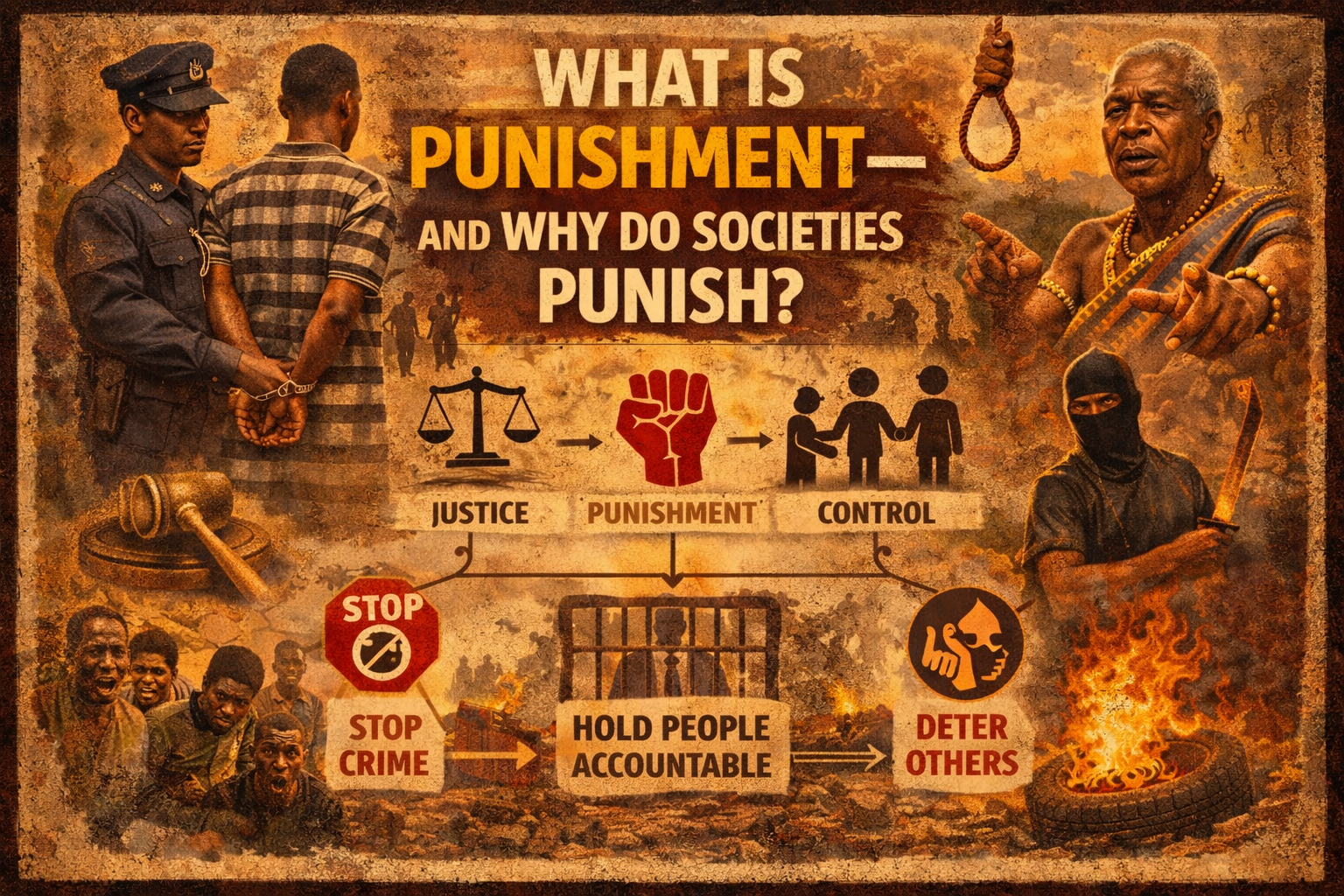
Punishment is a central feature of every organized society. While rewards are designed to encourage conformity and socially approved behavior, punishment exists to negatively sanction deviant behavior. When individuals act in ways that align with societal norms, they are often rewarded through praise, status, or material benefits. When they violate those norms, society—or its authorized agents such as the courts, police, or traditional authorities—responds with punishment.
At its core, punishment is a social control mechanism. It signals what a society considers unacceptable and enforces compliance with its moral, legal, and cultural rules.
The Core Principles That Underlie Punishment
Scholars who study punishment—known as penologists—identify four main goals of punishment that guide criminal justice systems across the world:
- Retribution
- Deterrence
- Incapacitation
- Rehabilitation
Most modern justice systems rely on a combination of these principles rather than a single approach.
Retribution: Punishment as Just Deserts
Retribution is the idea that offenders should be punished because they deserve it. The focus here is not on reforming the offender or preventing future crime, but on moral retaliation—paying the offender back for the harm caused.
This philosophy is often captured by the ancient Mosaic principle:
“An eye for an eye, a tooth for a tooth.”
In legal and philosophical terms, retribution is known as lex talionis, the “law of retaliation.” The pain imposed on the offender is expected to be proportionate to the pain inflicted on the victim. This is why penologists sometimes describe retribution as “deserved punishment.”
Expressions such as “tit for tat” reflect this logic in everyday language. Capital punishment best exemplifies retributive justice: when a person intentionally kills another, the state responds by taking the offender’s life. The punishment mirrors the crime.
Incapacitation: Preventing Further Harm
Incapacitation focuses on protecting society by making it impossible for the offender to commit further crimes while under punishment.
A prison sentence is the most common form of incapacitation. An incarcerated individual is physically removed from society and therefore unable to victimize others during that period. The emphasis is not on moral blame or reform, but on public safety.
In some countries, incapacitation takes more extreme forms. For example:
- Thieves may have their hands amputated, eliminating their physical capacity to steal.
- In public debates, some citizens call for the castration of male sex offenders, arguing that removing sexual capacity would prevent penile-vaginal rape.
These examples highlight how incapacitation seeks to eliminate the ability to offend, not merely the desire.
Rehabilitation: Treating Crime as a Social or Medical Problem
Rehabilitation rests on the assumption that offenders are not inherently evil, but rather socially, psychologically, or medically impaired. Crime, from this perspective, is a symptom of an underlying problem that can be treated.
This philosophy draws heavily on the medical model of crime. For example:
- Drug offenders are seen as needing treatment for addiction.
- Kleptomaniacs are viewed as suffering from compulsive disorders.
- Sex offenders are believed to require psychological or psychiatric intervention.
Because of this orientation, rehabilitation relies on professionals such as social workers, psychologists, psychiatrists, and counselors.
Rehabilitation can also be economic and vocational in nature. Thieves and robbers are sometimes viewed as products of unemployment and poverty. By providing skills training, education, and employment opportunities, rehabilitation seeks to reduce the motivation to commit crime.
Deterrence: Using Punishment to Prevent Crime
Deterrence is one of the most influential theories of punishment. Its central aim is behavioral cessation—to stop crime from occurring.
Deterrence theorists argue that punishment works best when it is:
- Swift (quickly imposed),
- Certain (likely to be applied), and
- Severe (sufficiently painful or costly).
Types of Deterrence
There are two forms of deterrence:
Specific (or Individual) Deterrence
This targets the offender directly. The punishment should be unpleasant enough that the individual chooses not to repeat the crime in the future. Specific deterrence is also known as special deterrence.
General Deterrence
Here, punishment serves as a public warning. When an offender is punished, the wider society observes the consequences and is discouraged from engaging in similar behavior. The message is clear: crime does not pay.
Conclusion: Why Punishment Remains Central to Society
Punishment exists because societies must regulate behavior, enforce norms, and maintain order. Whether through retribution, deterrence, incapacitation, or rehabilitation, punishment reflects a society’s moral values, fears, and hopes for justice.
Modern criminal justice systems continue to debate which approach works best. In reality, punishment is rarely about a single goal. Instead, it represents an ongoing struggle to balance justice, safety, morality, and human dignity.