








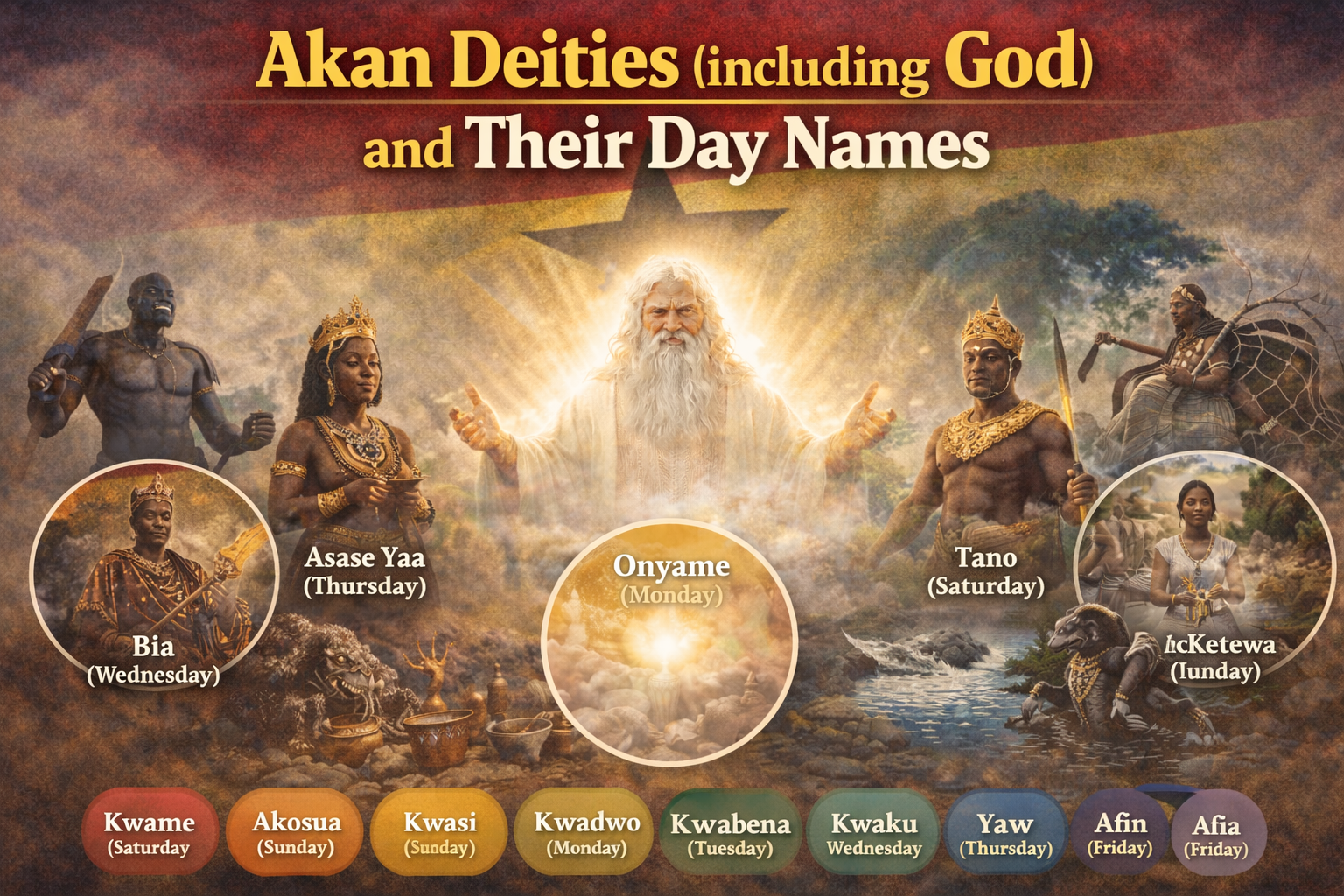
Among the Akan of Ghana, naming is never a casual act. Names locate a person in time, history, morality, and the spiritual universe. One of the most distinctive Akan naming practices is the giving of day names (kradin), assigned according to the day of the week on which a child is born. These names are gendered: males and females born on the same day receive different names—Kofi and Afua for Friday, Kwame and Ama for Saturday, Yaw and Yaa for Thursday, Kwabena and Abena for Tuesday, and so on.
People, Personalities, and Temperament
Day names are far more than convenient markers of birth dates. In Akan thought, they are believed to encode personality traits, temperament, moral disposition, and even destiny. A person born on Monday (Kwadwo or Adwoa), for instance, is often said to be calm and reflective, while a Saturday-born person (Kwame or Ama) is thought to be serious-minded, authoritative, and strong-willed. These character attributions form part of everyday Akan social knowledge and are frequently invoked to explain behavior, success, conflict, and interpersonal dynamics.
Day Names for Animals
Within this cultural logic, it is not surprising that the practice of day naming extends beyond human beings. Certain animals, especially those prominent in Akan folklore and oral literature, are also assigned day names. The otwe (duiker or deer) may be referred to as Otwe Kwabena, while the tortoise—akyekyedeɛ, the quintessential trickster in Akan stories—is known as Kofi Akyekyedeɛ. These names anthropomorphize animals, drawing them into the moral and symbolic universe that day names represent.
Day Names for God and Deities
It is along this same cultural trajectory that powerful spiritual beings, including deities and even the Supreme God, are sometimes spoken of using day names. Hence, expressions such as Onyankopɔn Kwame, Asaase Yaa, and Kofi Yesu circulate in Akan speech, religious imagination, and popular discourse.
Strictly speaking, within orthodox Akan theology, Onyankopɔn, the Supreme Being, is uncreated, eternal, and unborn. God is not brought into existence through birth and does not enter the world at a particular moment in time. For this reason, Onyankopɔn does not literally have a day name. Day names presuppose birth, temporality, and participation in the cyclical rhythm of human life—conditions that do not apply to the Akan conception of God. In this sense, Onyankopɔn transcends the seven-day structure that governs human existence.
Yet, the attribution of a day name to God or sacred beings is not meant to be literal. Rather, it is symbolic, relational, and deeply cultural. Calling God Onyankopɔn Kwame situates the Supreme Being within Akan cosmology and moral imagination. Saturday (Memeneda), associated with Kwame, is often linked to gravity, authority, finality, and seriousness. These are qualities that resonate strongly with the Akan conception of the Supreme God as powerful, morally upright, and sovereign over the universe. The name thus functions as a cultural bridge between human temporal categories and divine transcendence.
The case of Asaase Yaa—Mother Earth Yaa—offers an even clearer illustration of how day names are embedded in Akan religious thought. In Akan cosmology, Asaase Yaa is conceived as a feminine spiritual entity, intimately associated with fertility, morality, truth, and justice. Her designation as Yaa identifies her as Thursday-born, and Thursday holds profound ritual significance in many Akan communities. In numerous farming areas, people are prohibited from going to the farm on Thursdays, which is regarded as the Earth’s day of rest or sabbath. The land is not to be disturbed.
Violating this prohibition is believed to invite grave consequences. It is commonly said that a person who farms on Thursday risks misfortune: a falling tree may kill the offender, a venomous snake may strike, or a fatal accident may occur. Such narratives reinforce moral discipline and respect for the land, linking ecological stewardship to spiritual accountability. Asaase Yaa, then, is not merely a poetic name; she is a moral force whose day name structures human behavior and regulates communal life.
Day Name for the Sea or Ocean
A similar logic applies to the treatment of the sea in Ghanaian cosmology. Among both Akan and Ga communities, the sea is anthropomorphized and treated as a living entity. The sea is known as Po Abena, indicating that it is Tuesday-born. In Accra and other coastal areas, Tuesday is widely regarded as the sea’s day of rest. Fishing, swimming, and other sea-related activities are traditionally discouraged or outright prohibited on that day.
Many drownings that occur on Tuesdays are popularly interpreted as the result of violating this sacred injunction. Whether or not one accepts these explanations literally, they underscore an important point: day names are used to impose moral order on the environment, reminding human beings that nature is not inert matter but a spiritually charged domain deserving of respect.
Day Name for Jesus the Christ of Nazareth
The expression Kofi Yesu follows the same cultural logic. By assigning Jesus a Friday-born name (Kofi), Akans localize the Christian figure within Akan temporal and symbolic categories. This is not an attempt to rewrite Christian theology but rather to render Jesus intelligible and relatable within Akan cultural frameworks. Just as Akans translated biblical texts into Twi and used indigenous metaphors to explain Christian ideas, giving Jesus a day name brings him into the moral universe of Akan naming practices.
In short, God does not have a day name in a literal sense, but Akans may ascribe day names to God, deities, and sacred figures as a way of domesticating the divine—anchoring transcendent beings in familiar cultural forms. This practice reflects a broader Akan tendency to interpret the cosmos through kinship, birth, naming, and moral reciprocity. Even the sacred is brought into meaningful social relationships with the human world.
Far from being theological confusion, the practice reveals the creative genius of Akan religious thought, in which the divine is not distant or abstract but woven into the rhythms of daily life, the calendar, the land, and the sea. In Akan culture, to name is to know, to relate, and to situate—and even God, though eternal and unborn, may be spoken of in the language of days.
Watch the full video on YouTube – https://youtu.be/tdHoryj1j8M