






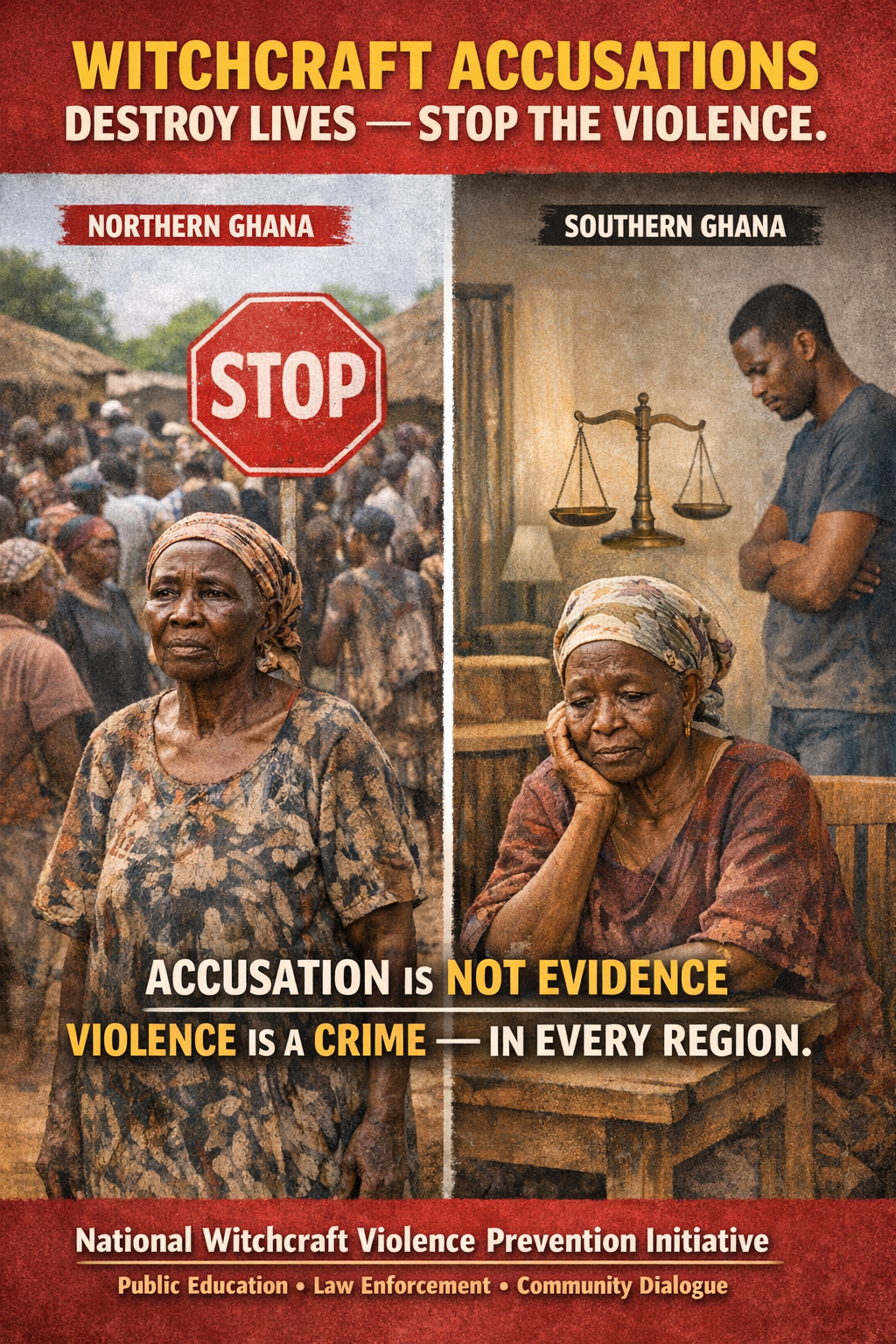
Recent reports in the Ghanaian media have once again drawn attention to a disturbing and persistent problem: the murder, attempted murder, and lynching of women accused of practicing witchcraft. These incidents are often shocking in their brutality and tragic in their consequences. They also raise an important question: Are witchcraft accusations a problem confined to Northern Ghana, or are they a national crisis?
One case that captured widespread national and international attention was that of Akua Denteh in Kafaba, in the Northern Region. She was publicly assaulted and beaten to death after being accused of witchcraft. The horrifying spectacle of vigilante violence underscored the lethal consequences of such allegations and the urgent need for education, legal enforcement, and sustained national intervention.
Because many of the highly publicized cases occur in the Northern Region, it is easy to assume that witch hunts are primarily a northern phenomenon. However, this assumption is both inaccurate and dangerous. Allegations of witchcraft are not confined to one region, ethnicity, or community. They are a national concern.
Several cases from southern Ghana illustrate this reality.
In 2010, 72-year-old Amma Hemma was doused with petrol and burnt to death in Accra by a Christian pastor and four accomplices after she reportedly wandered into the living room of a woman. She was accused of being a witch whose alleged aerial flight had aborted. Her family later indicated that she was in the early stages of dementia. What may have been a medical condition was interpreted as supernatural malevolence, with fatal consequences.
More recently, in June 2025, a 31-year-old woman in Akyem Apinamang, in the Denkyembuor District of the Eastern Region, reportedly set her mother’s room ablaze after her pastor told her that her mother was a malevolent witch responsible for her personal hardships, including the decline of her business. Here again, suspicion fueled by spiritual consultation escalated into criminal violence within the family itself.
Similarly, in June 2024, in Abuakwa Asonomaso in the Ashanti Region, a 55-year-old woman allegedly attacked and killed her 76-year-old wheelchair-confined mother with a machete. According to reports, a pastor had informed her that her mother was the cause of her failure to marry, her childlessness, and her economic struggles. Instead of seeking counseling, medical evaluation, or social support, the accused resorted to irreversible violence.
These cases demonstrate that witchcraft accusations and their violent consequences are not geographically restricted. While vigilante-style mob attacks in northern communities often attract greater media attention because of their dramatic and collective nature, southern cases frequently involve one aggrieved individual acting against a suspected witch. Because they occur within private spaces and involve fewer actors, they may receive less publicity. Yet the outcome is the same: an avoidable death.
It is therefore misleading to frame witch hunts as a “Northern problem.” Doing so stigmatizes particular regions while allowing similar practices elsewhere to escape scrutiny. The underlying drivers—fear, economic hardship, family conflict, gender inequality, declining mental health awareness, and certain strands of religious interpretation—cut across regional boundaries.
At the heart of many accusations are vulnerable women: elderly mothers, widows, poor women, and those suffering from cognitive decline or mental illness. They become convenient scapegoats for misfortune, unemployment, infertility, business failure, or unexplained illness.
If Ghana is serious about addressing this menace, the response must be national in scope. Law enforcement must act swiftly and consistently. Religious and traditional leaders must speak clearly against violence. Public education must challenge harmful beliefs while promoting medical and psychological understanding of behavior often misinterpreted as witchcraft.
Whether in the north or the south, a death is a tragedy. And every such death is preventable.
Witchcraft allegations are not a regional issue. They are a Ghanaian issue.