



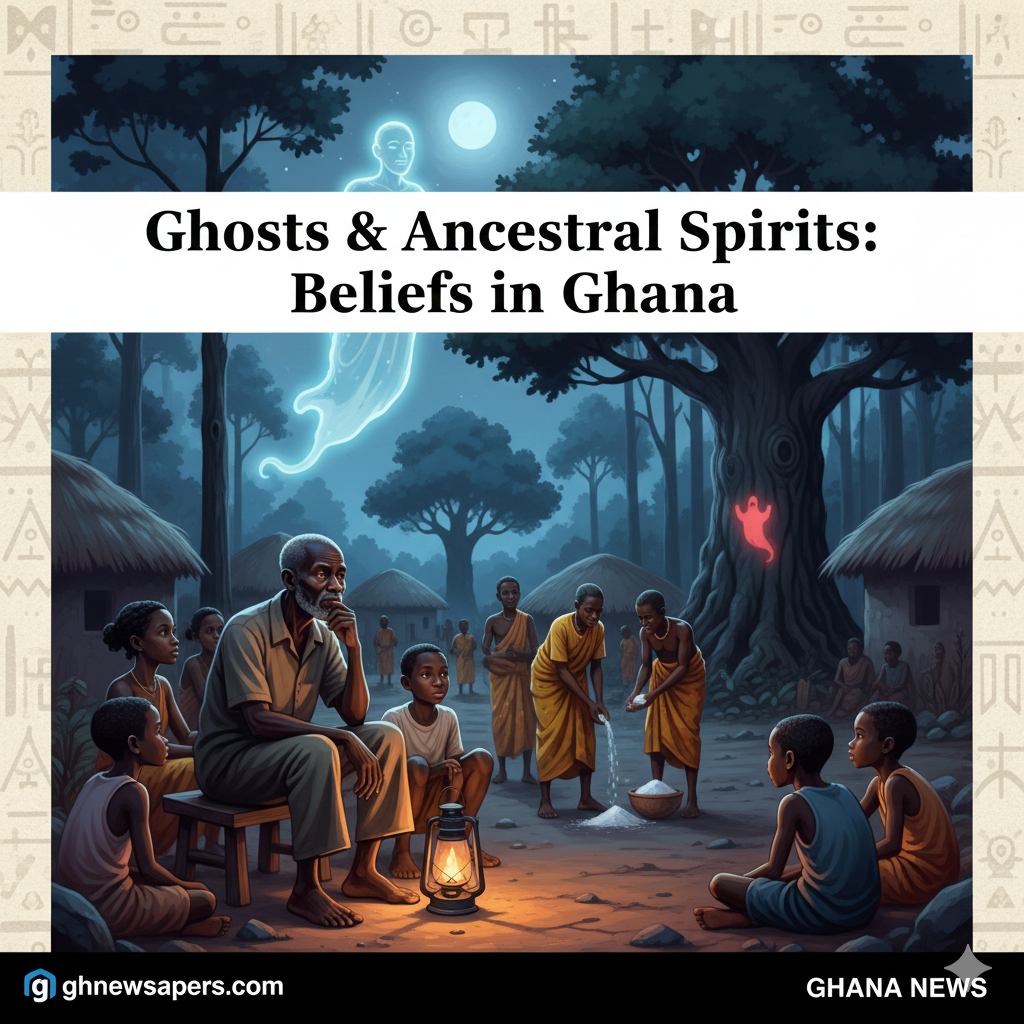
Widespread Beliefs in Ghosts
Although no large-scale self-report study has been conducted on belief in ghosts in Ghana, it is fair to say that belief in ghosts or apparitions is widespread across the country. These beliefs are especially strong among the Akan of southern Ghana, where ideas about death, spirits, and the afterlife are deeply embedded in everyday life.
The Journey of the Spirit
In Akan cosmology, death marks a separation between the physical body and the spirit. The body is buried and eventually decomposes, but the spirit begins a journey to Asamando—also known as Asaman—the land of the spirits. There, the deceased is believed to reunite with relatives who died earlier and are already living in Asamando. The spirit remains in this realm until it is reincarnated, usually within the same matrilineage (abusua).
Saman and the Spirit World
The spirit of the deceased is called saman, and the collective dwelling place of spirits is known as Asaman or Asamando. In Akan belief, ghosts are understood as spirits that are still in transit and have not yet completed their journey to the spirit world. Many Akans hold that this journey takes about forty days, during which the spirit remains close to the human world.
Bad Deaths and Restless Spirits
Important distinctions are made when a person dies a bad death (atɔfowuo), such as through an accident, homicide, or suicide. In these cases, the spirit is believed to linger at or near the place where the death occurred. This type of restless spirit is known as samantwentwen. Although samantwentwen are not generally considered dangerous, they are said to frighten people who encounter them unexpectedly. Unless the proper rituals are performed to send the spirit on its way, it is believed that the spirit will remain there until the time it was destined to die.
Dreams as a Channel of Communication
Akans also believe that deceased relatives sometimes appear in dreams, bringing messages from Asamando or offering warnings, instructions, or guidance to the living. These dream encounters are taken seriously and are often interpreted as meaningful communications from the spirit world.
Fear and Physical Traits of Ghosts
Despite the continued presence of ancestors in the moral and spiritual life of the community, Akans are widely described as fearing ghosts. Ghosts are commonly imagined as wearing white clothing, a color strongly associated with the spirit world. They are also believed not to eat pepper or salt, substances associated with vitality, physical strength, and the realm of the living.
Ghostly Voices
Ghosts are further said to speak with a distinctive nasal tone, a vocal quality that immediately marks them as non-human. This altered voice is understood as an auditory sign of their in-between status—no longer fully part of the physical world, yet not completely removed from it. Such sensory markers help the living recognize encounters with spirits and reinforce the boundary between humans and the spirit realm.
Spirits Living Among the Living
One of the most striking themes in ghost narratives is the claim that a person may die in one town, yet the saman relocates to another town or even another country and continues life there as though still alive. In these stories, the spirit is said to find work, marry, and have children, fully participating in ordinary social life. In some cases, such spirits are believed to send their children back to the town or village where they themselves once lived, even though the spirit never appears there in person.
Remittances from the Dead
There are also widely told accounts of these spirits sending money or other remittances to their parents or relatives in their natal homes. These payments are said to be delivered through intermediaries—such as senders, carriers, or couriers—who do not know that the person they are dealing with is dead, or has been dead for many years. The messenger completes the task believing the sender is still alive.
Life After Death in Ghanaian Thought
Together, these beliefs blur the line between life and death. They reflect a worldview in which the dead can continue to work, form families, communicate, and fulfill kinship obligations long after physical death, reinforcing the idea that in Ghanaian thought, death does not end social existence—it transforms it.