







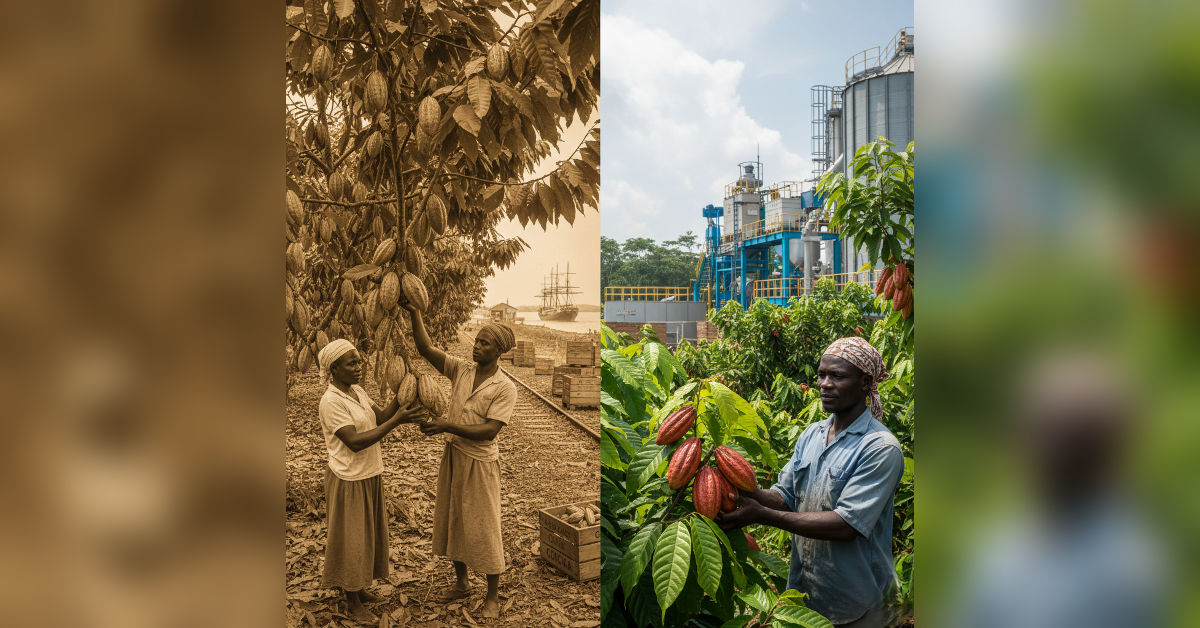
Few business stories have shaped Ghana as deeply and enduringly as cocoa. From a small agricultural experiment in the late 19th century to becoming the backbone of the national economy, cocoa transformed the Gold Coast into one of the world’s most important producers and laid the foundation for modern Ghana’s economic identity.
The Birth of a Cocoa Economy (1879–1900)
The cocoa story in the Gold Coast began in 1879, when Tetteh Quarshie, a blacksmith and farmer from Mampong, returned from Fernando Po (now Bioko, Equatorial Guinea) with cocoa pods. He planted them successfully, proving that cocoa could thrive in the forest zones of the Gold Coast.
By the 1890s, cocoa cultivation had spread rapidly across Akwapim, Ashanti, and the Eastern Region. Unlike colonial mining enterprises controlled by foreign firms, cocoa was grown largely by African farmers, making it a rare example of indigenous capitalist success during colonial rule.
Cocoa Boom and Colonial Prosperity (1900–1930s)
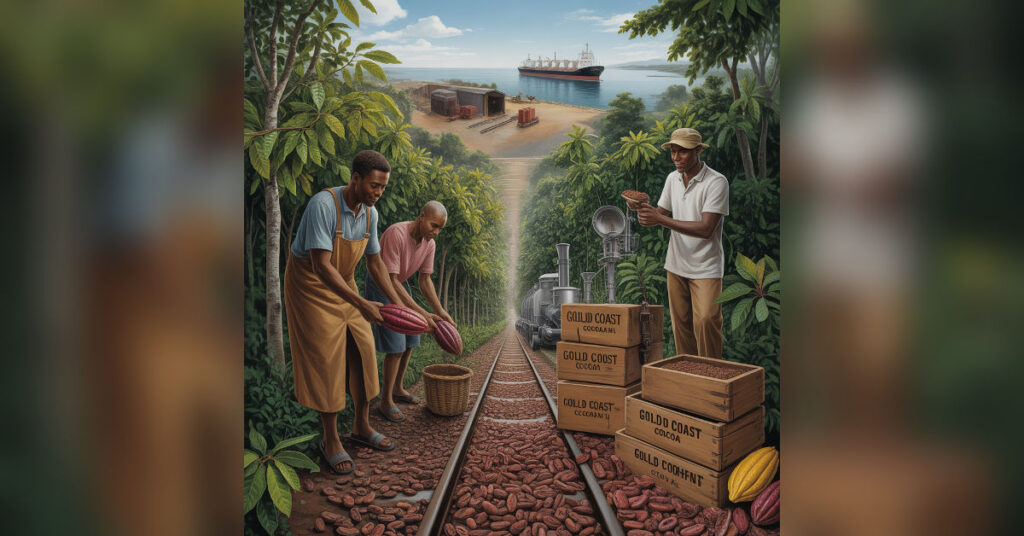
By 1911, the Gold Coast had become the world’s leading cocoa producer, overtaking Brazil. Cocoa exports generated enormous revenue, financing:
- railways and roads,
- ports such as Takoradi (opened in 1928),
- urban growth in Accra, Kumasi, and Sekondi.
Colonial authorities depended heavily on cocoa export taxes, even as African farmers bore the risks of price fluctuations and diseases. Cocoa money also helped fund education, newspapers, and early nationalist movements, indirectly fueling political consciousness.
Farmer Resistance and Market Control (1930s–1940s)
The 1930s global economic depression exposed the vulnerability of cocoa farmers to volatile international prices. European trading firms often fixed prices to their advantage, leading to widespread farmer dissatisfaction.
In 1937–1938, cocoa farmers organized boycotts against expatriate firms, marking one of the earliest mass economic protests in the Gold Coast. These actions influenced the colonial government’s decision to create a regulatory body.
In 1947, the Cocoa Marketing Board (now COCOBOD) was established to stabilize prices, protect farmers, and regulate exports—a major milestone in Ghana’s business history.
Independence and State Control (1957–1970s)
At independence on 6 March 1957, cocoa accounted for about 60% of Ghana’s foreign exchange earnings. Under Kwame Nkrumah, cocoa revenue funded ambitious industrial and infrastructure projects, including:
- the Akosombo Dam (completed 1965),
- state factories,
- education and healthcare expansion.
However, heavy state control, falling world prices, and mismanagement in the 1960s and 1970s reduced farmer incentives and output. Smuggling of cocoa to neighboring countries became widespread.
Reform and Recovery (1980s–1990s)
By the early 1980s, cocoa production had declined sharply. Economic reforms under the Economic Recovery Programme (1983) revived the sector through:
- better farmer pricing,
- rehabilitation of farms,
- institutional reforms at COCOBOD.
These changes restored confidence and boosted production, helping stabilize Ghana’s economy during a difficult period.
Cocoa in Modern Ghana (2000s–Present)
Today, Ghana remains the second-largest cocoa producer in the world, competing closely with Côte d’Ivoire. Cocoa continues to:
- employ millions of Ghanaians,
- support rural livelihoods,
- generate significant export earnings.
Recent business strategies focus on value addition, sustainability, and fair pricing, including local processing and chocolate manufacturing to capture more global value.
Why Cocoa Still Matters
Cocoa is more than a crop—it is Ghana’s longest-running indigenous business success story. From the Gold Coast era to the present, it has shaped trade, politics, infrastructure, and national development. Its story demonstrates how African enterprise, when supported by sound policy and fair markets, can transform a nation.
Key Historical Dates at a Glance
- 1879 – Tetteh Quarshie introduces cocoa to the Gold Coast
- 1911 – Gold Coast becomes world’s leading cocoa producer
- 1928 – Takoradi Harbour opens
- 1937–1938 – Cocoa farmers’ boycott
- 1947 – Cocoa Marketing Board established
- 1957 – Ghana gains independence
- 1983 – Economic Recovery Programme reforms the cocoa sector
Sources & References
- Hill, P. (1963). The Migrant Cocoa-Farmers of Southern Ghana. Cambridge University Press.
- Austin, G. (2005). Labour, Land and Capital in Ghana. University of Rochester Press.
- Kimble, D. (1963). A Political History of Ghana. Oxford University Press.
- Ghana Cocoa Board (COCOBOD) – Historical Records.
- National Archives of Ghana – Colonial Trade and Agriculture Reports.
Watch full video on YouTube – https://youtu.be/AnN8zWOA7XY