





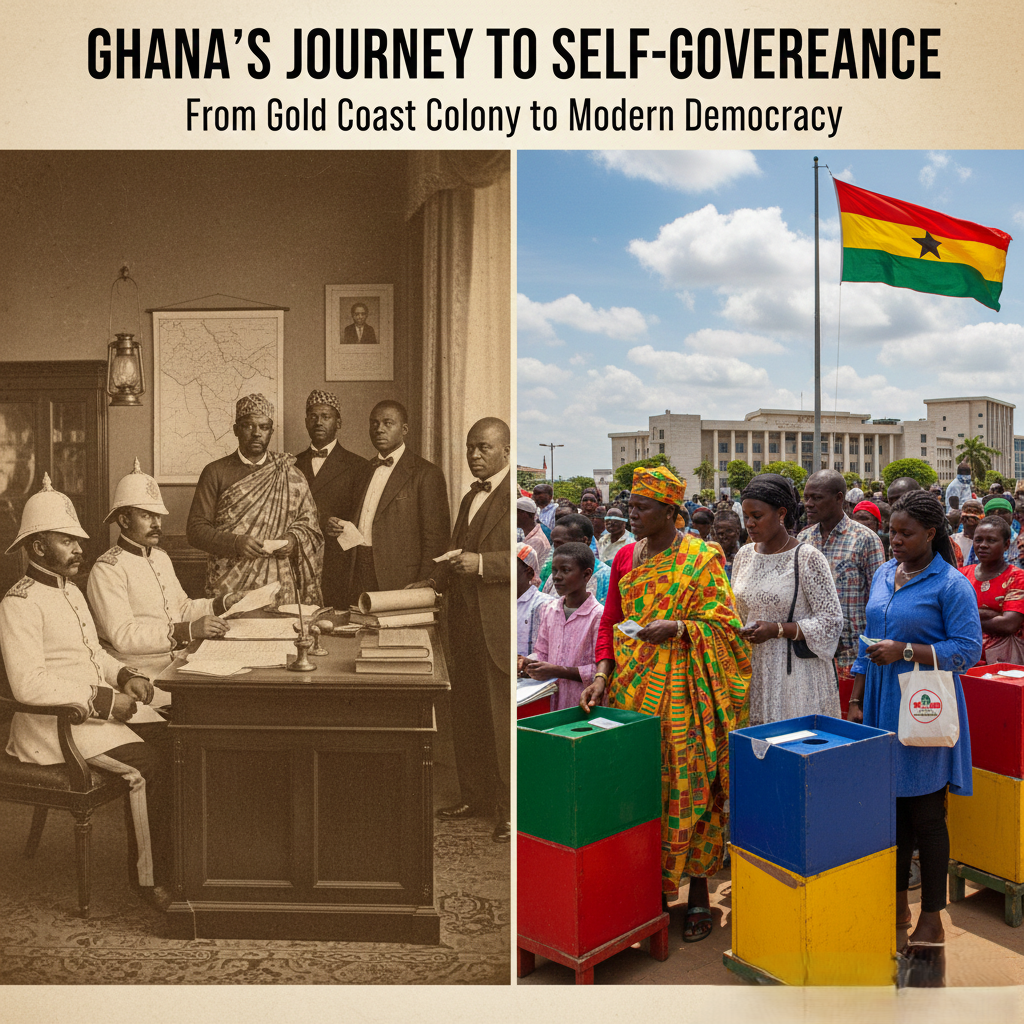
If there is one idea that has mattered more to Ghana than any other from the Gold Coast era to the present, it is the struggle for self-governance and accountable leadership. From colonial domination to modern democracy, Ghana’s history has been shaped by a single, powerful question: Who governs us, and in whose interest?
This question has defined our politics, inspired resistance, fueled nationalism, justified coups, and continues to influence public debate today.
The Gold Coast Awakening (1800s–1940s)
British colonial rule formally began in 1821, and by 1874, the Gold Coast was declared a Crown Colony. Governance during this period was imposed from above, with little regard for indigenous political systems or popular participation.
Early resistance emerged through traditional authorities, merchants, and educated elites, who challenged unfair taxation, land expropriation, and exclusion from decision-making. The Aborigines’ Rights Protection Society (ARPS), founded in 1897, marked a turning point by opposing colonial land bills that threatened communal ownership.
Newspapers such as the Gold Coast Aborigines and later the Accra Herald (1858) became platforms for debate, signaling that political awareness and demand for self-rule were growing long before independence.
Nationalism and the Demand for Self-Rule (1940s–1957)
The post-World War II period intensified calls for self-governance. The 1948 Accra riots, triggered by the shooting of ex-servicemen protesting economic hardship, exposed the failures of colonial administration and accelerated constitutional reforms.
The formation of the United Gold Coast Convention (UGCC) in 1947 and later the Convention People’s Party (CPP) in 1949, led by Kwame Nkrumah, transformed elite agitation into mass political action.
The demand was simple but revolutionary: self-government now.
This struggle culminated in Ghana’s independence on 6 March 1957, making it the first sub-Saharan African country to break free from colonial rule.
Independence, Power, and Accountability (1957–1966)
Independence brought freedom, but it also revealed a new challenge: how to govern ourselves responsibly. Under Nkrumah, Ghana pursued rapid modernization, but increasing centralization of power raised concerns about accountability and political freedom.
By the early 1960s, opposition voices were suppressed under laws such as the Preventive Detention Act (1958). This tension between national development and democratic accountability remains one of the most debated aspects of Ghana’s early independence.
The 1966 military coup, which overthrew Nkrumah, justified itself by claiming to restore accountability—ironically through undemocratic means.
Coups, Experiments, and Lessons (1966–1992)
Between 1966 and 1992, Ghana oscillated between civilian and military rule. Each regime claimed legitimacy by promising better governance, discipline, and economic stability. Yet repeated coups revealed a painful truth: removing leaders without building strong institutions does not guarantee good governance.
This period taught Ghanaians a hard lesson—self-governance is not merely about who holds power, but about systems that limit power.
The Fourth Republic and the Ongoing Debate (1992–Present)
The return to constitutional rule in 1992 marked Ghana’s most sustained attempt at accountable self-governance. Regular elections, a free press, and peaceful transfers of power have earned Ghana international respect.
Yet the core question remains unresolved. Citizens continue to debate:
- corruption and political accountability,
- the independence of state institutions,
- the role of the media, and
- whether democracy is delivering economic justice.
This shows that the struggle for self-governance did not end in 1957—it simply evolved.
Why This Idea Still Matters
Self-governance is Ghana’s most important national idea because it defines our dignity, our responsibility, and our future. From colonial resistance to modern democracy, Ghanaians have consistently demanded a voice in how they are governed.
The lesson of history is clear: freedom without accountability is fragile, and development without participation is unsustainable. Ghana’s progress depends not only on elections, but on an informed, engaged citizenry willing to question power—just as our ancestors did during the Gold Coast era.
Key Historical Dates at a Glance
- 1821 – British Crown assumes control of the Gold Coast
- 1874 – Gold Coast declared a Crown Colony
- 1897 – Aborigines’ Rights Protection Society founded
- 1948 – Accra riots
- 1949 – Convention People’s Party formed
- 6 March 1957 – Ghana gains independence
- 1966 – First military coup
- 1992 – Start of the Fourth Republic
Sources & References
- Kimble, D. (1963). A Political History of Ghana. Oxford University Press.
- Austin, D. (1976). Politics in Ghana 1946–1960. Oxford University Press.
- Rathbone, R. (2000). Nkrumah & the Chiefs. James Currey.
- Boahen, A. A. (1987). African Perspectives on Colonialism. Johns Hopkins University Press.
- National Archives of Ghana – Gold Coast constitutional records.
Watch full video on YouTube – https://youtu.be/22tYjTeUIHg