







Along the wind-carved coastline of southern Ghana, among the Fante, physical games were never idle diversions. They were social rehearsals—training grounds for endurance, hierarchy, and communal rhythm. Two in particular—Atentam and Osibir—stand out in the historical record.
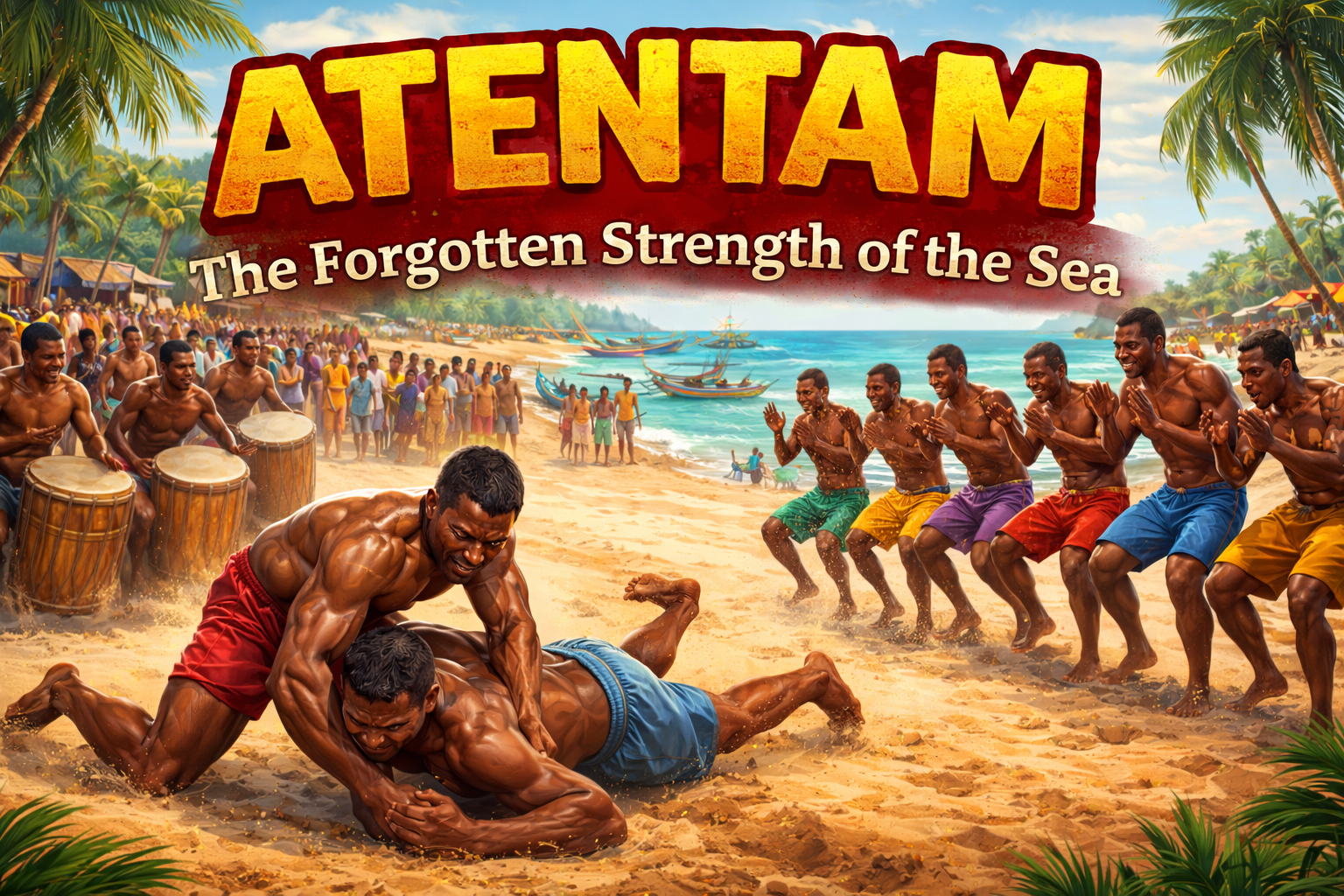
Atentam derives from the Fante/Akan root tam, meaning “to push,” “to press,” or “to force against.” The prefix a- nominalizes the verb, suggesting “the act of pushing.” In practice, Atentam was a form of traditional wrestling performed on sandy beaches after fishing expeditions or during communal gatherings. Contestants aimed to push an opponent off balance until his back touched the ground. Victory brought more than applause—it conferred prestige. Among fishing communities where physical stamina determined survival at sea, Atentam functioned as both entertainment and informal selection mechanism for leadership and respect.
Archival research from the University of Ghana notes Atentam as a strength-based contest embedded in pre-colonial Akan society, particularly along coastal settlements European observers in the seventeenth century frequently remarked on the remarkable physiques of Gold Coast fishermen, indirectly affirming the kind of physical culture that games like Atentam reinforced.
If Atentam was confrontation, Osibir was coordination. The word is believed to stem from Akan verbal roots related to rhythmic movement and group jumping, though precise etymological documentation is sparse in written archives—reflecting the oral nature of Fante linguistic heritage. Osibir was performed in two facing lines, often during full-moon nights or fishing taboos when the sea was ritually “resting.” Participants leapt in synchronized patterns to drum rhythms, testing agility, timing, and collective discipline.
Unlike wrestling, Osibir blurred sport and ceremony. It strengthened communal bonds in towns where cooperation at sea—hauling nets, steering canoes, reading tides—was literally lifesaving. The game embodied what sociologists call “functional play”: physical expression that mirrors occupational reality.
These games were not peripheral amusements. They were coastal institutions—social technologies forged in salt, sand, and surf. Atentam trained the body for resistance; Osibir trained the body for rhythm and unity. Together, they reveal a Fante worldview in which survival, celebration, and strength moved in one continuous tide.