







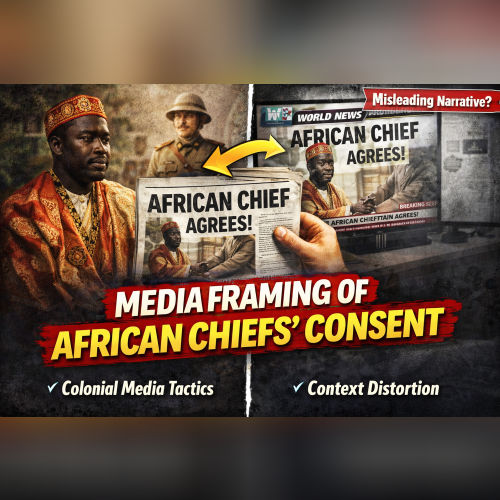
The concept of “chiefs’ consent” occupies a central place in the colonial history of the Gold Coast, present-day Ghana. Throughout the nineteenth and early twentieth centuries, colonial authorities frequently claimed that African chiefs willingly agreed to treaties, land concessions, and administrative reforms that facilitated British control. Newspapers—both colonial and African-run—played a decisive role in shaping how this consent was portrayed, interpreted, and contested. The framing of chiefs’ consent in the media reveals how journalism functioned as a political instrument in legitimizing or challenging colonial power.
Traditional Authority Before Colonial Rule
Before European colonial consolidation, chiefs in the Gold Coast wielded authority through complex political systems rooted in lineage, customary law, and community accountability. Among Akan states such as Asante and Fante, chiefs governed with the advice of councils of elders, and their legitimacy depended on public support.
Consent in this context was not an individual decision but a collective process. Major political agreements—including alliances and trade negotiations—required consultation within traditional governance structures.
However, European colonial administrators often misunderstood or deliberately simplified these systems, treating chiefs as absolute rulers capable of unilaterally granting consent on behalf of their people.
Early Treaties and Colonial Narratives
One of the most significant examples of media framing occurred following the signing of the Bond of 1844. This agreement between British officials and several coastal chiefs established British judicial authority in parts of the Gold Coast.
Colonial newspapers portrayed the Bond as a voluntary request by chiefs seeking protection and legal reform. Reports emphasized the narrative that African leaders had willingly embraced British governance to end “barbaric practices” such as human sacrifice.
In reality, historical evidence suggests a far more complex situation. Many chiefs faced economic pressures, military threats, and shifting trade dynamics that constrained their choices. Moreover, the extent of consultation within local communities varied significantly.
Media Framing Strategies
Newspapers used several strategies to shape public perceptions of chiefs’ consent:
1. Personalization of Authority
Colonial press reports often focused on individual chiefs rather than collective decision-making bodies. By highlighting prominent figures—such as King Kweku Dua I—newspapers created the impression that treaties represented unified national agreements rather than negotiated compromises.
2. Moral Justification Narrative
Articles frequently framed chiefs’ consent as a moral endorsement of colonial rule. Newspapers emphasized themes of “civilization,” portraying chiefs as progressive leaders aligning their people with modern legal and economic systems.
3. Silence on Coercion
Media reports rarely acknowledged the power imbalances underlying treaty negotiations. Military presence, economic dependency on European trade, and political rivalries significantly influenced chiefs’ decisions, yet these factors were largely absent from colonial reporting.
African Newspapers and Counter-Framing
By the late nineteenth century, African-owned newspapers began to challenge colonial narratives. Publications such as the Gold Coast Aborigines and the Gold Coast Chronicle provided platforms for educated African elites to question the legitimacy of treaty interpretations.
Writers argued that chiefs’ consent was often misrepresented and that colonial authorities selectively interpreted agreements to expand control. They emphasized that many treaties were intended as limited partnerships rather than permanent transfers of sovereignty.
Prominent nationalist figures like J. E. Casely Hayford used the press to critique colonial legal claims and advocate for African self-governance. Through editorials and essays, they reframed chiefs’ consent as conditional and context-specific rather than unconditional endorsement of colonial rule.
The Role of Language and Translation
Another crucial factor in media framing was language. Many treaties were drafted in English, while negotiations occurred in local languages through interpreters. Differences in translation often created misunderstandings about the scope and meaning of agreements.
Newspapers rarely discussed these linguistic complexities, instead presenting treaties as clear and mutually understood contracts. This omission reinforced colonial legal claims while obscuring the ambiguities surrounding consent.
Long-Term Political Consequences
The media framing of chiefs’ consent had lasting implications for colonial governance and nationalist politics. By portraying chiefs as willing collaborators, colonial authorities justified indirect rule systems that relied on traditional leaders to administer local populations.
However, this framing also generated tensions within African societies. Some communities viewed chiefs who signed treaties as having exceeded their authority, leading to internal conflicts and challenges to traditional legitimacy.
During the twentieth century, nationalist movements revisited these historical narratives. Activists argued that colonial rule lacked genuine consent from African populations, using historical reinterpretations to support demands for independence.
Post-Colonial Reassessment
Following independence under Kwame Nkrumah in 1957, Ghanaian historians began critically reassessing colonial-era media narratives. Scholars highlighted the complex interplay of coercion, negotiation, and agency in treaty-making processes.
Modern research has demonstrated that chiefs operated within constrained political environments, balancing local interests against external pressures. The simplistic portrayal of their consent in colonial newspapers is now widely recognized as a form of political propaganda.
Conclusion
Media framing of African chiefs’ consent illustrates how newspapers shaped historical narratives to serve competing political agendas. Colonial publications emphasized voluntary collaboration to legitimize imperial authority, while African-owned newspapers later challenged these portrayals by exposing their limitations and biases.
Understanding these media dynamics provides deeper insight into the contested nature of colonial legitimacy and the enduring importance of journalism in shaping political memory in Ghana’s history.
Watch the full video on YouTube – https://youtu.be/ToyNPa–o1g