






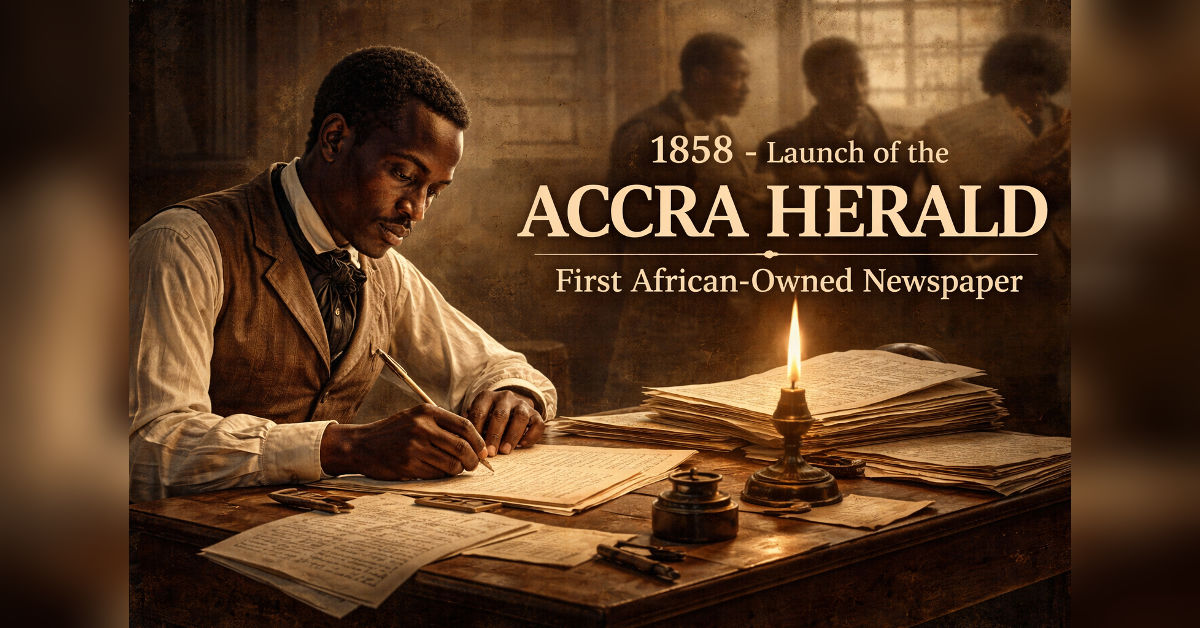
In 1858, Charles Bannerman — the son of a British lieutenant governor and an Asante princess — founded the Accra Herald, recognized as the first African-produced newspaper in West Africa. Unlike the colonial-run press, this handwritten paper reached primarily African readers, circulating among some 300 subscribers. It focused on local issues, social commentary, and matters of civic import, marking a turning point where Gold Coast journalism became a platform for local voices and perspectives. The paper ran for 16 years and encouraged the growth of indigenous journalism in the region
1858 — Launch of the Accra Herald: Africa’s First Indigenous-Owned Newspaper
Published by: Charles Bannerman
Source: Accra Herald
Category:
Archives → Gold Coast Era
Newspapers → Early African Newspapers
Historical Background
The establishment of the Accra Herald in 1858 marks a watershed moment in African media history, representing the first known newspaper produced, owned, and circulated by an African in West Africa. At a time when the press in the Gold Coast (modern-day Ghana) was dominated by European missionaries, colonial administrators, and trading companies, the Accra Herald stood out as a bold indigenous intervention in public discourse.
Its founder, Charles Bannerman, occupied a unique cultural and political position. Born to a British lieutenant governor and an Asante royal woman, Bannerman embodied both colonial and indigenous worlds. This dual heritage gave him rare access to European education while maintaining deep connections to African social realities—an influence clearly reflected in the newspaper’s editorial direction.
Nature and Production of the Newspaper
Unlike later printed newspapers, the Accra Herald was handwritten, a practical response to the limited availability of printing presses and the high cost of mechanical reproduction in mid-19th century West Africa. Despite these constraints, the newspaper maintained regular circulation and reached approximately 300 subscribers, a significant readership for the period.
Distribution was largely confined to educated African elites, traders, clerks, interpreters, and local leaders in and around Accra, Cape Coast, and nearby coastal settlements. Copies were often shared communally, extending their influence beyond formal subscribers.
Editorial Focus and Content
The Accra Herald deliberately shifted attention away from European commercial and missionary concerns toward African-centered issues, including:
- Local governance and customary authority
- Social conditions within coastal towns
- Relations between traditional rulers and colonial officials
- Civic responsibilities and public morality
- Economic challenges faced by African traders
- Commentary on colonial policies affecting indigenous populations
Rather than functioning as a colonial mouthpiece, the newspaper acted as a platform for African opinion, critique, and reflection. It encouraged informed discussion and nurtured an early sense of political consciousness and civic identity among African readers.
Significance in African Journalism
The importance of the Accra Herald lies not only in its “first” status but in its long-term influence. The newspaper reportedly operated for approximately sixteen years, an extraordinary lifespan given the logistical, financial, and political challenges of the era.
Its success demonstrated that:
- Africans could own, produce, and sustain newspapers
- Indigenous perspectives were viable and valuable in public discourse
- Journalism could serve as a tool for self-representation and resistance, even within colonial constraints
The Accra Herald laid the intellectual groundwork for later African-owned newspapers such as the Gold Coast Times, Western Echo, and nationalist presses of the late 19th and early 20th centuries.
Legacy and Historical Impact
Today, the Accra Herald is widely regarded as a foundational pillar of African media history. It marked the beginning of a transition from colonial information control to African-authored narratives, contributing to the eventual rise of nationalist journalism and political activism in the Gold Coast.
By creating a space where African voices could document their realities, debate governance, and critique colonial authority, Charles Bannerman’s Accra Herald helped redefine journalism as a vehicle for African agency—a legacy that continues to shape media practice in Ghana and across Africa.
Watch full video on YouTube – https://youtu.be/VR-rXYN4RYk