








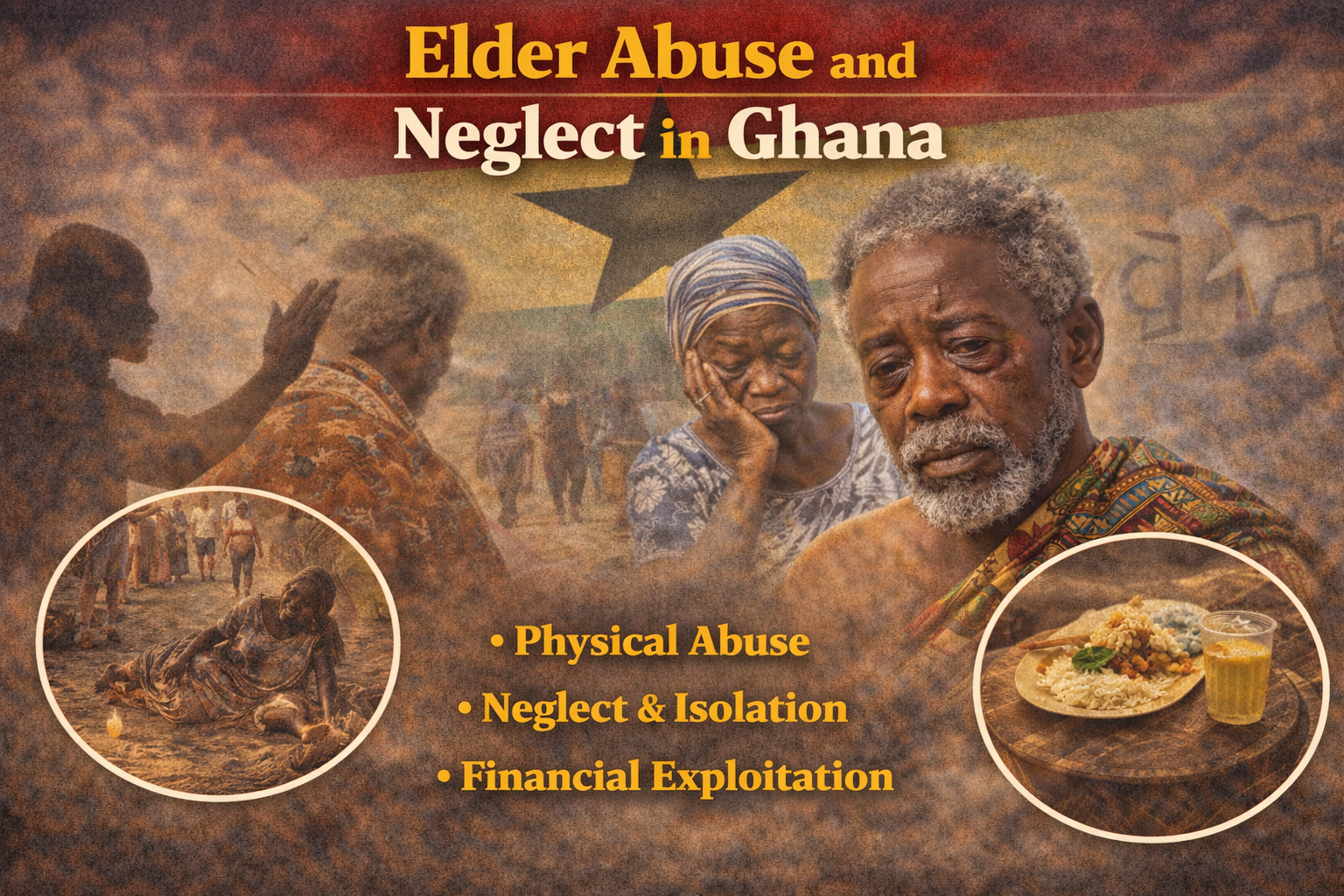
Ghanaian society traditionally values respect for the elderly. Older people are regarded as repositories of wisdom, custodians of tradition, and moral anchors of the family. Yet beneath this ideal lies a troubling reality: many elderly persons in Ghana experience neglect, abuse, and profound social vulnerability.
Elderly neglect refers to the failure of family members, caregivers, or society to provide the basic necessities required for the well-being of older persons. These include food, shelter, medical care, emotional support, and protection.
Elderly abuse, on the other hand, involves deliberate actions that cause physical, psychological, emotional, or economic harm to older people.
Psychological Neglect and Abuse
Psychological abuse of the elderly in Ghana often takes subtle but devastating forms. One of the most pernicious is the accusation of elderly women as witches. In many communities, older mothers, grandmothers, and aunts are blamed when misfortune strikes—illness, examination failure, infertility, job loss, or persistent poverty. Such accusations impose severe emotional and psychological strain on elderly women who have no means of proving their innocence.
To be branded a witch is to be socially isolated, feared, and stigmatized. The accused may be avoided, verbally abused, or treated as a moral threat to the family and community. This form of abuse strips elderly women of dignity and security, subjecting them to chronic anxiety, shame, and emotional suffering.
Economic Neglect of the Elderly
Neglect of the elderly in Ghana is frequently economic in nature. Rapid rural-urban migration has transformed family structures. Younger family members migrate to cities in search of education and employment, often leaving elderly parents and grandparents behind in rural areas. Over time, many fail to send remittances or provide consistent financial support.
This neglect is especially severe because Ghana lacks a comprehensive social welfare system for older adults who did not work in the formal sector. While some retirees receive pensions, these payments are often meager and insufficient to meet basic needs. As a result, many elderly people struggle to afford food, healthcare, clothing, and other necessities, plunging them into poverty and dependence.
From Accusation to Violence
In some cases, psychological abuse escalates into physical violence. Elderly women accused of witchcraft have been beaten, tortured, and forcibly expelled from their homes. Some suffer severe injuries; others lose their lives.
Sociologist Mensah Adinkrah, drawing on empirical studies of witchcraft-related violence in Ghana, coined the term grannicide to describe the killing of grandmothers by their grandchildren. In the broader criminological and victimological literature, related terms such as eldercide, senilicide, and geronticide are used to denote the killing of elderly persons—typically defined as those aged 65 years and older—because of their age and perceived burden or threat.
A Growing Social Crisis
The neglect and abuse of the elderly represent a profound moral contradiction in Ghanaian society: a culture that publicly venerates old age while privately abandoning or victimizing its elders. As family systems weaken and economic pressures intensify, elderly persons—especially women—are increasingly exposed to harm.
Addressing this crisis requires not only legal protection and social policy reform but also a cultural reckoning. Respect for the elderly must move beyond rhetoric to concrete action—through family responsibility, community vigilance, and state support—so that aging in Ghana does not become a pathway to suffering, fear, and indignity.
Policy Recommendations
Addressing the neglect and abuse of the elderly in Ghana—particularly abuses rooted in witchcraft accusations—requires decisive legal, economic, and social interventions.
Criminalize Witchcraft Accusations
The public accusation of elderly persons, especially women, of witchcraft should be explicitly criminalized. Such accusations constitute psychological abuse and, in many cases, incite physical violence, banishment, and death. Clear legal sanctions would serve both as a deterrent and as a statement that superstition cannot justify human rights violations. Law enforcement agencies must be trained to treat witchcraft accusations as a serious form of elder abuse.
Provide Supplementary Financial Support for Poor Elderly Persons
The state must strengthen and expand social protection programs for older adults, particularly those who never worked in the formal sector and therefore receive no pension or only minimal benefits. Supplementary income support, food assistance, and access to affordable healthcare would reduce elderly vulnerability and dependence, thereby lowering their risk of neglect, exploitation, and abuse.
Promote Family Responsibility and Regular Contact
Families must be encouraged—through public education campaigns and community norms—to maintain regular contact with elderly parents and grandparents. Urban migration should not sever family bonds. Even when physical visits are difficult, regular communication by telephone or other means can provide emotional support, monitor well-being, and reduce isolation. Caring for the elderly must be reaffirmed as a moral obligation, not a discretionary act.