




Introduction: A Name That Became a Symbol
In the sociological imagination of the Gold Coast—what is today Ghana—names are never merely labels; they are identities, narratives, and sometimes prophecies. The name Abedi Pele transcends the ordinary. It is a fusion of biography, mythmaking, and cultural symbolism that reflects both indigenous values and global influences. To understand Abedi Pelé is not simply to recount the life of a footballer, but to explore how a name becomes a legend within a society deeply rooted in oral tradition, communal memory, and symbolic language.
Gold Coast Foundations: Society, Play, and Identity
Before colonial consolidation, the Gold Coast was a network of Akan, Ga, Ewe, and other societies where communal activities—including games—served social and cultural functions. While modern football was introduced during colonial contact, the spirit of competitive play and physical artistry existed long before, embedded in traditional games and festivals. Thus, when football later emerged as a dominant sport, it found fertile ground in a culture already attuned to performance, rhythm, and communal celebration.
In Akan thought, excellence in any field—be it war, oratory, or craft—earns one not just admiration but symbolic elevation. This cultural logic would later shape how figures like Abedi Pelé were perceived: not just as athletes, but as embodiments of excellence.
The Birth of Abedi Ayew: From Humble Beginnings
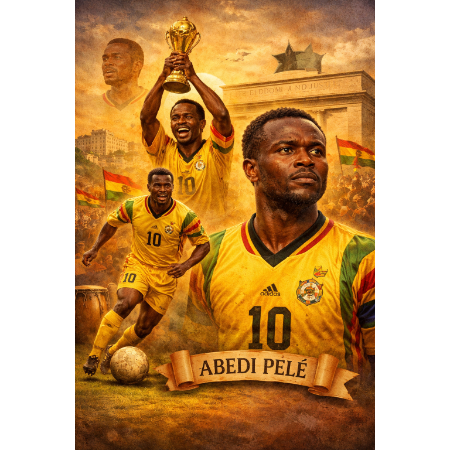
Abedi Ayew was born on November 5, 1964, in the outskirts of Accra, specifically around Dome and Oko—areas that historically straddle the transition between rural and urban Gold Coast life. His upbringing reflects a classic West African “grass-to-grace” narrative: a child from modest means who, through discipline and communal support, rises to prominence.
As a boy, Abedi played football barefoot on dusty grounds, often improvising balls from bundled materials—a practice common in many Ghanaian communities. In local parlance, such environments are often described as “street football”. It signifies raw talent honed without institutional support—a theme central to his myth.
The Name “Pelé”: Borrowed Glory, Local Meaning
The most intriguing sociological element is the adoption of the name “Pelé.” Originally belonging to the Brazilian icon Pelé, the name itself has no intrinsic meaning in Portuguese. Yet, when applied to Abedi Ayew, it becomes deeply meaningful within the Ghanaian context.
He earned the nickname due to his extraordinary skill, which evoked comparisons with the Brazilian legend. But in the Gold Coast tradition of naming, this was more than comparison—it was transference of essence. In Akan culture, names can carry power, expectation, and identity. By calling him “Pelé,” the community effectively declared him the embodiment of footballing genius.
This reflects a broader linguistic phenomenon in Ghanaian parlance: “naming as elevation.” Similar to how exceptional individuals might be called “Chairman,” “General,” or “Professor” in local slang, “Pelé” became a title rather than just a nickname.
Myth-Making: From Player to “Maestro”
Abedi Pelé’s playing style—marked by dribbling, vision, and creativity—fed into the construction of myth. In Ghanaian football discourse, he is often referred to as “The Maestro,” a term that resonates with both Western musical imagery and indigenous ideas of mastery.
In local football slang, one might hear expressions like:
- “He dey control the game” (he dictates play effortlessly)
- “Ball no dey worry am” (he is completely at ease with the ball)
Such phrases elevate skill into something almost supernatural. This aligns with precolonial storytelling traditions, where heroes are described in ways that blur the line between human and extraordinary.
Chronology of Greatness: A Journey Rooted in Home
Abedi’s career began with Real Tamale United in the late 1970s, marking his entry into organized football within Ghana. His rise coincided with Ghana’s 1982 African Cup of Nations victory, embedding him within a national narrative of pride and resilience.
From there, his journey took him beyond Africa—to Qatar, Switzerland, and ultimately France, where he became a central figure at Olympique Marseille, winning the UEFA Champions League in 1993. Yet, despite his global success, his identity remained firmly rooted in Ghanaian consciousness.
In sociological terms, he became a “transnational hero”—someone who operates globally but symbolizes local identity.
Legend Status: The Collective Ownership of a Hero
What transforms a great individual into a legend in the Gold Coast context is not just achievement but collective ownership. Abedi Pelé belongs to the people. His story is retold in homes, on radio, and in street debates.
He achieved feats such as:
- Winning African Player of the Year three consecutive times (1991–1993)
- Leading and captaining the Black Stars for years
- Becoming one of Africa’s most influential footballers globally
But beyond statistics, his legend is sustained through narrative. In Ghanaian oral culture, repetition builds permanence. Each retelling adds nuance, exaggeration, and reverence—hallmarks of myth-making.
Language, Memory, and Cultural Legacy
In Ghanaian popular discourse, Abedi Pelé is often invoked metaphorically. For example:
- Calling someone “Pelé” implies exceptional skill
- Saying “you be Pelé?” can challenge someone’s ability
This linguistic embedding signifies that his name has moved from person to concept. In sociological terms, this is the ultimate form of cultural immortality.
Conclusion: The Name That Outgrew the Man
Abedi Pelé is not just a historical figure; he is a cultural construct shaped by Gold Coast traditions of naming, storytelling, and communal identity. His name—borrowed, adapted, and redefined—illustrates how global influences are localized within African contexts.
In the end, the myth of Abedi Pelé is not an exaggeration of reality but a reflection of how societies remember greatness. His story reminds us that in the Gold Coast tradition, legends are not just born—they are collectively created.