







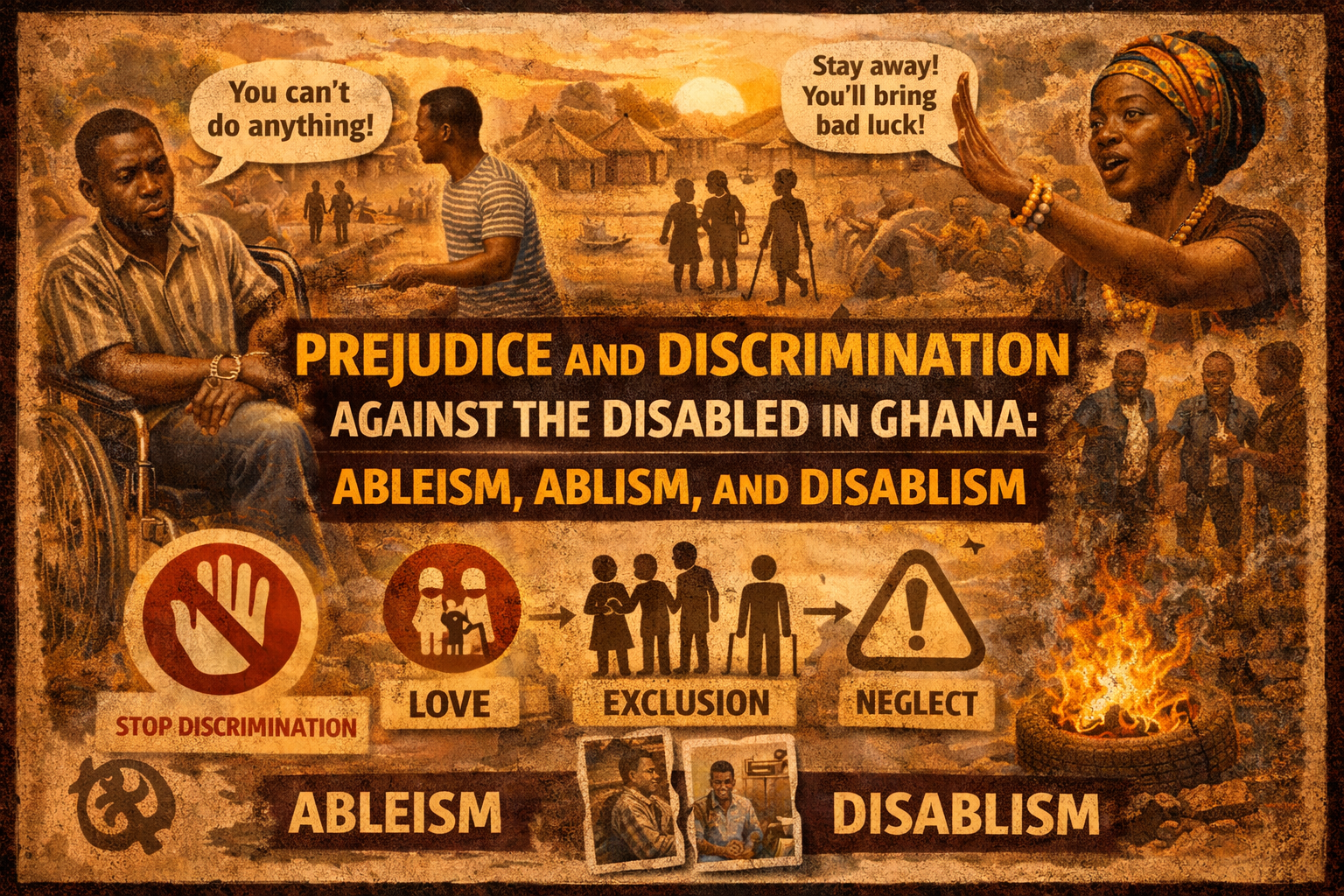
Sociologists use the term ableism to describe prejudice, discrimination, and social exclusion directed against persons with disabilities. The terms ablism and disablism are also used in the scholarly literature to refer to the same phenomenon, namely, the systematic disadvantaging of people whose bodies or minds do not conform to socially constructed notions of “normalcy.” Although the terminology may differ, the underlying social reality remains the same: people with disabilities are frequently marginalized, stigmatized, and denied full participation in society.
In Ghana, as in many societies across the world, prejudice and discrimination against persons with disabilities remain widespread and deeply entrenched. Despite constitutional protections and the existence of disability-related legislation, many disabled persons continue to face social exclusion, economic deprivation, and routine humiliation in everyday life.
Disability in Ghana takes many forms. Some disabilities are physical, while others are mental or cognitive in nature. Physical disabilities include mobility impairments, limb deformities, paralysis, visual impairment, and speech difficulties. Persons born with cleft palates, for example, often experience both functional challenges and severe social stigma. Mental and psychosocial disabilities include mental illness, intellectual disabilities, epilepsy, and other neurological conditions. Regardless of type, disability in Ghana is often interpreted not merely as a medical condition but as a moral, spiritual, or social defect.
Causes of Disability in Ghana
Disabilities in Ghana arise from a variety of causes. Some are the result of accidents, including road traffic crashes, industrial injuries, domestic accidents, and falls. Ghanaian media frequently report cases of individuals who become permanently disabled following motor accidents, especially involving commercial vehicles and motorcycles. These accidents often leave victims with spinal injuries, amputations, or chronic mobility challenges, plunging entire families into poverty.
Other disabilities occur during childbirth. Complications such as prolonged labor, lack of skilled birth attendants, and inadequate access to emergency obstetric care can result in birth injuries that lead to cerebral palsy, physical deformities, or intellectual disabilities. In rural areas, where access to quality maternal healthcare remains uneven, such outcomes are more common.
Illnesses, infections, malnutrition, and inadequate healthcare also contribute significantly to disability. Conditions such as polio (historically), meningitis, stroke, and untreated infections have left many Ghanaians disabled. Yet, while biomedical explanations for disability are well known among health professionals, they are not always accepted at the level of popular belief.
Prejudices Toward the Disabled
While some Ghanaians demonstrate compassion, generosity, and kindness toward persons with disabilities, widespread prejudice and discrimination persist. These prejudices are deeply rooted in cultural interpretations of disability and in limited public understanding of its scientific causes.
A significant source of stigma arises from beliefs about what causes disability. In many Ghanaian communities, disability is not viewed as accidental or natural but as the result of spiritual punishment, witchcraft, ancestral curses, or moral transgression. Some believe that a disabled person may have committed a serious offense—such as theft, incest, or ritual wrongdoing—either in this life or a previous one, and that the disability is the consequence of duabo (imprecation or curse).
Because of these beliefs, some people fear that helping a disabled person may attract misfortune, spiritual contamination, or similar punishment upon themselves. This fear leads to avoidance, neglect, and social distancing. In extreme cases, disabled persons are treated as bearers of bad luck and are excluded from communal activities, family gatherings, and religious rituals.
Epilepsy provides one of the clearest examples of culturally rooted disablism in Ghana. In many Ghanaian languages, epilepsy is commonly referred to as abonsam yadeɛ, literally meaning “the devil’s disease” or “evil disease.” Because epileptic seizures are sudden, dramatic, and poorly understood by the public, they are often interpreted as evidence of demonic possession or witchcraft. As a result, persons with epilepsy are frequently shunned, denied employment, excluded from school, and discouraged from marriage.
Ghanaian media have reported several cases in which children with epilepsy were forced out of school because teachers and parents feared contagion or spiritual danger. In some instances, students who experienced seizures in class were mocked, isolated, or sent home indefinitely. Similar reports have documented adults losing jobs or housing after employers or landlords discovered their condition.
Disability, Religion, and Cultural Interpretations
Religious interpretations further shape attitudes toward disability in Ghana. In some Christian contexts, disability is framed as a test of faith, a sign of divine punishment, or evidence of demonic attack. While many churches provide charity and prayer support, others inadvertently reinforce stigma by emphasizing deliverance over medical treatment. Media reports have documented cases in which persons with disabilities were taken to prayer camps, restrained, fasted, or subjected to exorcism rituals instead of receiving professional healthcare.
Traditional religious beliefs also play a role. In some communities, children born with visible deformities were historically labeled as spirit children and, in extreme cases, subjected to neglect or ritual killing. Although such practices have declined and are widely condemned, the underlying beliefs continue to influence how disability is perceived and discussed.
Contemporary Media Cases and Public Awareness
Ghanaian newspapers, radio stations, and television networks have increasingly highlighted the lived experiences of persons with disabilities. Media stories have covered cases of disabled beggars subjected to harassment, children with disabilities denied access to education, and women with disabilities experiencing sexual abuse with little legal redress. One recurring theme in these reports is the vulnerability of disabled persons to exploitation, violence, and neglect.
There have also been widely publicized cases of persons with disabilities achieving academic, athletic, or professional success despite systemic barriers. While these stories are often framed as inspirational, they also expose the structural inequalities that make such success exceptional rather than ordinary.
Conclusion
Disablism in Ghana is not merely a matter of individual prejudice but a deeply embedded social problem shaped by culture, religion, misinformation, and structural inequality. Addressing it requires more than sympathy. It demands public education, inclusive policies, accessible healthcare, and a deliberate effort to challenge harmful beliefs about disability.
Until Ghana fully recognizes persons with disabilities as complete human beings—entitled to dignity, opportunity, and social belonging—prejudice and discrimination will continue to limit not only their lives but the moral progress of society as a whole.