





The Atlantic as Living Arena
Along the Atlantic edge of the pre-colonial Gold Coast, long before European forts punctuated the shoreline, the sea was already a theatre of movement, daring, and communal pride. The coastal societies of present-day Ghana—particularly the Fante, Ga, and related Akan maritime communities—did not encounter the ocean as a boundary. They inhabited it. And within that intimate maritime world, the dugout canoe evolved from a tool of survival into an instrument of spectacle, recreation, and competition.
Engineering the Dugout: Technology and Mastery
The canoe itself was a technological achievement of striking sophistication. Carved from a single massive tree trunk, often silk-cotton or other hardwood species, these vessels were engineered to endure heavy Atlantic surf. Historical scholarship on West African maritime culture emphasizes the centrality of the canoe in political, economic, and social organization. Far from being primitive contraptions, Gold Coast canoes were hydrodynamically efficient and capable of carrying large crews and cargo through turbulent breakers.
Shoreline Proving Grounds
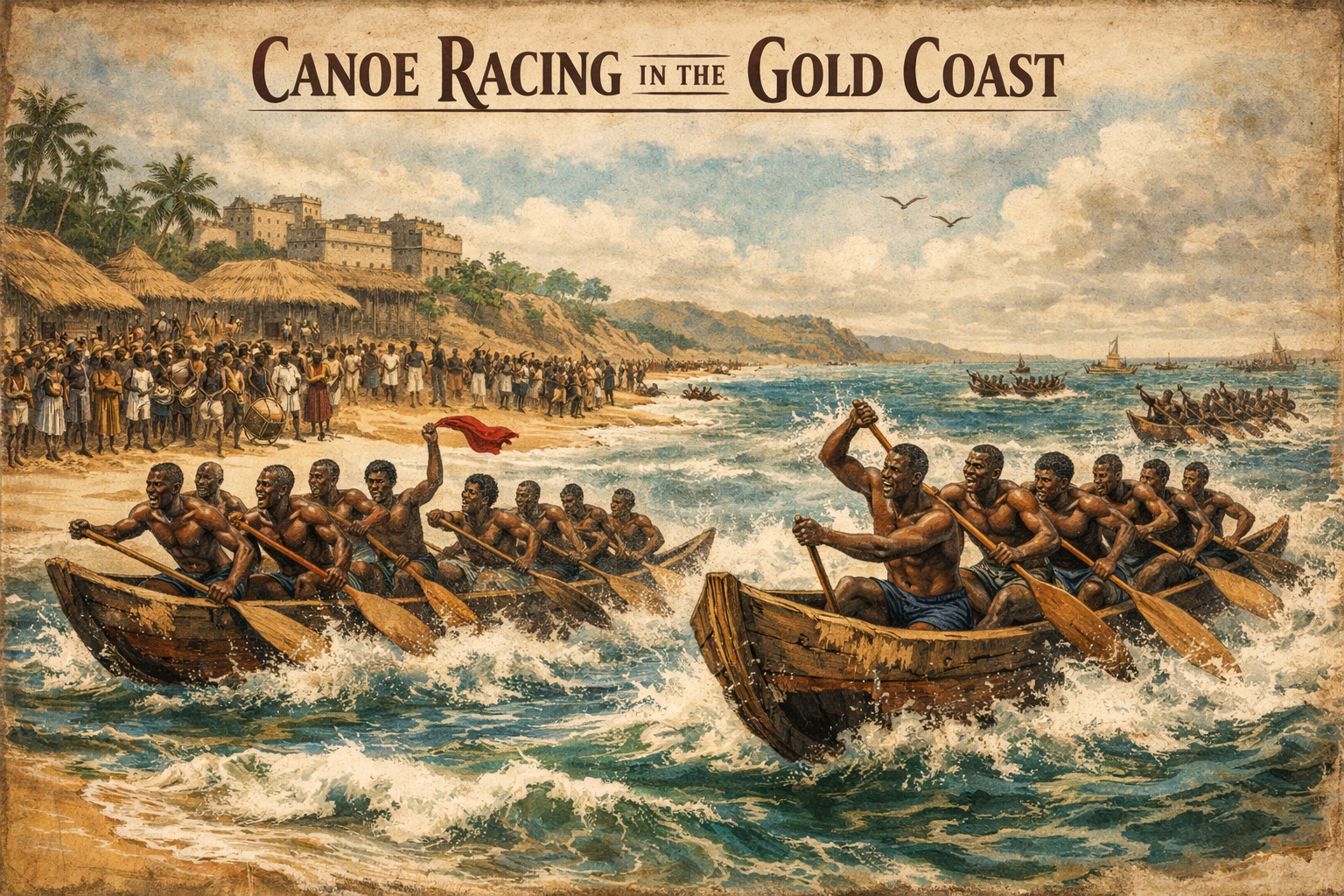
In settlements such as Elmina, Cape Coast, and Accra, the shoreline was a daily proving ground. Fishermen launched through punishing surf, timing their strokes to the rhythm of incoming waves. Young boys observed, learned, and eventually joined. Skill in canoe handling—particularly in negotiating the surf zone—became both necessity and social currency. It is within this culture of mastery that recreational canoe racing likely flourished.
Sport Without Separation
Pre-colonial sport on the Gold Coast was rarely segregated from daily life. Physical competition—whether in wrestling, hunting, or aquatic feats—served communal purposes: entertainment, training, and reputation building. As documented in studies of indigenous sport in pre-colonial Ghana, aquatic skill formed part of informal youth training systems sometimes described as “bush schools.” These were not schools in the European sense but community-based institutions where boys acquired martial discipline, endurance, and technical knowledge—including canoe navigation.
European Observations and Maritime Skill
European observers arriving in the fifteenth and sixteenth centuries frequently remarked on the extraordinary dexterity of Gold Coast canoemen. Accounts compiled in maritime histories describe African paddlers outmaneuvering European boats in the surf, demonstrating superior speed and balance. Kevin Dawson’s more recent scholarship on African maritime traditions further illustrates how swimming, wave riding, and canoe play were culturally embedded long before modern water sports were codified.
From Labor to Contest
It is not difficult to imagine how functional surf launches transitioned into organized or semi-organized contests. A crew that reached the horizon first, a youth who cut across a breaking wave with sharper precision, or a rival fishing group that returned to shore ahead of another—these moments would have drawn cheers, wagers, and pride. In communities where identity was often organized around lineage and occupation, canoe prowess reinforced status.
Ritual, Language, and Maritime Identity
Language itself reflects this intimacy with water. Among the Fante, the annual Bakatue Festival marks the opening of the fishing season. “Bakatue” translates as “opening the lagoon” or “draining of the lagoon,” symbolizing renewed engagement with marine life. Although primarily a fishing festival, its rituals highlight the ceremonial and performative dimensions of canoe culture. The canoe was not simply transport; it was an emblem of continuity between ancestors, sea gods, and living communities.
Among the Ga of Accra, oral traditions suggest the diffusion of certain surf techniques from Fante mariners—evidence of inter-ethnic exchange along the coast. The canoe, in this sense, functioned as both vehicle and vector of cultural transmission. Recreational racing would have strengthened such bonds while sharpening maritime skill.
Recreation Embedded in Life
It is important to emphasize that pre-colonial canoe racing was not “sport” in the bureaucratic, rule-bound modern sense. There were no standardized lanes, no fixed regattas. Instead, competition was embedded in work rhythms, festival cycles, and youthful bravado. The line between labor and leisure blurred, and perhaps that is the most revealing sociological insight. In the Gold Coast’s early coastal settlements, recreation did not require separation from daily life. It emerged organically from it.
Skill, Sea, and Social Memory
The Atlantic was both teacher and adversary. To race upon it—even informally—was to declare competence in the face of a force larger than oneself. And in doing so, early Gold Coast communities transformed survival skill into communal celebration. That transformation—practical necessity becoming performance—is the quiet origin of canoe racing along Ghana’s coast.