







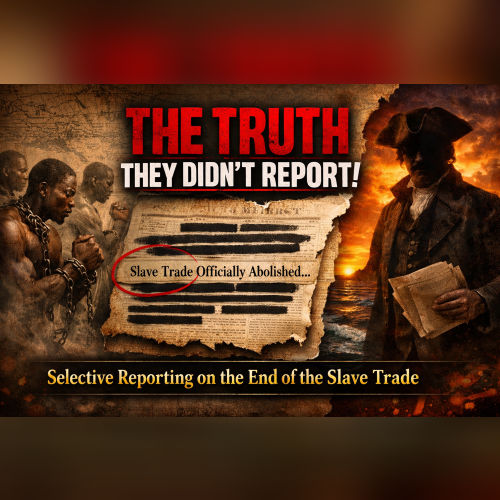
The end of the trans-Atlantic slave trade in the nineteenth century is often presented in historical narratives as a clear moral victory led by European abolitionists. However, in reality, the process was complex, uneven, and frequently misrepresented—particularly in early newspapers and colonial reports. In the region now known as Ghana, selective reporting played a crucial role in shaping public understanding of abolition, often emphasizing imperial benevolence while minimizing African agency, economic disruptions, and the persistence of coercive labor systems.
The Legal End vs. the Practical Reality
Britain’s passage of the Slave Trade Act of 1807 marked a legal turning point, making it illegal for British ships to participate in the slave trade. This was followed by aggressive naval patrols along the West African coast aimed at suppressing illegal trafficking. Later, the Slavery Abolition Act of 1833 formally abolished slavery within the British Empire.
However, newspapers—both in Britain and the Gold Coast—tended to present these legislative acts as immediate and comprehensive successes. In reality, illegal slave trading continued for decades. Portuguese, Spanish, Brazilian, and American traders remained active, and clandestine operations persisted well into the 1860s.
Early reporting rarely acknowledged this gap between policy and enforcement. Instead, newspapers often portrayed abolition as swift and definitive, reinforcing the narrative of British moral leadership led by figures such as William Wilberforce.
Colonial Press and the “Civilizing Mission” Narrative
By the mid-nineteenth century, missionary presses and colonial newspapers had begun circulating in the Gold Coast. Publications often framed abolition within the broader ideology of the “civilizing mission.” Articles emphasized that British rule had liberated Africans from barbaric practices, presenting colonial expansion as a humanitarian intervention.
This selective framing ignored several critical realities:
- European demand had been the primary driver of the slave trade.
- African societies had complex systems of servitude that differed from plantation slavery.
- The transition to colonial rule often replaced slave labor with forced labor and exploitative taxation systems.
By omitting these complexities, newspapers reinforced imperial legitimacy and justified expanding colonial administration.
Underreporting African Resistance and Agency
Another major aspect of selective reporting was the marginalization of African resistance movements. Throughout the nineteenth century, many African rulers and communities actively resisted both slave trading and colonial control. Some coastal leaders negotiated trade reforms, while inland states restructured economies away from slave exports.
Newspapers of the period rarely highlighted these indigenous initiatives. Instead, abolition was depicted primarily as a European achievement. This omission erased the roles of African diplomats, merchants, and reformers who facilitated economic transitions toward “legitimate commerce” such as palm oil, rubber, and cocoa.
Economic Consequences Downplayed
The end of the slave trade caused significant economic disruptions across the Gold Coast. Many states that had depended on slave trading revenue experienced political instability and shifting power dynamics. For example, warfare patterns changed, and commercial elites had to adapt to new forms of trade.
Yet newspapers often downplayed these economic challenges. Instead, they focused on success stories of emerging industries, especially agricultural exports. By the late nineteenth century, reports celebrated cocoa cultivation led by pioneers like Tetteh Quarshie as proof of successful post-slavery economic transformation.
While cocoa indeed became a cornerstone of Ghana’s economy, such reporting overlooked the difficult transition period and the labor exploitation that accompanied plantation expansion.
Selective Silence on Continued Forced Labor
Perhaps the most significant omission in abolition-era reporting was the persistence of forced labor under colonial rule. Systems such as “indentured labor,” compulsory public works, and taxation policies compelled Africans to work under conditions that closely resembled earlier forms of coercion.
Colonial newspapers seldom described these practices as exploitation. Instead, they framed them as necessary for modernization and infrastructure development. This selective language shaped public perception, masking the continuity between slavery and colonial labor regimes.
Influence on Historical Memory
The selective reporting of abolition profoundly influenced historical memory in Ghana and beyond. For decades, textbooks and popular narratives echoed colonial-era framing, emphasizing European humanitarianism while minimizing African complexity.
Only in the twentieth century, particularly during nationalist movements, did Ghanaian scholars and journalists begin critically reassessing these narratives. They highlighted African participation in both the slave trade and its abolition, as well as the structural inequalities that persisted after legal emancipation.
Selective reporting on the end of the slave trade illustrates how newspapers functioned not merely as sources of information but as instruments of power and ideology. By emphasizing imperial morality, downplaying African agency, and ignoring ongoing exploitation, early press narratives shaped a simplified and often misleading historical record.
Understanding these biases is essential for reconstructing a more accurate history of abolition—one that recognizes both the global forces involved and the complex roles played by African societies in the transformation from slavery to colonial modernity.
Watch full video on YouTube – https://youtu.be/xr6kOPj6bhw