




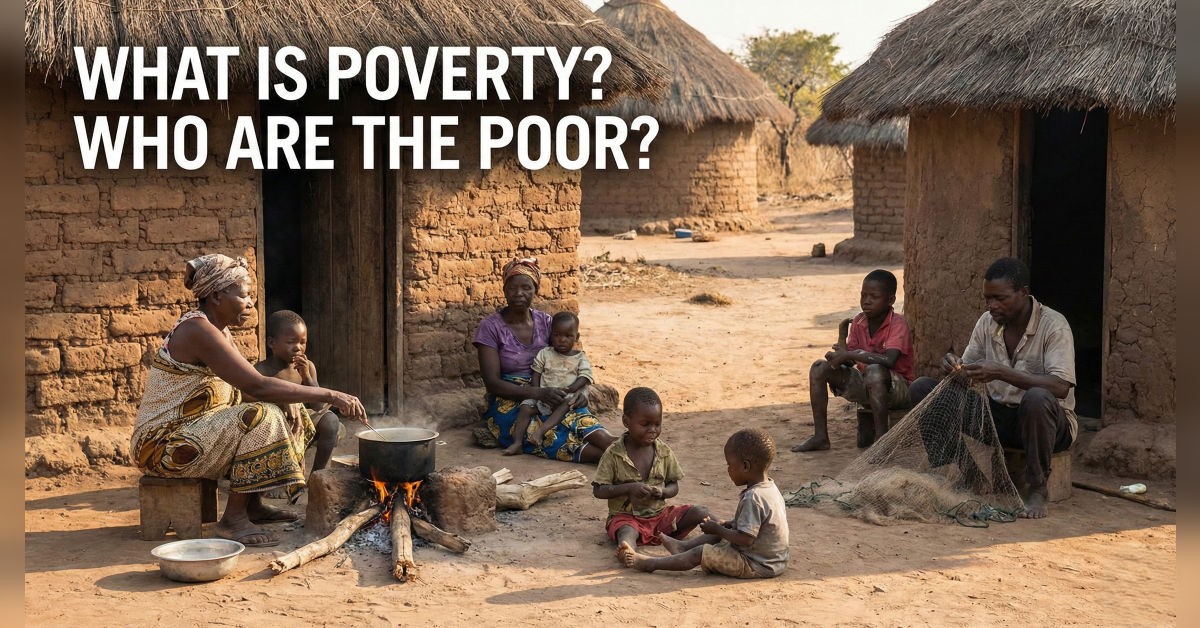
People often talk about poverty and poor people. However, two important questions are not always clearly answered: What is poverty? And who are the poor?
Poverty simply means deprivation. When a person lacks something that is important for living well, that person is said to be poor. Most of the time, when people talk about poverty, they are referring to lack of money or material things. From this point of view, poor people are those who do not have enough money.
Sociologists explain poverty in two main ways: absolute poverty and relative poverty.
A person is said to be experiencing absolute poverty when they do not have enough money or resources to meet basic needs. These basic needs include food, clothing, housing or shelter, healthcare or medicine, and transportation. People living in absolute poverty struggle to survive from day to day.
Sociologists also talk about relative poverty, which is based on comparison. A person may not be poor in the absolute sense, but can still be considered poor when compared to others. For example, someone who earns 15,000 cedis a month may be considered relatively poor when compared to someone who earns 25,000 cedis a month. A person who drives a Toyota Corolla may be seen as relatively poorer than someone who drives a BMW, even though both cars can take their owners to the same destination. In the same way, someone who wears shoes costing GHC 150 may be considered relatively poorer than someone who wears shoes costing GHC 250.
In conclusion, poverty is not only about having nothing. It can also be about having less than others. This leads to an important question for reflection:
Which do you think is more painful—absolute poverty or relative poverty? Why?