










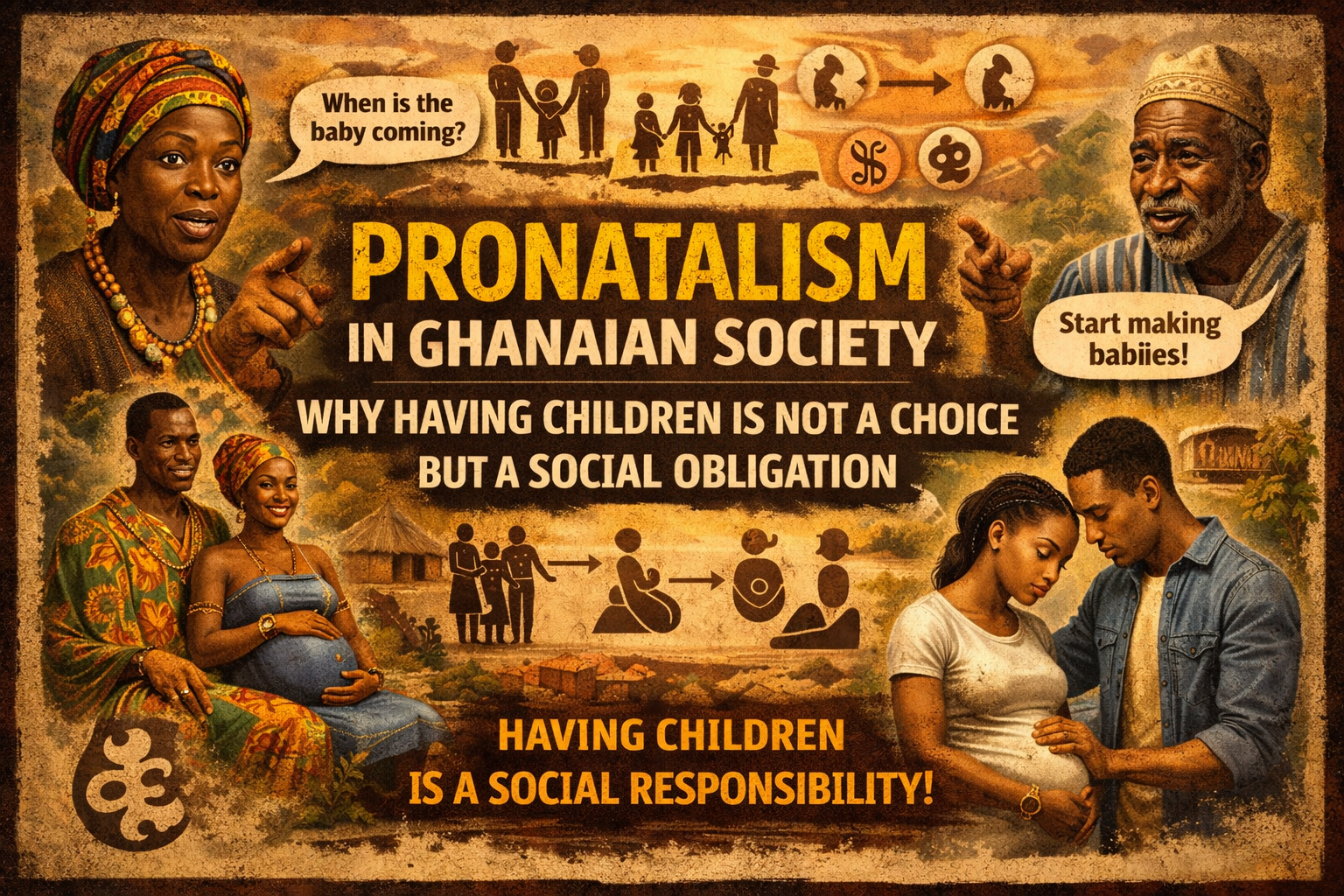
Pronatalism refers to a strong cultural and social preference for having children, often accompanied by expectations that adults should reproduce as a normal and desirable life course.
In Ghanaian society, having one’s own child is not merely a personal choice; it is widely regarded as a social obligation. Adulthood is culturally incomplete without parenthood, and voluntary childlessness is often viewed as deviant, abnormal, or deeply suspicious. Powerful cultural norms prescribe that every adult must reproduce.
For many Ghanaians, marriage itself is primarily about having children. While companionship, love, and mutual support may matter, procreation is frequently the dominant—or even overriding—reason people marry. Once a couple weds, society immediately begins to watch and wait. A pregnancy is often expected within the first three to six months of marriage, and any delay quickly attracts attention.
When pregnancy does not occur within this socially acceptable timeframe, inquisitive questions begin to surface. Whispers and speculation follow. Some suggest the man may be impotent or sterile; others assume the woman is barren. Although these speculations are often voiced discreetly, their psychological weight is immense.
Subtle but persistent pressure is placed on the woman by the husband’s relatives—especially sisters and female kin—who may insist that she must “prove” her worth by bearing a child. At the same time, the woman’s own family may quietly pressure the man to impregnate her, reminding him of his responsibilities. What begins as concern often escalates into tension.
If pregnancy or childbirth is slow in coming, anxiety deepens and impatience grows. Suggestions are sometimes made—explicitly or implicitly—that the couple should separate so that each partner can “try again” with someone else. In extreme cases, threats of divorce or remarriage emerge, especially against the woman.
These pressures take a serious emotional toll. Delayed conception becomes a source of intense stress, shame, and fear. Unfortunately, in most cases, it is the woman who bears the brunt of the blame, regardless of medical realities. Female infertility is assumed, while male infertility is often denied or ignored.
Encouragingly, there is a gradual shift in awareness. Increasingly, many people are beginning to recognize that infertility can originate from either partner, and that men, too, may be responsible for delayed conception. This growing understanding, however, has not yet erased deeply entrenched gendered blame.
The intense preoccupation with having children “at all costs” carries significant social and human consequences. In their desperation, some women spend countless nights at all-night prayer vigils organized by churches, seeking divine intervention. Others resort to ingesting unverified substances or using herbal enemas in the hope of inducing pregnancy. These practices sometimes lead to serious health complications, further worsening their physical and emotional well-being.
Pronatalism in Ghana thus operates as both a cultural value and a source of profound pressure. While children are cherished and celebrated, the expectation that everyone must reproduce—quickly and successfully—can generate anxiety, stigma, marital instability, and health risks. As society evolves, there is a growing need for compassion, medical education, and a broader acceptance that human worth does not rest solely on the ability to bear children.