








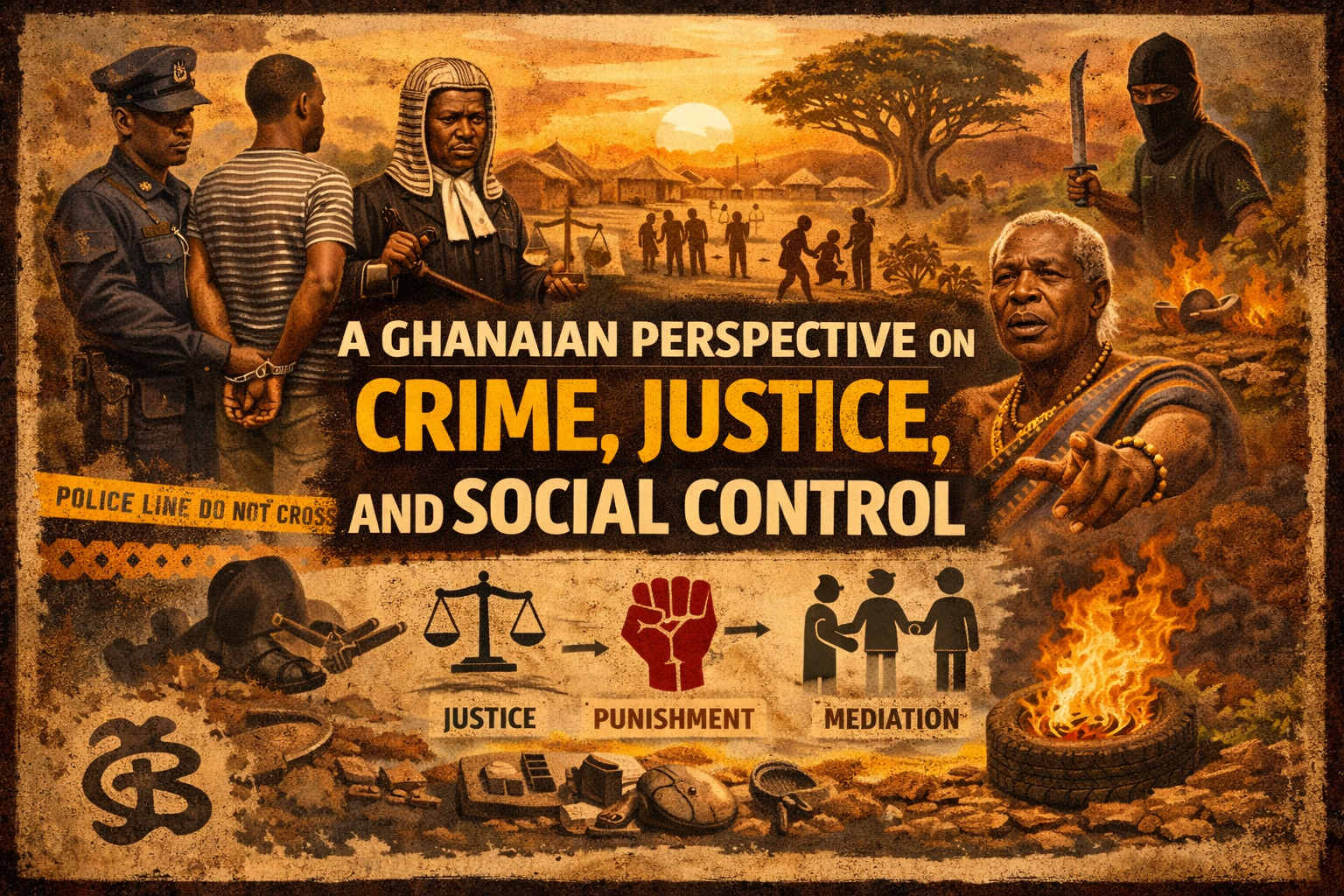
Punishment is a central feature of every organized society, including Ghana. While rewards are designed to encourage conformity and socially approved behavior, punishment exists to negatively sanction deviant behavior. When individuals act in ways that align with societal norms, they are often rewarded through praise, status, social recognition, or material benefits. When they violate those norms, society—or its authorized agents such as the courts, police, prisons, customary authorities, and religious institutions—responds with punishment.
In Ghana, punishment operates at multiple levels. It is enforced formally through the state’s criminal justice system, including the Ghana Police Service, the courts, and correctional institutions. It is also enforced informally through traditional councils, family elders, chiefs, churches, mosques, and community opinion. A thief, adulterer, or violent offender may face not only legal sanctions, but also social shame, public condemnation, and exclusion from communal life.
At its core, punishment is a mechanism of social control. It signals what a society considers unacceptable and enforces compliance with its moral, legal, and cultural rules. In Ghana, these rules are shaped simultaneously by statutory law, customary law, and religious norms.
The Core Principles That Underlie Punishment
Scholars who study punishment—known as penologists—identify four main goals of punishment that guide criminal justice systems across the world, including Ghana’s:
- Retribution
- Deterrence
- Incapacitation
- Rehabilitation
Ghana’s criminal justice system, like most modern systems, does not rely on a single philosophy. Instead, it combines all four principles, sometimes uneasily, in responding to crime.
Retribution: Punishment as Just Deserts
Retribution is the idea that offenders should be punished because they deserve it. The focus here is not on reforming the offender or preventing future crime, but on moral retaliation—paying the offender back for the harm caused.
This philosophy is often captured by the ancient Mosaic principle:
“An eye for an eye, a tooth for a tooth.”
In legal and philosophical terms, retribution is known as lex talionis, the “law of retaliation.” The pain imposed on the offender is expected to be proportionate to the pain inflicted on the victim. This is why penologists sometimes describe retribution as “deserved punishment.”
In Ghanaian society, retributive thinking is not confined to formal law. Many Ghanaians believe strongly that wrongdoing must be paid for, whether through imprisonment, fines, corporal punishment in traditional settings, or divine retribution. Phrases such as “nea woayɛ no, wobɛtua” (“you will pay for what you have done”) reflect deep cultural endorsement of retributive justice.
Capital punishment—although rarely carried out in contemporary Ghana—best exemplifies retributive justice in law. When a person intentionally kills another, the state retains the legal authority to take the offender’s life. Even where executions are not implemented, the death sentence symbolically affirms the idea that taking a life warrants the ultimate punishment.
Incapacitation: Preventing Further Harm
Incapacitation focuses on protecting society by making it impossible for the offender to commit further crimes while under punishment.
A prison sentence is the most common form of incapacitation in Ghana. An incarcerated individual is physically removed from society and therefore unable to victimize others during that period. This logic underpins long prison sentences for armed robbery, rape, and violent offenses under Ghanaian law.
In public discourse, especially following high-profile crimes, many Ghanaians call for harsher incapacitative measures. Radio phone-in programs, social media discussions, and community forums frequently feature demands for life imprisonment or permanent removal of offenders from society.
In some countries outside Ghana, incapacitation takes more extreme forms. For example:
- Thieves may have their hands amputated, eliminating their physical capacity to steal.
- Some citizens advocate the castration of male sex offenders, arguing that removing sexual capacity would prevent penile-vaginal rape.
Although such punishments are not part of Ghana’s legal system, the popularity of these arguments in public debate reflects a widespread desire for absolute incapacitation, particularly in cases involving child defilement, ritual murder, and serial sexual abuse.
Rehabilitation: Treating Crime as a Social or Medical Problem
Rehabilitation rests on the assumption that offenders are not inherently evil, but rather socially, psychologically, or medically impaired. Crime, from this perspective, is a symptom of an underlying problem that can be treated.
This philosophy aligns closely with Ghana’s social realities. Drug abuse, youth unemployment, homelessness, and poor access to education are frequently cited as drivers of crime. As a result, rehabilitation draws heavily on the medical and social welfare models of punishment.
For example:
- Drug offenders are increasingly seen as needing treatment rather than only incarceration.
- Kleptomaniacs are viewed as suffering from compulsive disorders.
- Sex offenders are believed to require psychological or psychiatric intervention.
Because of this orientation, rehabilitation relies on professionals such as social workers, psychologists, psychiatrists, counselors, and probation officers. In Ghana, institutions such as the Department of Social Welfare and NGOs working in prisons support this rehabilitative ideal, despite chronic underfunding.
Rehabilitation can also be economic and vocational. Many thieves and robbers are understood as products of poverty and unemployment. Skills training, education, and reintegration programs—though limited—aim to reduce recidivism by addressing the structural roots of crime.
Deterrence: Using Punishment to Prevent Crime
Deterrence is one of the most influential theories of punishment in Ghanaian criminal justice and public opinion. Its central aim is behavioral cessation—to stop crime from occurring.
Deterrence theorists argue that punishment works best when it is:
- Swift (quickly imposed),
- Certain (likely to be applied), and
- Severe (sufficiently painful or costly).
Public frustration in Ghana often arises when punishment is perceived as slow, uncertain, or selective—especially in cases involving corruption, political elites, or powerful individuals. Delayed trials and perceived impunity undermine deterrence and weaken public trust in the justice system.
Types of Deterrence
Specific (or Individual) Deterrence
This targets the offender directly. The punishment should be unpleasant enough that the individual chooses not to repeat the crime in the future. Prison sentences, fines, and probation orders in Ghana are partly designed with this goal in mind.
General Deterrence
Here, punishment serves as a public warning. When an offender is punished, the wider society observes the consequences and is discouraged from engaging in similar behavior. Media coverage of criminal convictions, police arrests, and court judgments plays a crucial role in general deterrence in Ghana.
Conclusion: Why Punishment Remains Central to Ghanaian Society
Punishment exists because societies must regulate behavior, enforce norms, and maintain order. In Ghana, punishment reflects a complex blend of law, culture, religion, and communal values.
Whether through retribution, deterrence, incapacitation, or rehabilitation, punishment expresses Ghanaian ideas about justice, responsibility, and social harmony. Modern debates—over prison reform, capital punishment, police brutality, and restorative justice—show that punishment is not static. It remains an evolving moral and social project.
Ultimately, punishment in Ghana is about more than crime control. It is about how society balances justice, safety, morality, and human dignity in a rapidly changing world.