






In Ghana, there exists a long-standing practice in which some parents send their children to live with other families as househelps. While this arrangement is often justified as a strategy for providing children with better opportunities, it has, in many cases, become a source of profound exploitation and suffering.
Many of these children are sent from rural areas to urban centers to provide domestic services for city-based families. The receiving households are usually wealthy or modestly well-to-do, and the children are expected to perform a wide range of household chores, often without pay or formal protection.
In some cases, children are effectively rented out, with their parents receiving monthly compensation for the child’s labor. These arrangements frequently occur without written agreements, oversight, or clear expectations regarding the child’s welfare, education, or working conditions.
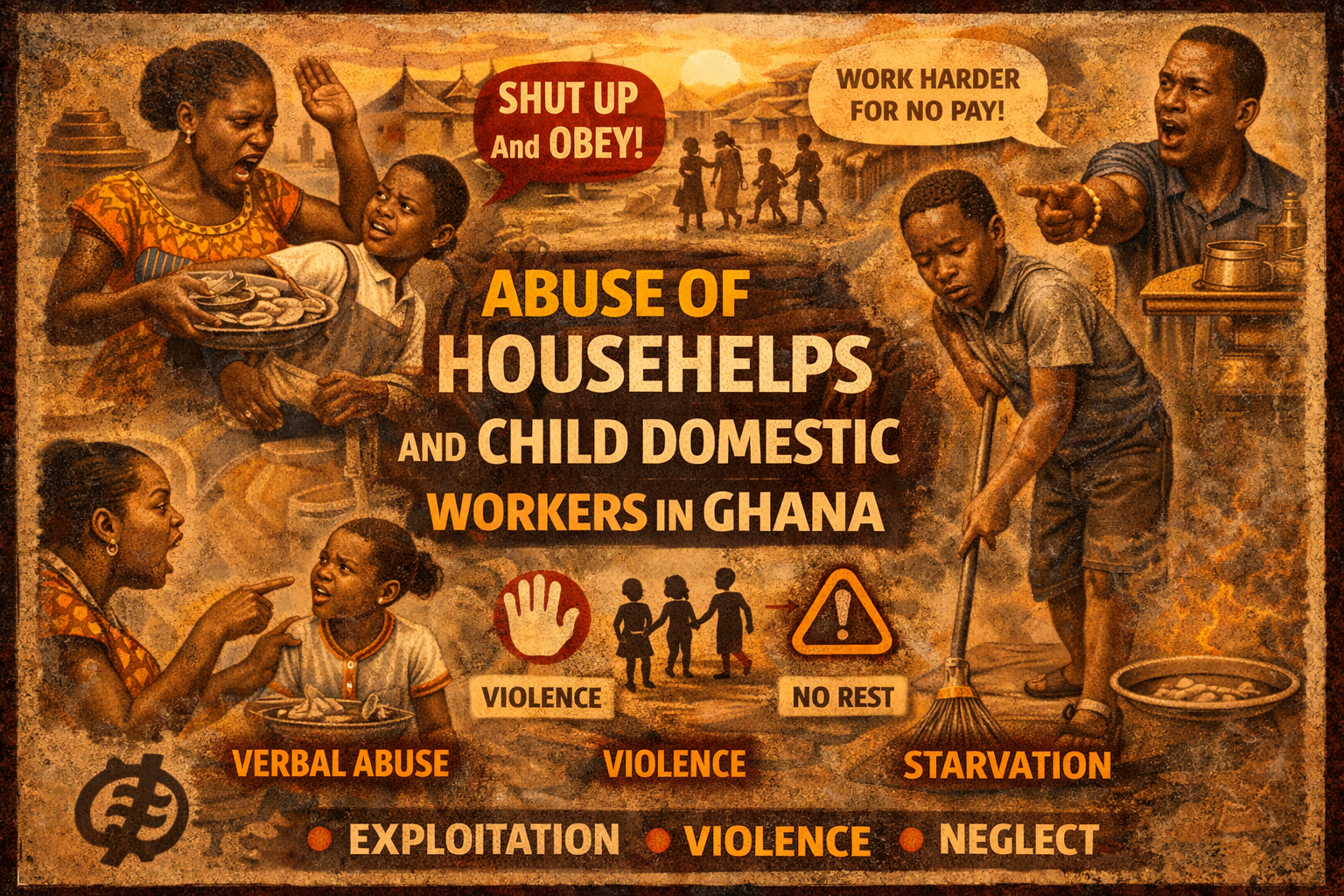
Media reports and human rights investigations consistently show that many househelps are subjected to various forms of abuse. A significant number are denied access to formal education and are instead required to work from morning until night, performing domestic tasks such as cooking, cleaning, washing, childcare, and errand running. Rather than being enrolled in school, some are compelled to sell goods—such as ice water, doughnuts, or other wares—on behalf of the host family, often in unsafe environments.
Disciplinary practices toward househelps are frequently harsh and disproportionate. Reports describe children being beaten, starved, insulted, or humiliated for minor infractions, imagined offenses, or accusations that are exaggerated or entirely fabricated. In some instances, househelps are accused of being witches or bearers of misfortune, a charge that further justifies mistreatment and social isolation.
Sexual abuse represents one of the gravest dangers faced by househelps. There are documented cases in which children are sexually exploited by older children within the host family or by adult male household members, including husbands of the families they serve. Such abuse often goes unreported due to fear, shame, power imbalance, and the absence of trusted avenues for complaint.
Unable to endure persistent mistreatment, some househelps flee their host households and attempt to return to their natal homes. Others drift into street life, where they face additional risks, including homelessness, trafficking, and further exploitation.
Although rare, incidents of suicide among househelps have been reported in the Ghanaian media. These tragic cases underscore the extreme psychological distress that prolonged abuse, isolation, and hopelessness can produce in vulnerable children.
Media Reports and Documented Abuse
Ghanaian mass media reports provide disturbing confirmation that the abuse of househelps is not anecdotal but systemic. Newspapers, online news portals, and radio investigations have repeatedly documented cases in which child househelps have suffered severe physical, emotional, and sexual abuse at the hands of those entrusted with their care.
In one widely reported case, a young female househelp was rescued after neighbors noticed visible scars and injuries on her body. Investigations revealed that she had been repeatedly beaten with household objects by her employer, prompting intervention by the Domestic Violence and Victim Support Unit (DOVVSU) and subsequent court proceedings . Similar reports describe househelps being subjected to excessive punishment for minor mistakes, imagined infractions, or accusations that were later found to be unfounded.
Other media accounts highlight the vulnerability of househelps to sexual abuse. In a particularly troubling case covered by the Ghanaian press, a teenage househelp was allegedly raped by her employer, a foreign national living in Accra. The victim reportedly endured repeated abuse in silence out of fear of losing her livelihood, only seeking help after confiding in a trusted acquaintance. The case eventually made its way to court, underscoring both the power imbalance inherent in domestic labor arrangements and the difficulty victims face in reporting abuse .
Beyond individual cases, opinion pieces and investigative reports in the Ghanaian media have drawn attention to the broader social neglect of child domestic workers. Some commentators have described househelps as among the most forgotten and unprotected categories of vulnerable children in the country, noting the absence of consistent monitoring, weak enforcement of child protection laws, and societal indifference to their plight . These reports emphasize that many househelps suffer in silence, unseen by neighbors, schools, and state institutions.
Collectively, these media accounts reveal a troubling pattern: children sent into domestic service often occupy a social blind spot, where abuse can flourish behind closed doors. The stories reported in the press serve not only as individual tragedies but as indictments of a system that allows child labor, violence, and exploitation to persist under the guise of household assistance.
Conclusion
The plight of househelps in Ghana raises urgent questions about child rights, social inequality, and the moral limits of traditional labor arrangements. While domestic assistance has long existed within Ghanaian society, the exploitation of children under the guise of caregiving represents a profound social failure—one that demands sustained public attention, legal enforcement, and collective moral reckoning.