




The Akans are the largest ethnic group in Ghana, comprising approximately 46 percent of the national population. The Akan language, commonly referred to as Twi, is widely spoken across the country. Although it is the mother tongue of the Akan people, it also functions as a lingua franca and is understood or spoken by a large majority of Ghanaians.
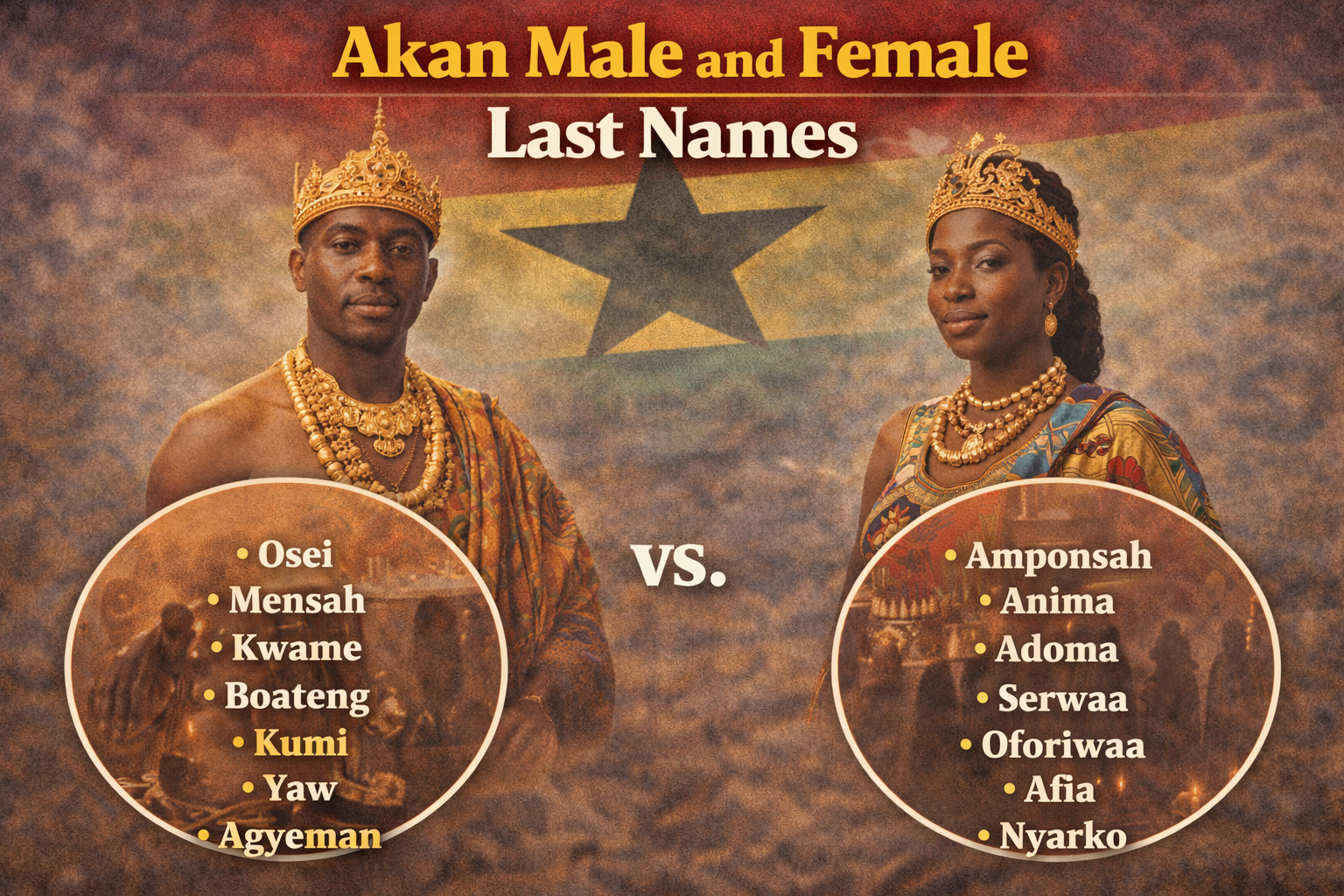
One distinctive feature of Akan naming practices is that male and female names—especially surnames—can often be differentiated by their endings. In many Akan communities, female versions of male names are formed by adding specific suffixes.
The “-waa / -aa” Female Name Ending
In many Akan groups, when a name ends in “-waa,” “-aa,” or a related vowel sound, it typically indicates a female name, while the shorter form is male.
Below are common Akan male surnames with their female equivalents:
- Adom (m) – Adomaa (f)
- Agyei (m) – Agyeiwaa (f)
- Amoako (m) – Amoakowaa (f)
- Ansong (m) – Ansomaa (f)
- Boadi (m) – Boadiwaa (f)
- Boakye (m) – Boakyewaa (f)
- Darko (m) – Darkoa (f)
- Kissi (m) – Kissiwaa (f)
- Kye (m) – Kyewaa (f)
- Kyei (m) – Kyeiwaa (f)
- Osei (m) – Serwaa (f)
- Obeng (m) – Obenewaa (f)
- Oduro (m) – Durowaa (f)
- Ofori (m) – Oforiwaa (f)
- Ofosu (m) – Ofosua (f)
- Ohene (m) – Ohenewaa (f)
- Opoku (m) — Opokua (f)
- Safo (m) – Safowaa / Safoa (f)
- Takyi (m) – Takyiwa / Takyiwaa (f)
The Akwapim “-bea” Female Name Ending
Among the Akwapim, an Akan subgroup, female names often end in “-bea.” In Akwapim Twi, the word for woman or female is “obea.” Other Akan groups, such as the Asante and Kwahu, commonly use “obaa.”
Below are examples of Akwapim male surnames and their female counterparts:
- Offei (m) – Offeibea (f)
- Larteh (m) – Lartebea (f)
- Addo (m) – Addobea (f)
- Ayeh (m) – Ayebea (f)
- Okyere (m) – Okyerebea (f)
- Otu (m) – Otubea (f)
Conclusion
Akan naming practices reflect deep cultural understandings of gender, identity, and lineage. The use of suffixes such as “-waa,” “-aa,” and “-bea” allows speakers to distinguish male and female names with ease, while also preserving family and clan identities. These linguistic patterns remain an important marker of Akan cultural heritage in contemporary Ghana.