








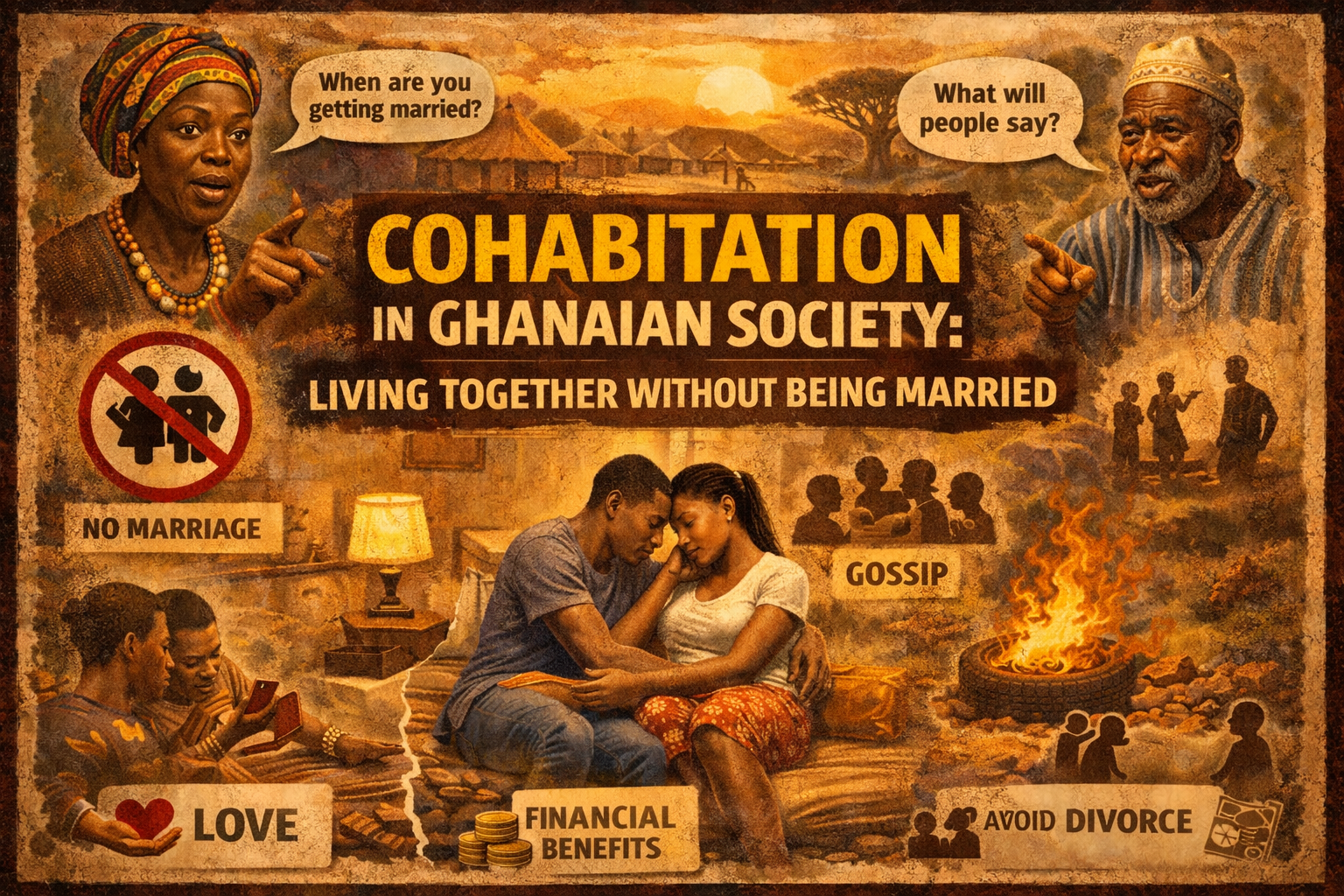
Cohabitation refers to an intimate arrangement in which a man and a woman live together in a shared residence without being formally married. While cohabitation has become increasingly common in many contemporary societies, it is generally frowned upon in Akan society and regarded as socially improper.
Within the Akan marital system, there is a strong cultural expectation that marriage must precede co-residence. A man and a woman are not expected to live together as husband and wife unless the appropriate marriage rites have been duly performed. Central to Akan marriage is the payment of bridewealth (tiri nsa and associated items) to the woman’s family, followed by customary rituals that formally recognize the union. Only after these steps have been completed is the woman expected to move into the man’s residence or begin living with him as a wife.
When a man lives with a woman without fulfilling these obligations, the relationship is culturally condemned. Among the Akan, such conduct is described as kwaseabuo—literally meaning foolishness or reckless behavior, but culturally understood as taking advantage of the woman’s matrilineage. The man is seen as enjoying the privileges of marriage—companionship, sexual access, and sometimes labor—without honoring the social and ritual responsibilities owed to the woman’s family and ancestors.
Cohabitation is therefore not merely a private matter between two individuals; it is viewed as a violation of lineage rights and social order. Since Akan society is largely matrilineal, a woman’s sexuality and marital status are closely tied to her lineage, and informal unions are seen as undermining the dignity and authority of her family.
In some Akan and related ethnic communities, the seriousness of this violation becomes especially evident if the woman dies while cohabiting without being properly married. In such cases, the man may be compelled to perform a posthumous marriage. This involves carrying out the required marriage rites after the woman’s death and, in some traditions, sleeping in the same room with the corpse overnight as a symbolic acknowledgment of marital responsibility. This ritual act serves to restore moral balance, legitimize the relationship retroactively, and prevent spiritual or social sanctions against the man and the woman’s lineage.
Cohabitation: Contemporary Social Trends, Urbanization, and Modern Lifestyles
As Ghana continues to urbanize and modernize, cohabitation has become increasingly visible, particularly among younger generations and urban residents. Several interrelated social and economic factors account for this shift.
First, economic pressures play a major role. The rising cost of living, unemployment, and job precarity make it difficult for many young couples to afford customary marriage rites, including bridewealth, family negotiations, and ceremonial obligations. For some, cohabitation becomes a temporary or pragmatic alternative to marriage rather than a deliberate rejection of it.
Second, higher levels of education and exposure to global cultural norms have reshaped attitudes toward intimate relationships. Through schooling, media, migration, and digital platforms, many young Ghanaians encounter models of partnership in which cohabitation is normalized and decoupled from stigma.
Third, there is a growing tendency to delay formal marriage. Many individuals prioritize education, career development, and financial stability before marrying. Cohabitation is therefore sometimes framed as a transitional stage—a way of “trying out” compatibility while postponing the social and financial demands of marriage.
In many urban neighborhoods, cohabitation may be socially tolerated or quietly accepted among peers, even though it continues to attract disapproval from older relatives and remains strongly discouraged in rural communities.
Cohabitation: Shifts in Social Attitudes
Survey data and qualitative studies suggest a gradual increase in tolerance toward cohabitation, particularly among younger Ghanaians. For many, cohabitation is viewed either as a modern alternative to marriage or as a stepping stone toward eventual formal union. Couples often describe it as a practical response to economic realities, rather than a rejection of cultural values.
Changing gender roles also shape these attitudes. As women gain education and financial independence, traditional expectations surrounding marriage, dependence, and domestic arrangements are being renegotiated. Cohabitation, in this context, reflects broader transformations in ideas about intimacy, partnership, and autonomy.
Nevertheless, religious institutions—especially Christian churches—continue to emphasize formal marriage and frequently discourage cohabitation on moral and doctrinal grounds. Religious leaders often frame cohabitation as sinful, unstable, or socially harmful, reinforcing the tension between traditional moral authority and emerging social practices.
Conclusion
Overall, while cohabitation is increasingly visible in modern Ghana due to urbanization, economic pressures, and changing social norms, traditional Akan society continues to regard it as morally improper and culturally unacceptable. Marriage, not cohabitation, remains the legitimate pathway to living together and forming a recognized family.