





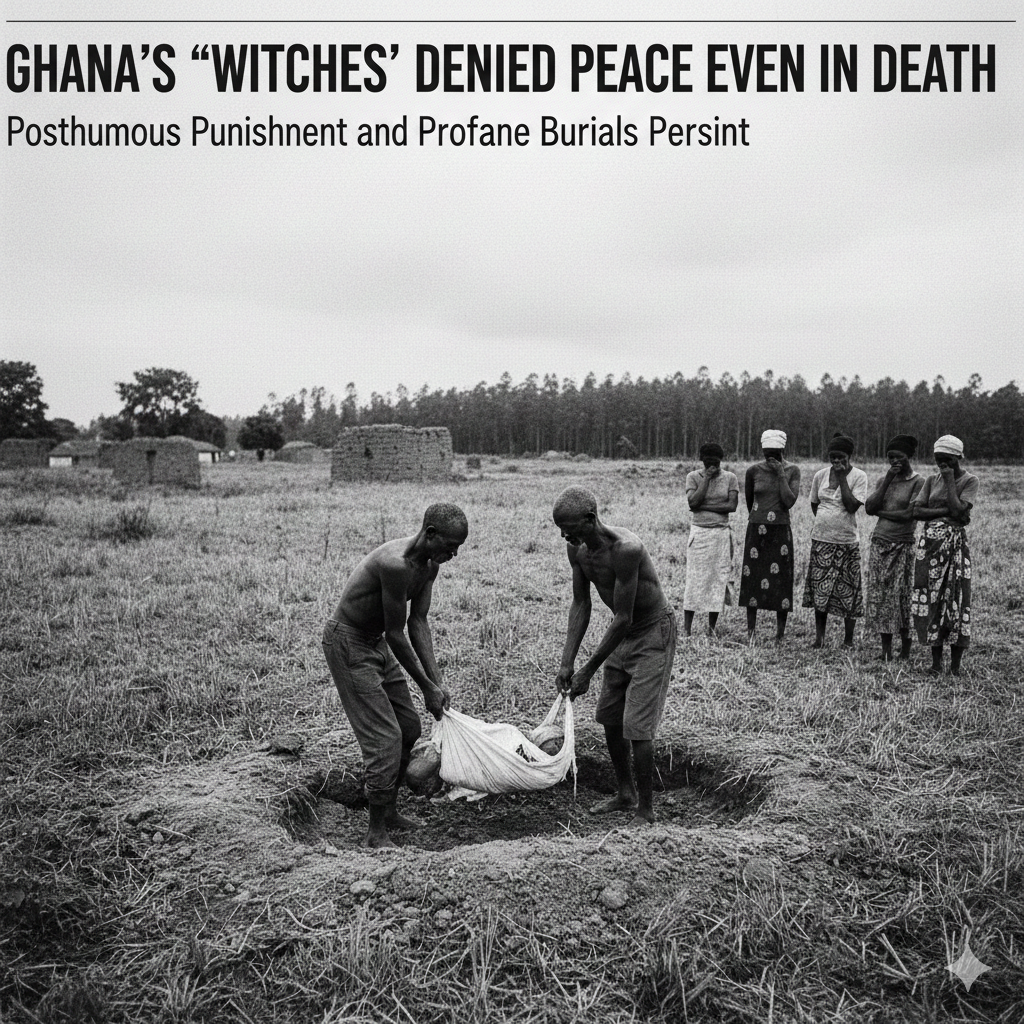
In many Ghanaian communities, accusations of witchcraft generate intense moral outrage and social hostility. Persons believed to be malevolent witches are frequently subjected to verbal abuse, physical assault, forced displacement, and, in extreme cases, extrajudicial killing (Adinkrah, 2004, 2015). Crucially, however, the sanctioning of alleged witches does not necessarily terminate at biological death. Rather, death often becomes the final arena in which communal justice is enacted, as mortuary and funerary practices are mobilized to impose posthumous punishment, affirm moral boundaries, and complete the process of social death.
Drawing on Orlando Patterson’s concept of social death, accused witches may be understood as individuals who, even prior to death, have been symbolically expelled from full social personhood. Their moral status is degraded, their relational ties weakened or severed, and their belonging to the moral community rendered precarious. Death does not restore this personhood; instead, it frequently ratifies and finalizes their exclusion. Through the denial of normative burial rites and funeral obsequies, the community formally inscribes the accused witch’s marginality into the posthumous record.
One of the most striking expressions of this social death is the refusal to grant accused witches a “good death.” In several Ghanaian ethnic communities, individuals alleged to be witches—and whose status is purportedly confirmed through divination, confession, or communal consensus—are buried summarily and without ceremony. Funeral rituals, public mourning, drumming, music, and lamentation are explicitly forbidden. These ritual prohibitions are not merely punitive but symbolic: they mark the deceased as morally polluted, unfit for incorporation into the ancestral realm, and dangerous even in death.
From a symbolic-anthropological perspective, the witch’s corpse is treated as a source of moral contagion. The denial of funeral rites serves as a mechanism of purification, protecting the living community from the lingering spiritual threat believed to emanate from the witch’s body and spirit. Burial in segregated cemeteries—often shared with those who have suffered “bad deaths” or committed serious moral transgressions—further spatializes this pollution, physically distancing the morally tainted dead from the socially valued ancestors.
The Ghanaian media has documented such practices. In 1995, a local newspaper reported a case in which the remains of a 72-year-old woman were exhumed from a public cemetery by a vigilante group and reburied in a small burial ground reserved for witches and other moral offenders (Atsu 1995). The exhumation was not merely corrective but retroactive: it symbolically reclassified the deceased, rewriting her posthumous identity and rescinding the dignity previously accorded to her burial. In this sense, the act constituted a form of posthumous punishment, enacted to realign the moral order believed to have been violated by her initial interment among the socially pure dead.
Further insight into the lived consequences of such practices appears in a letter to the editor published in a national newspaper. The writer recounts two instances in which alleged witches were denied normative funerary rites and buried under degrading conditions. Describing the first case, the author writes:
In 1989, my family suffered gross injustice at the hands of the rulers of my town, Katakyiease, near Fante Nyakomase… In the year referred to, my grandmother aged about 89, died. While we were preparing for the funeral and making other arrangements to bury her, the rulers of the town came to inform us that the old lady had been branded a witch so they would not permit her to be buried in the normal way. We were ordered to put her in a coffin at the mortuary and bury her quietly at sunset. We were ordered not to weep, not to perform any funeral ceremony and not to play any musical instrument. We were simply told that that was the custom for burying witches. We were forced to comply, and my old grandmother was buried like a dog.
The letter further reports that a similar episode occurred in 2006, when an 85-year-old woman, Obaapanin Yaa Koduah, was likewise declared a witch and denied a normal burial (Mensah 2007). These narratives illustrate how accusations of witchcraft produce enduring social consequences that extend beyond the accused individual to their surviving kin, who are compelled to participate in rituals of degradation under threat of communal sanction.
Analytically, such practices may be understood as ritualized mechanisms of moral governance. By denying accused witches proper funerary rites, communities prevent their symbolic transformation into benevolent ancestors and instead consign them to a category of restless, dangerous, or morally disqualified dead. In Akan cosmology, where proper burial and funerals are central to ancestral incorporation and social continuity, this denial represents the ultimate sanction. It ensures that the accused witch’s exclusion from the moral community is not only social but metaphysical.
In this way, mortuary practices surrounding accused witches function as a powerful form of posthumous discipline, reinforcing communal norms, reasserting moral boundaries, and dramatizing the consequences of perceived antisocial power. Death, rather than dissolving social judgment, becomes its most enduring expression.
References
Adinkrah, Mensah. (2004). Witchcraft accusations and female homicide victimization in contemporary Ghana. Violence Against Women, 10, 325-356.
Adinkrah, Mensah. (2015). Witchcraft, witches, and violence in Ghana. New York: Berghahn Books.
Atsu, Kodjo. 1995. “Woman’s Body Sent Off to Witches Cemetery.” The Mirror, July 22, p.1.
Mensah, Agnes Kutin. (2007). “Magistrate Rules Against Obnoxious Custom.” Daily Graphic, January 12, p.9.
Patterson, Orlando. (1982). Slavery and Social Death: A Comparative Study. Cambridge, MA: Harvard University Press.