





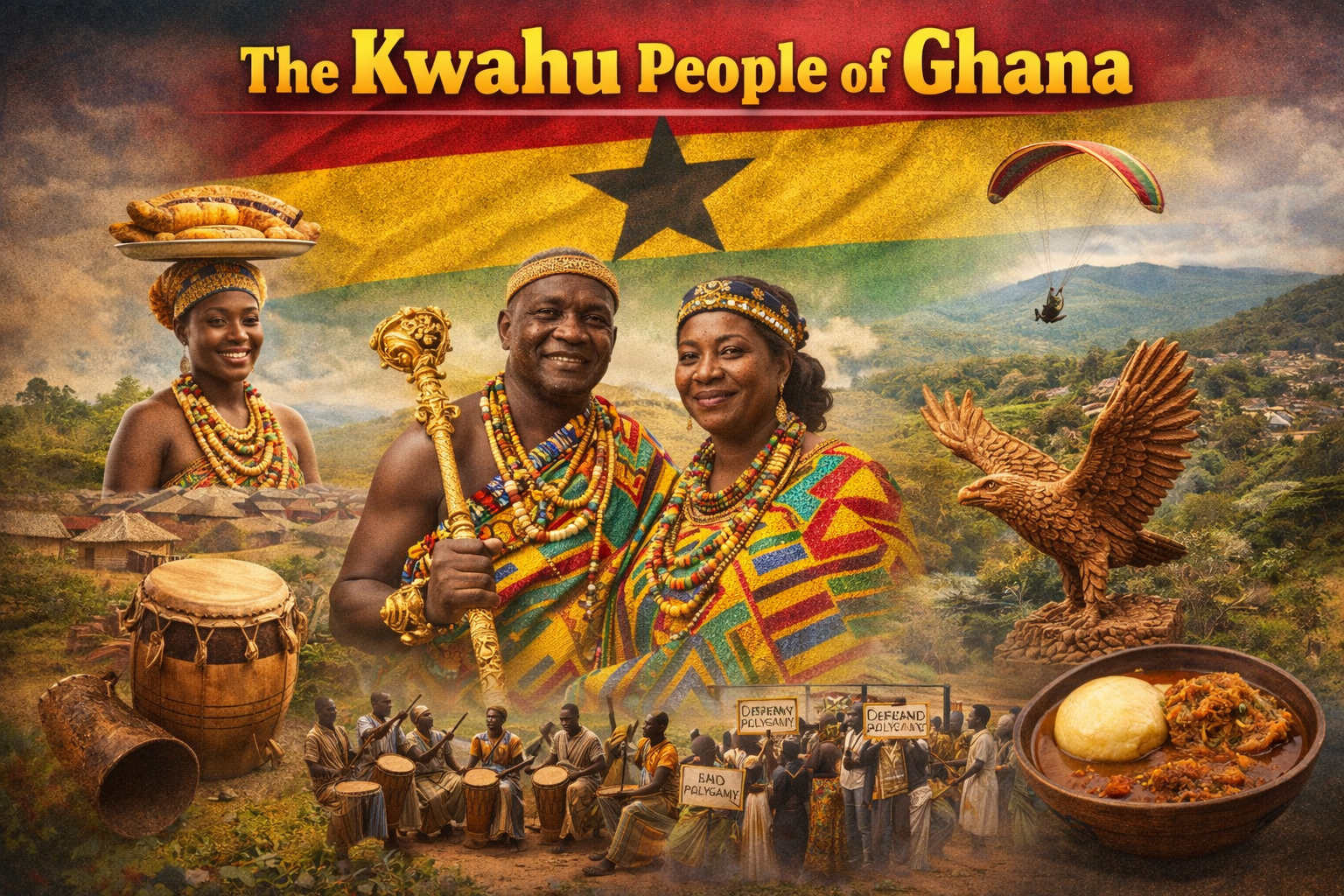
Ghana is a multiethnic and multilingual country, home to numerous ethnic groups with distinct histories and cultural traditions. Among these groups are the Kwahu people, one of the many subgroups within the larger Akan ethnic group.
The Kwahu are primarily located in the Eastern Region of Ghana. Their largest town, Nkawkaw, lies approximately 66 miles from Kumasi, the cultural capital of the Akan people. Current estimates suggest that the Kwahu population numbers between 600,000 and 700,000, out of Ghana’s total population of about 35 million.
Kwahu settlements include towns such as Abene (traditional seat), Abetifi, Aduamoa, Asakraka, Atibie, Bepong, Kwahu Tafo, Mpraeso (administrative capital), Nkwatia, Obo, Obomeng, Pepease, and Twenedurase. Like all Akan groups, the Kwahu trace descent through the maternal line. Inheritance of wealth, property, and lineage membership is likewise transmitted matrilineally, a system that strongly shapes family organization and social relations.
The Kwahu are widely known in Ghana for their prominent role in the retail and trading sector, where many have built successful commercial enterprises. As a result, they are often stereotyped as wealthy and financially shrewd—sometimes humorously labeled kwahufo pɛpɛɛfo, meaning “thrifty” or “tight-fisted” people. The Kwahu area itself reflects this prosperity, with several towns noted for their large and impressive homes.
Culturally, the Kwahu are especially renowned for their elaborate Easter celebrations, which attract visitors from across Ghana and the diaspora. These festivities combine religious observance, social gatherings, and economic activity, reinforcing Kwahu identity and communal pride.
In addition to their entrepreneurial reputation, the Kwahu are also recognized for their philanthropic contributions. Many individuals invest in community development by constructing clinics, police stations, and classroom blocks for schools in their hometowns. Through these efforts, the Kwahu continue to shape both the economic and social landscape of Ghana.
Because Kwahu settlements are located on the Odweanoma Mountain, the Kwahu people are informally known as Obuomma—literally, “children of stone,” a reference to the rocky mountain terrain they inhabit. A single Kwahu person is called Obuoba, to which the customary response is “Yɛntɛ gyae,” meaning “we do not stop until the goal is achieved.” This expression reflects the Kwahu reputation for resilience, determination, and perseverance, qualities widely associated with their history of mountain settlement, commerce, and enterprise.
Well-known contemporary and living Kwahus include Dr. Bryan Acheampong, a prominent entrepreneur and politician; Professor Dr. Mensah Adinkrah, an internationally recognized sociologist, criminologist, and thanatologist; and Albert Dwamena, a leading importer and distributor of pharmaceutical products.