







Polygamy refers to a marital arrangement in which a person is permitted to have two or more spouses at the same time. Although the term polygamy is often used loosely in everyday conversation, sociologists and anthropologists make important distinctions among its different forms.
There are two main types of polygamy. The first, and by far the most common, is polygyny—a marriage system in which a man is allowed to have two or more wives concurrently or simultaneously. Polygyny has been practiced in many societies across Africa and remains culturally recognized in countries such as Ghana and Nigeria. In some polygynous societies, a man may marry two or more sisters at the same time, a practice known as sororal polygyny. This arrangement is often justified culturally as a way to reduce conflict among co-wives, since sisters are believed to coexist more harmoniously than unrelated women.
The second form of polygamy is polyandry, in which a woman is permitted to have two or more husbands simultaneously. Polyandry is extremely rare globally. One society frequently cited in anthropology and sociology textbooks as practicing polyandry is the Toda of India. In contexts where two or more brothers are married to the same woman, the practice is described as fraternal polyandry. Unlike polygyny, polyandry has never been a recognized or widespread marital institution in Ghanaian societies.
Legal Status of Polygyny in Ghana
The legal status of polygyny in Ghana reflects the country’s plural legal system. Under customary law, polygyny is permitted and socially recognized in many traditional communities. A man who marries multiple wives under customary law is regarded as lawfully married within that cultural framework.
However, under modern statutory law, particularly marriages contracted under the Marriage Ordinance, polygyny is not recognized. The law recognizes only the first wife. Subsequent wives have no legal standing in matters such as inheritance, spousal rights, or marital claims. This legal dualism creates tensions, especially in cases involving property disputes, widowhood, and succession after the death of a polygynous husband.
How Widespread Is Polygyny in Ghana?
Polygyny remains a significant, though declining, marital practice in Ghana. According to data from the Ghana Demographic and Health Survey (GDHS), approximately 18 percent of married women aged 15–49 report having at least one co-wife, while about 9 percent of married men report having two or more wives. The practice is more prevalent in rural areas than in urban settings (DHS Program).
Earlier GDHS estimates indicate that 13 percent of women reported having one co-wife, while an additional 2 percent reported having two or more co-wives, with prevalence increasing among older women (DHS Program). Other studies using multiple-indicator datasets suggest that about 21.6 percent of Ghana’s population lives in polygynous unions, including both Christians and non-Christians (PMC).
Taken together, these findings indicate that polygyny affects a significant minority of marriages in Ghana, with estimates generally ranging between 15 and 22 percent of married women (DHS Program).
Regions and Areas with Higher Rates of Polygyny
Polygyny in Ghana shows strong regional variation. The practice is consistently more common in the Northern, Upper East, and Upper West Regions, as well as the Volta Region, than in southern Ghana (DHS Program).
GDHS data indicate that more than 30 percent of married women in the Upper West, Upper East, Northern, and Volta Regions report having co-wives, whereas prevalence in many southern regions is often below 17 percent (DHS Program). Earlier national data from the Ministry of Health similarly show that the three northern regions historically recorded the highest rates of polygyny.
Overall, polygyny is far more widespread in northern and some eastern parts of Ghana, particularly in rural areas, than in the more urbanized southern regions.
Ethnic Groups with Higher Rates of Polygyny
Research examining predictors of polygyny in Ghana reveals clear ethnic differences. Using the Akan as a reference group, several studies find significantly higher odds of polygynous marriage among:
- Mole-Dagbani ethnic groups,
- Gurma groups, and
- Ewe, who also show higher likelihood in some analyses.
These patterns suggest that Mole-Dagbani and Gurma ethnicities, which are more prevalent in northern Ghana, have higher rates of polygyny, while Akan groups, who dominate much of southern Ghana, tend to have comparatively lower prevalence.
Why Do Men Marry Multiple Wives in Ghana?
In some Ghanaian communities, having multiple wives has traditionally been a mark of prestige and social status. Men with many wives were often respected, partly because maintaining several wives and their children required substantial economic resources. Polygyny thus functioned as a visible indicator of wealth, productivity, and masculine success.
Some men have explained that they married additional wives because their first wife was unable to bear children. In societies where fertility is highly valued and lineage continuity is central, childlessness is often seen as a serious problem, and polygyny is viewed as a culturally acceptable solution.
Other men justify polygyny on sexual grounds, arguing that when one wife is menstruating, pregnant, ill, or unavailable, another wife can meet the husband’s sexual needs. Such explanations reflect deeply embedded gender norms that prioritize male sexual entitlement while placing the burden of accommodation on women.
Why Fewer Men Are Marrying Multiple Wives in Ghana
Despite its historical and cultural roots, polygyny is steadily declining in Ghana. One major reason is economic pressure. The financial cost of maintaining multiple households, paying school fees, providing healthcare, and meeting basic living expenses has become prohibitive, especially in an era of rising living costs and economic uncertainty.
Another key factor is women’s education and economic empowerment. Increasing numbers of Ghanaian women are educated, employed, and financially independent. Many no longer see the need to enter marriages as second or third wives for economic survival. Where polygyny once offered security, it is now often perceived as emotionally costly, legally risky, and socially undesirable.
Urbanization, Christianity, changing gender ideals, and exposure to global norms emphasizing monogamy and gender equality have also contributed to the decline of polygyny, particularly among younger generations.
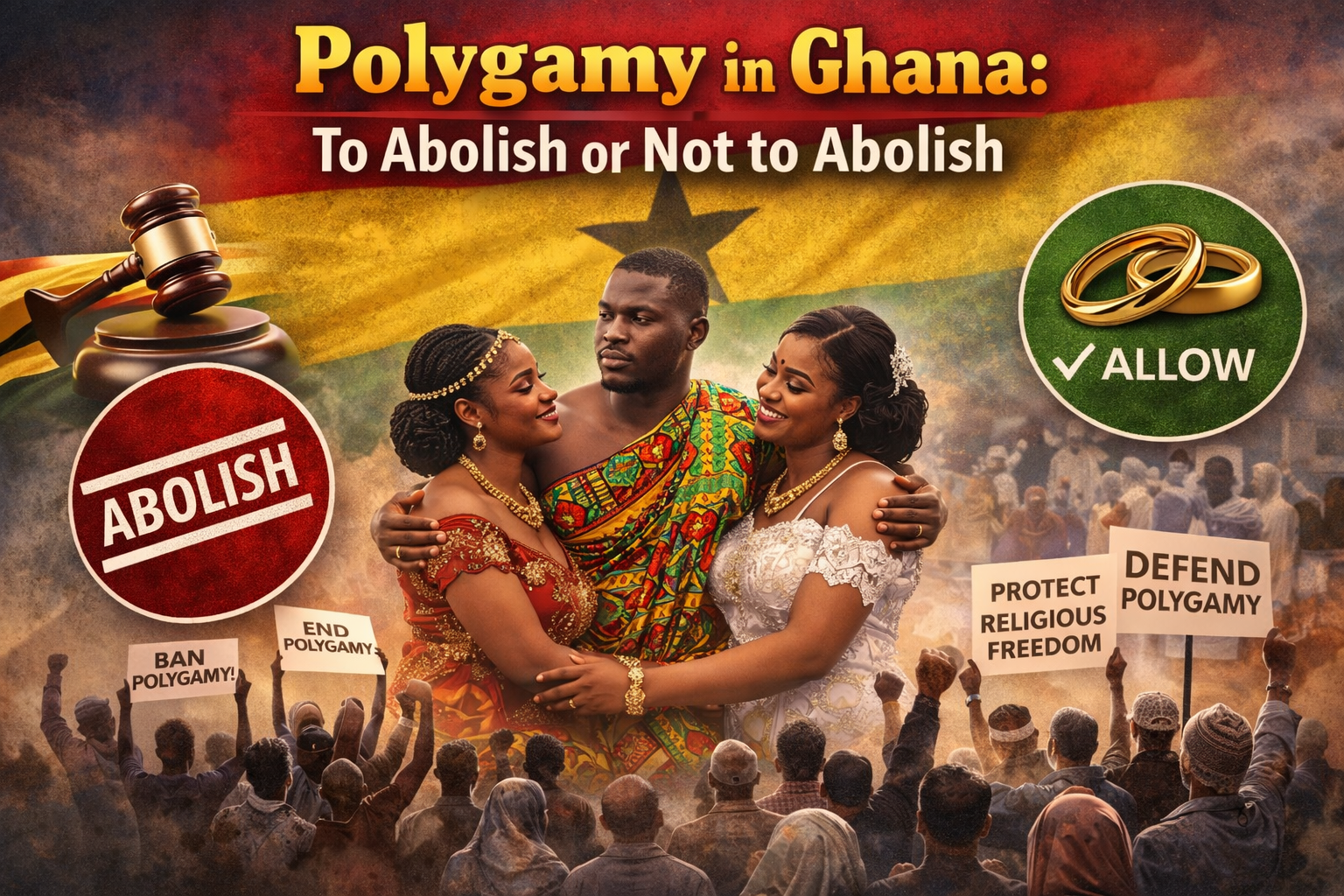
To Abolish or Not to Abolish?
The question of whether polygyny should be abolished in Ghana remains contentious. Supporters argue that it is a legitimate cultural institution that has long served social and economic functions. Critics contend that it reinforces gender inequality, disadvantages women and children legally, and conflicts with contemporary ideals of human rights and marital equality.
Ultimately, the debate is not merely legal but cultural, economic, and moral. As Ghana continues to modernize, the future of polygyny will likely be shaped less by outright legal abolition and more by social change—especially women’s empowerment, economic realities, and shifting conceptions of marriage, family, and gender relations.
Women’s Groups Calling for the Abolition of Polygyny in Ghana
Women’s legal and advocacy organizations in Ghana have long raised concerns about polygyny, arguing that the practice entrenches gender inequality and disadvantages women and children. One notable example is LAWA-Ghana Alumnae Incorporated, a women lawyers’ association, which has publicly called for a complete ban on polygamy and polygyny under all forms of marriage in Ghana. The group contends that polygyny undermines women’s legal rights, weakens their economic security, and reinforces unequal power relations within marriage.
Beyond explicitly abolitionist positions, broader women’s rights movements have addressed polygyny indirectly through advocacy for gender equality in marriage, inheritance, and family law. Initiatives such as the Women’s Manifesto for Ghana emphasize equal rights and protections for women within marriage and the family. While these movements do not always call explicitly for the abolition of polygyny, their reform agenda targets many of the legal and social inequalities that arise from polygynous unions.
However, recent, large-scale national campaigns solely focused on abolishing polygyny are relatively limited in public documentation. Much contemporary activism is framed within wider struggles for gender equality, legal reform, and women’s empowerment rather than as a singular campaign against polygyny itself. As a result, opposition to polygyny in Ghana is often embedded within broader debates about customary law, marriage reform, and women’s rights rather than pursued as a standalone abolitionist movement.