










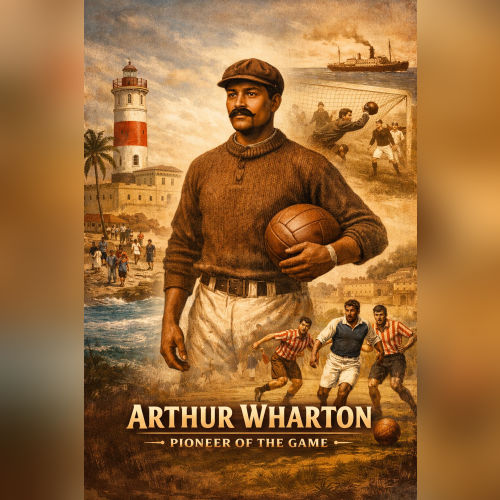
When people discuss the early history of football, the narrative often begins in Britain and gradually expands to the rest of the world. Rarely, however, does the conversation turn toward West Africa—particularly the historic Gold Coast, present-day Ghana. Yet one of the most remarkable pioneers of the sport, widely regarded as the first Black professional footballer, was born there. His name was Arthur Wharton, and his story connects the cultural landscapes of precolonial and early colonial West Africa with the rise of modern football in Europe.
Understanding this remarkable figure requires stepping back in time—to the bustling coastal communities of the Gold Coast in the nineteenth century and the transnational networks that linked them to Britain.
Jamestown: A Historic Gold Coast Community
Arthur Wharton was born in 1865 in Jamestown, a coastal district of Accra in the Gold Coast. Today Jamestown is a historic quarter of Ghana’s capital, but in the nineteenth century it was already an important trading and cultural hub inhabited largely by the Ga people. Jamestown emerged around European trading forts such as Ussher Fort and James Fort, established along the Atlantic coast during the seventeenth century.
These communities formed part of the broader Ga-Mashie area—one of the oldest urban settlements in Accra—known historically for fishing, trade, and cultural interaction between Africans and Europeans.
Within the Ga language spoken in Jamestown, the word “Mashie” loosely refers to the historic town or settlement of the Ga people. Another term often used locally is “mantse,” meaning a chief or traditional ruler. These linguistic expressions reveal the deep-rooted political and social structures that existed in the region long before the imposition of colonial administration. Such communities were vibrant, multilingual environments where indigenous traditions intersected with missionary education and international trade.
It was in this culturally rich environment that Arthur Wharton first opened his eyes.
Family Background: A Transnational Gold Coast Elite
Wharton’s background reflected the complex social hierarchy of the Gold Coast during the nineteenth century. His father, Henry Wharton, was a missionary of Scottish and Grenadian descent, while his mother, Annie Florence Egyriba, belonged to Fante royalty.
This mixture of African and Caribbean-European heritage was not uncommon among the educated elite of the coastal Gold Coast. Missionary networks, merchant families, and educated Africans often formed influential social groups in towns such as Accra and Cape Coast.
One of Wharton’s relatives was Francis Chapman Grant, a prominent merchant and member of the Gold Coast Legislative Council who also participated in the Fante Confederation, a nineteenth-century political movement attempting to unite coastal states against European domination.
Thus, Wharton emerged from a family deeply embedded in the political and cultural life of the Gold Coast.
Journey to Britain: Missionary Aspirations
In the early 1880s, like many young men from elite families along the Gold Coast coast, Wharton traveled to Britain for education. He initially planned to become a Methodist missionary and enrolled at Cleveland College in Darlington.
Yet destiny had other plans. While studying, he discovered an extraordinary athletic talent that would propel him into sporting history.
A Multi-Sport Phenomenon
Before becoming famous as a footballer, Wharton gained attention as a runner. In 1886, he recorded a time of 10 seconds in the 100-yard sprint, a performance considered one of the earliest world records in athletics.
This achievement made him known as the fastest man of his era. But Wharton was far more than a sprinter. He competed in cycling, played cricket, and even participated in rugby. His versatility illustrates how sport in the nineteenth century was less specialized than today; athletes often competed across multiple disciplines.
Still, it was football that would secure his place in history.
The First Black Professional Footballer
Wharton began playing football as an amateur goalkeeper for local teams such as Darlington. His athletic ability soon attracted attention, and he later played for Preston North End, one of England’s strongest clubs at the time.
In 1889, Wharton signed professionally with Rotherham Town, becoming widely recognized as the first Black professional footballer in the world.
During his career, he also played for clubs such as:
- Rotherham Town
- Sheffield United
- Stalybridge Rovers
- Ashton North End
- Stockport County
His football career spanned roughly 17 years, from the mid-1880s to the early 1900s.
As a goalkeeper, Wharton was famous for his unconventional style. He reportedly wore protective leather gloves and sometimes crouched in unusual positions to anticipate shots—a technique that baffled opposing players.
Race and Society in Early Football
To appreciate Wharton’s significance, one must understand the racial climate of nineteenth-century Europe. At the time, pseudo-scientific racial theories were widely circulated in Europe, often portraying Africans as inferior.
Against this backdrop, Wharton’s athletic achievements directly challenged racist assumptions about Black physical and intellectual capability. Contemporary observers frequently commented on his extraordinary speed, reflexes, and composure.
Despite his success, racism remained an obstacle. Although he played professionally, his career never brought the wealth or recognition later enjoyed by football stars. After retiring in 1902, he worked as a labourer and eventually died in relative poverty in 1930.
Forgotten and Rediscovered
For many decades after his death, Wharton’s achievements were largely forgotten. He was buried in an unmarked grave in England.
It was not until 1997 that anti-racism activists campaigned to give him a proper headstone and restore his place in football history.
Today he is widely celebrated as a trailblazer whose legacy paved the way for generations of Black footballers across Europe and beyond.
The Gold Coast Legacy in Global Sport
From a sociological perspective, Arthur Wharton’s story illustrates how the Gold Coast was never an isolated society. Long before Ghana’s independence, coastal communities like Jamestown were part of a global network connecting West Africa to Europe and the Americas.
The cultural exchange that occurred in these ports produced individuals capable of navigating multiple worlds—traditional African society, missionary education, and European professional life.
Wharton embodies this transnational identity. Born in a Ga fishing community of the Gold Coast, educated in Britain, and celebrated worldwide, he symbolizes the early globalization of sport.
Conclusion
The story of the first Black professional footballer does not begin in a European stadium. It begins on the West African coast—in the historic district of Jamestown in the Gold Coast.
Arthur Wharton’s life demonstrates how African communities contributed to global cultural developments long before the modern era of international sport. His achievements remind us that football’s history is not solely European; it is also African, Caribbean, and global.
Today, every Black footballer who steps onto a professional pitch walks in the footsteps of a young man from the Gold Coast who dared to chase a ball—and unknowingly made history.