



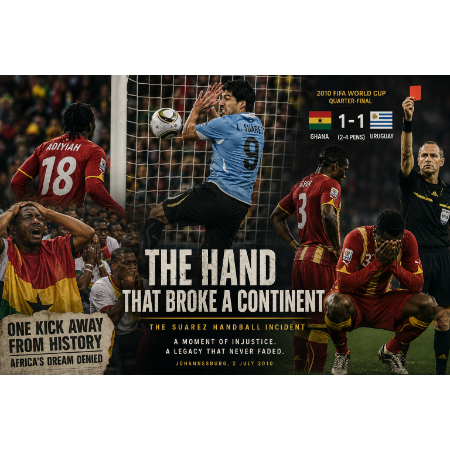



There are football matches that end with a scoreline, and there are matches that never truly end. The 2010 FIFA World Cup quarter-final between Ghana national football team and Uruguay national football team belongs firmly in the second category. More than fifteen years later, the image still burns in the memory of millions: the ball flying toward goal, the desperate leap, the outstretched hands of Luis Suárez, and the shattered hopes of an entire continent.
As another World Cup approaches in just a month’s time, the incident remains one of football’s most emotionally charged moments. It was not merely a handball. It became a continental trauma, a global ethical debate, and a defining lesson about football, justice, psychology, and preparation under pressure.
For many Africans, that night in Johannesburg felt bigger than football. Ghana had become the last African side standing at the 2010 FIFA World Cup, the first World Cup ever hosted on African soil. Cameroon had once reached the quarter-finals in 1990. Senegal repeated the feat in 2002. But Ghana now stood one kick away from becoming the first African nation ever to reach a World Cup semi-final. The symbolism was enormous. Across cities like Accra, Lagos, Nairobi, Johannesburg, and Dakar, people who normally supported rival nations united behind the Black Stars.
The match itself was dramatic even before the infamous moment. Ghana had taken the lead through Sulley Muntari before Diego Forlán equalized for Uruguay. Deep into extra time, with penalties looming, Ghana launched one final attack. Stephen Appiah’s effort was blocked on the line, and then Dominic Adiyiah’s header appeared destined for the net before Suárez intentionally stopped it with both hands. The referee immediately issued a red card and awarded a penalty.
Everything that followed felt almost cinematic. Asamoah Gyan, Ghana’s talisman, stepped forward. Millions held their breath. The shot crashed against the crossbar. Ghana eventually lost on penalties. Uruguay advanced. Africa mourned.
The nationwide reaction in Ghana was unlike anything seen before in the country’s football history. In Accra, Kumasi, Tamale, Cape Coast, and Takoradi, streets reportedly fell silent after the miss. Some people wept openly. Others sat motionless before television screens long after the match had ended. Radio stations transformed into emotional forums where callers expressed anger, heartbreak, and pride all at once.
What made the pain unique was the feeling that history had been stolen at the final possible second. Had Ghana simply lost comfortably, the emotional scars might have faded quickly. But this was different. The dream had been visible. Tangible. Reachable. Then it disappeared in one act of calculated illegality.
The emotional response stretched far beyond Ghana’s borders. Across Africa, supporters who had never before cheered for Ghana suddenly felt personally wounded. The Black Stars had become representatives of a continental ambition. Their victory would not merely have belonged to Ghana; it would have belonged to Africa itself.
The world quickly split into two opposing camps over the incident. One side viewed Suárez as a cheat who had denied Africa its greatest footballing achievement. The other side argued that he merely exploited football’s rules intelligently. Even today, that debate continues fiercely among pundits, supporters, and historians of the game.
Suárez himself embraced the role of villain. He famously suggested that the “Hand of God” now belonged to him and insisted he had nothing to apologize for because Ghana still received the penalty kick. His response only intensified the anger across Ghana and much of Africa. To many, his lack of remorse transformed the moment from a tactical foul into a moral betrayal.
Yet football history rarely remains simple.
In Uruguay, Suárez was celebrated as a patriot who sacrificed himself for his country. Uruguayan supporters viewed the handball not as cheating, but as heroic desperation. FIFA’s rules had punished him with a red card and suspension, and from their perspective, the matter had been settled within the laws of the game.
This divide revealed something profound about football culture: supporters often interpret morality through the lens of national identity. In Ghana, Suárez became a symbol of injustice. In Uruguay, he became a symbol of commitment and sacrifice.
Football, once again, mirrored human society itself.
As another World Cup approaches, the Suarez handball incident remains deeply relevant. It is not simply a historical memory; it is a lesson-filled case study for modern football.
Great tournaments are often decided not merely by talent, but by emotional control during decisive moments. Ghana had the advantage after the handball. The rules had given them justice in the form of a penalty kick. Yet emotionally, the chaos of the moment appeared overwhelming.
The psychological burden of “making history” became heavier than the kick itself. Modern national teams preparing for the World Cup must understand that pressure management is as important as tactics or technical quality. A single moment can define generations.
The Suarez incident also demonstrated football’s brutal realism. Elite competitors exploit every possible edge. Suárez understood that conceding a guaranteed goal meant elimination, while a handball at least created uncertainty.
Morally controversial? Certainly.
Strategically irrational? Not at all.
Future teams heading into the World Cup must recognize that knockout football is often unforgiving. The difference between glory and heartbreak can depend on split-second decisions made under extreme pressure.
Penalty kicks are not merely technical exercises; they are psychological wars. Nations preparing for the upcoming tournament must study how pressure transforms decision-making. A player may score dozens of penalties in ordinary circumstances yet struggle under the crushing weight of history and expectation.
The modern game increasingly recognizes the role of sports psychologists, emotional conditioning, and mental preparation. Ghana’s 2010 experience remains one of football’s greatest reminders of why such preparation matters.
Despite the heartbreak, the 2010 Ghana team changed African football forever.
They proved that African nations could compete tactically, physically, and mentally with football’s traditional powers. They defeated the United States men’s national soccer team, matched Germany for long stretches, and pushed Uruguay to the brink of elimination.
Their journey inspired belief across the continent. The disappointment was immense precisely because the possibility had become real.
Ironically, the Suarez incident may have strengthened African football psychologically in the long run. It created a generation of players and supporters who no longer viewed World Cup quarter-finals as impossible territory. The dream became imaginable.
When Ghana met Uruguay again at the 2022 FIFA World Cup, the old wounds resurfaced immediately. The global media framed the encounter as unfinished business, proving just how deeply the 2010 incident had entered football mythology.
Today, as another World Cup draws near, the Suarez handball incident serves as a reminder that football’s greatest moments often emerge not from triumph, but from heartbreak.
The 2010 Black Stars may not have reached the semi-finals, but they achieved something equally enduring: they united a continent emotionally and left behind a story powerful enough to survive across generations.
Football history does not only remember champions. Sometimes it remembers pain, controversy, sacrifice, and the thin line between glory and despair. The image of Suárez on the goal line remains painful for many Ghanaians, but it also symbolizes how close Africa once came to changing football history forever.
And perhaps, with another World Cup now on the horizon, that unfinished dream still waits somewhere ahead.