





The stadium clock in Cologne had barely ticked past the opening minute when Ghana announced itself to the world.
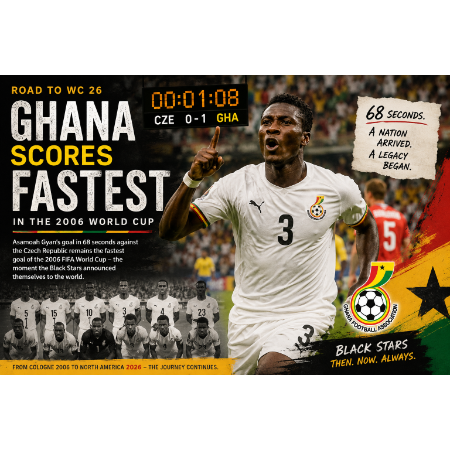
A loose touch in the Czech Republic defence. A flash of movement. Then came the finish — sharp, instinctive, ruthless. In just 68 seconds, Asamoah Gyan slammed the ball beyond Petr Čech and into World Cup history. The Black Stars, appearing at their first-ever FIFA World Cup, had scored the fastest goal of the 2006 tournament.
For millions of Ghanaians watching from Accra to Kumasi, from Tamale to Takoradi, it felt like a national release. Years of frustration, near-misses, and unanswered questions suddenly exploded into one unforgettable moment.
Ghana had finally arrived on football’s biggest stage.
And they arrived with fearless intent.
A Football Nation Long Before 2006
Long before the Black Stars walked onto German soil in 2006, Ghana already possessed one of Africa’s richest football cultures.
This was the nation of Abedi Pele, the midfield genius who conquered Europe with Olympique Marseille. It was the country that produced Tony Yeboah, whose thunderous strikes for Leeds United became Premier League folklore. Ghanaian youth teams had dazzled the world for decades, winning FIFA youth titles and producing wave after wave of elite talent.
Yet there remained an uncomfortable gap in the national story.
Despite all the talent and prestige, Ghana had never reached the senior FIFA World Cup.
Cameroon had shaken the globe in 1990. Nigeria became Africa’s glamorous football export in 1994 and 1998. Senegal stunned defending champions France in 2002.
Meanwhile, Ghana watched from home.
That absence carried weight.
So when the Black Stars finally qualified for the 2006 FIFA World Cup under Serbian coach Ratomir Dujković, the achievement felt bigger than football. It was validation for generations of Ghanaian supporters who believed their country belonged among the elite.
But qualification alone was never going to satisfy Ghana.
Not this team.
The Group of Death
Ghana’s World Cup debut could hardly have been more brutal.
Their group featured eventual champions Italy, a powerful Czech Republic side ranked second in the world, and the United States.
Many observers expected Ghana to finish bottom.
Even after the Black Stars’ opening defeat to Italy, the skepticism remained. Andrea Pirlo controlled the match with elegance, while Italy’s tactical maturity exposed Ghana’s defensive vulnerabilities.
Yet inside that defeat were warning signs for the rest of the group.
Michael Essien drove through midfield with ferocious energy. Stephen Appiah carried himself with authority. Sulley Muntari played with swagger and edge. Ghana lost 2-0, but they did not look intimidated.
That mattered.
Because four days later came the match that changed everything.
Sixty-Eight Seconds That Changed Ghanaian Football
The Czech Republic entered the game as overwhelming favourites.
They had demolished the United States 3-0 in their opening match and possessed one of Europe’s finest generations. Petr Čech was arguably the best goalkeeper in the world. Pavel Nedvěd brought experience and elegance. Tomáš Rosický orchestrated attacks with intelligence and composure.
On paper, Ghana were outsiders.
But football has never been played on paper.
Inside Cologne’s electric atmosphere, the Black Stars attacked from the opening whistle with astonishing conviction.
Then came the moment.
A defensive mistake presented an opening, and Asamoah Gyan reacted instantly. There was no hesitation in his movement, no fear in the finish. He struck low past Čech after just 68 seconds.
The fastest goal of the 2006 World Cup.
Suddenly, the entire tone of the tournament changed for Ghana.
What made the goal so significant was not merely its speed. It was the psychology behind it.
African teams at previous World Cups had often battled an invisible burden against elite European opponents — respect mixed with caution. Ghana shattered that mentality in one minute and eight seconds.
The Black Stars were not in Germany to admire reputations.
They were there to compete.
The Personality of That Team
The 2006 Ghana squad remains one of the most balanced teams in African football history.
Stephen Appiah was the emotional heartbeat, a captain who combined leadership with technical intelligence. Michael Essien covered ground like a storm system, overpowering opponents physically and tactically. Sulley Muntari brought chaos, confidence, and unpredictability.
Then there was Asamoah Gyan.
At just 20 years old, Gyan represented the raw hunger of a new football generation. His pace unsettled defenders. His movement was instinctive. Even his flaws — the occasional wastefulness, the emotional volatility — made him feel dangerously alive.
That spirit defined Ghana.
The Black Stars were not robotic. They played with emotion, rhythm, improvisation, and courage. At times they looked chaotic, but they were never passive.
Against the Czech Republic, Ghana eventually won 2-0 despite Gyan later missing a penalty. The result shocked Europe and electrified Africa.
For the first time, Ghana truly believed it belonged at the World Cup.
More Than a Debut
The significance of 2006 extended far beyond Germany.
That tournament became the foundation for Ghana’s modern football identity.
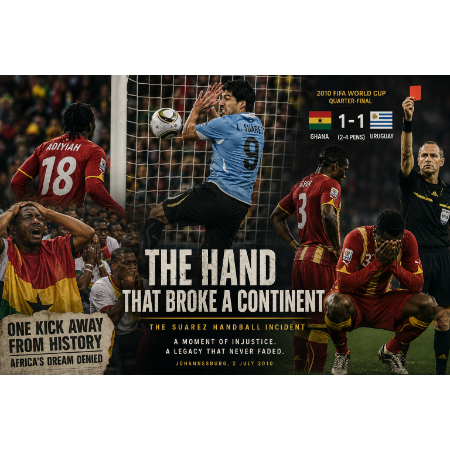
Four years later, in South Africa, the Black Stars would carry the hopes of an entire continent and come within a penalty kick of reaching the semi-finals. Players like André Ayew and Kevin-Prince Boateng emerged from the pathway created by the 2006 pioneers.
The confidence Ghana displayed in 2010 was born in Cologne.
The Black Stars learned in Germany that elite teams could be pressed, unsettled, and beaten.
That lesson changed African football.
For too long, many African nations approached major tournaments hoping to compete respectably. Ghana’s 2006 side approached football differently. They attacked the World Cup with ambition.
That psychological shift mattered as much as the results themselves.
The Road to 2026
As the countdown to the 2026 FIFA World Cup continues, the memory of that lightning-fast goal still carries meaning.
The modern Black Stars are talented, but they remain a team searching for coherence.
Mohammed Kudus possesses the fearless creativity that once defined Appiah and Muntari. Antoine Semenyo offers directness and aggression in attack. Thomas Partey, when fit, remains the team’s tactical anchor.
Yet Ghanaian football continues to wrestle with familiar problems.
Administrative instability has repeatedly disrupted long-term planning. Coaching changes arrive too quickly. Youth development remains inconsistent despite the country’s enormous talent pool.
At times, Ghana behaves like a football nation trapped between nostalgia and reinvention.
That is dangerous heading into a 2026 World Cup hosted by the United States, Canada, and Mexico — nations investing heavily in infrastructure, sports science, and long-term development.
The global game is evolving rapidly. Teams press harder, transition faster, and punish hesitation more ruthlessly than ever before.
Ironically, that makes Ghana’s fastest World Cup goal feel even more relevant today.
Because the lesson of 68 seconds was simple:
Be brave early.
The Black Stars did not wait for permission to belong in 2006. They imposed themselves immediately.
That mentality is what Ghana must rediscover.
Why the Goal Still Matters
Football history remembers moments because they reveal character.
Asamoah Gyan’s strike against the Czech Republic was not simply a quick goal. It was a statement about Ghanaian football.
It announced a nation unafraid of reputation.
It captured the emotional force that has always made Ghana dangerous at major tournaments — speed, confidence, technical freedom, and competitive pride.
Too often in recent years, African football conversations have become obsessed with structure alone. Systems matter. Organization matters. Modern football demands tactical discipline.
But Ghana’s greatest World Cup moments have never come from caution.
They came from belief.
The Black Stars at their best are bold, expressive, and fearless. They unsettle opponents not only with talent, but with emotional intensity.
That was true in Cologne in 2006.
And if Ghana hopes to make a serious impact at the 2026 FIFA World Cup, it must become true again.
Because football rarely rewards teams that arrive cautiously.
It remembers the ones brave enough to strike first.