




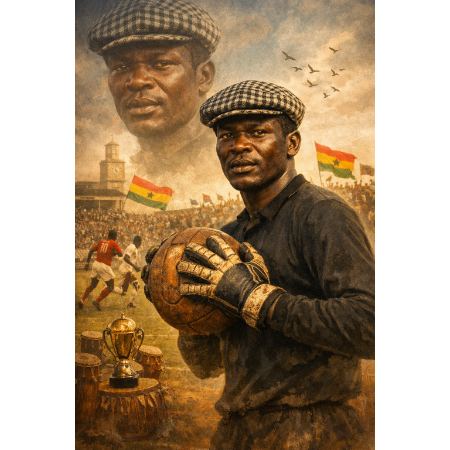
Robert Mensah: A Football Story and Tragedy in the Ghanaian Football
In the annals of Ghanaian sporting history, few names evoke as much reverence, myth, and sorrow as Robert Mensah. His story is not merely about football; it is a narrative woven into the socio-cultural fabric of late colonial Gold Coast and early post-independence Ghana—a period when football became both an instrument of identity and a theatre of popular memory.
Origins in the Late Colonial Gold Coast
Robert Mensah was born on 12 June 1939 in the Gold Coast, just under two decades before the territory gained independence as Ghana in 1957. His formative years coincided with a transformative era: urbanization, nationalist movements, and the growing popularity of football as a communal spectacle.
Football in the Gold Coast was not simply a sport. It was an expression of social mobility and colonial resistance. Local clubs—often tied to towns, ethnic identities, or workplaces—became sites of pride and rivalry. Mensah began his career with Mysterious Dwarfs in Cape Coast, a club deeply embedded in local identity and known by the appellation “Ebusua,” meaning family in Akan—a reflection of communal belonging.
Rise to Greatness: The Making of a Cultural Icon
Mensah’s career spanned several clubs, including Sekondi Independence Club, Asante Kotoko, and Tema Textiles Printing. His time at Kotoko, however, defined his legend. He was instrumental in their triumph in the African Clubs Cup (now CAF Champions League), marking Ghana’s growing dominance in continental football.
Standing over six feet tall, Mensah was renowned for his athleticism, reflexes, and unorthodox style. Oral accounts and journalistic records often describe him as flamboyant—sometimes even theatrical. One popular anecdote recounts him reading a newspaper during a match, mocking the opposition’s inability to threaten his goal.
His nickname, often linked to “Yashin,” referenced Lev Yashin, the legendary Soviet goalkeeper. This comparison was not casual—it placed Mensah within a global footballing imagination, signaling Africa’s emergence on the world stage.
Language, Myth, and Popular Memory
Mensah’s fame transcended sport and entered folklore. A well-known Ghanaian song composed after his death contains the line:
“Robert Mensah, goalkeeper number one… kwasia bi te hɔ… wakɔfa pintoa…”
In Akan:
- “Kwasia” – a foolish or senseless person (often used colloquially, not always literally insulting)
- “Pintoa” – a broken bottle
The song narrates his tragic death, blaming a “foolish person” who stabbed him with a broken bottle. This is significant sociologically: oral traditions in Ghana often transform real events into moral lessons. In this case, the song critiques jealousy, violence, and excess—particularly alcohol consumption.
Another key term is “akpeteshie”, a locally distilled spirit common in working-class drinking spots. These spaces, often informal and male-dominated, were central to social life but also associated with conflict and disorder.
The Tragedy: Death in Tema (1971)
The story of Robert Mensah takes a dark turn in late October 1971. Following Ghana’s failure to qualify for the 1972 Africa Cup of Nations—a national disappointment—Mensah found himself in Tema, a rapidly industrializing port city symbolic of post-independence ambition.
At an akpeteshie bar in Community 7, a quarrel broke out among patrons. Accounts differ slightly: some suggest Mensah intervened to separate fighters; others indicate he became entangled in the altercation. What is consistent is the outcome—he was stabbed with a broken bottle and later died at Tema General Hospital in the early hours of 2 November 1971.
He was only 32 years old.
The alleged assailant, identified as an electrician, was arrested and later imprisoned.
Sociological Interpretation: Discipline, Masculinity, and Urban Life
Mensah’s death cannot be understood solely as an isolated incident. It reflects broader dynamics in Ghanaian society at the time:
Urbanization and Social Tension
Cities like Tema were melting pots of migrants, laborers, and emerging middle classes. Such environments often fostered both opportunity and conflict.
Masculinity and Public Spaces
Drinking spots were arenas where masculinity was performed—through bravado, physical presence, and sometimes violence. Mensah, known for his bold personality, inhabited this culture fully.
Discipline vs. Genius
Contemporaries described him as both brilliant and undisciplined. One teammate suggested that his “lack of discipline” contributed to his tragic end. This duality—genius intertwined with vulnerability—is a recurring theme in sports history.
National Mourning and Myth-Making
The reaction to Mensah’s death was profound. His funeral procession moved across multiple cities—Tema, Accra, Kumasi, and Cape Coast—drawing massive crowds. Reports describe widespread grief, with thousands abandoning daily activities to pay their respects.
In sociological terms, this was a moment of collective mourning, where a nation projected its anxieties and aspirations onto a fallen hero. Footballers like Mensah were not just athletes—they were symbols of national pride in a young postcolonial state.
Legacy in Ghanaian Consciousness
Today, Mensah’s legacy endures in multiple forms:
- The Robert Mensah Sports Stadium in Cape Coast
- Folk songs and oral narratives
- Continued references in Ghanaian football discourse
A Story Beyond Football
Robert Mensah’s life encapsulates a critical period in Ghana’s history—bridging the colonial Gold Coast and independent Ghana. His rise reflects the possibilities of the era; his death exposes its tensions.
His story is, ultimately, a cautionary tale embedded in cultural memory. Through songs, language, and storytelling, Ghanaians have transformed his life into a moral narrative about brilliance, excess, and fragility.
In the words of popular memory, he remains:
“Goalkeeper number one”—not just for his skill, but for the enduring human story he represents.