










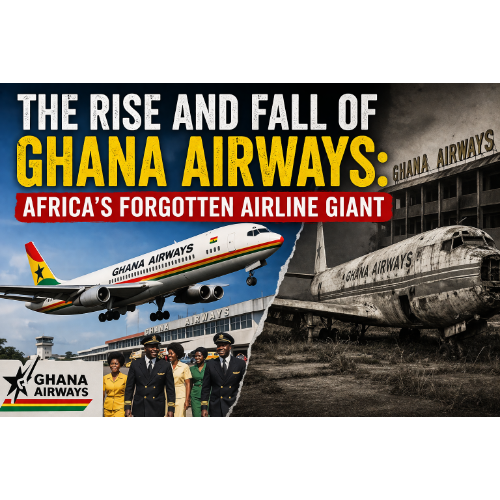

In the years following independence, Ghana set out to build not just a nation, but also a global presence. Among its boldest achievements was the creation of Ghana Airways, once one of Africa’s most respected national carriers.
For decades, the airline symbolized ambition, connectivity, and national pride. Yet, despite its promising beginnings, Ghana Airways eventually collapsed—leaving behind a legacy filled with both achievement and hard lessons.
The Birth of a National Airline
Shortly after independence in 1957, the government led by Kwame Nkrumah recognized the importance of aviation.
A national airline would:
- Connect Ghana to the world
- Promote trade and tourism
- Strengthen diplomatic ties
In 1958, Ghana Airways was established in partnership with international aviation stakeholders, including British Overseas Airways Corporation.
Early Growth and Expansion
In its early years, Ghana Airways experienced steady growth.
The airline began operating routes connecting Accra to major cities in:
- West Africa
- Europe
- The Middle East
Flights linked Ghana to destinations such as London, Lagos, and Rome.
This expansion positioned Ghana as a key aviation hub in the region.
A Symbol of National Pride
Ghana Airways quickly became more than just a transport company.
It was a symbol of independence and progress.
For many Ghanaians, seeing the national airline operate internationally represented:
- Sovereignty
- Modernization
- Global relevance
The airline carried not only passengers but also the image of a rising nation.
The Golden Years
During the 1960s and 1970s, Ghana Airways reached its peak.
It operated modern aircraft and expanded its route network.
The airline played a key role in:
- Facilitating business travel
- Supporting tourism
- Connecting the Ghanaian diaspora
It was widely respected across Africa and beyond.
Challenges Begin to Emerge
Despite its success, problems began to surface over time.
These included:
Financial Mismanagement
Operational costs increased, while revenue management became less efficient.
Aging Fleet
Aircraft required maintenance and upgrades, which were costly.
Political Interference
Changes in government often led to shifts in management and direction.
These issues gradually weakened the airline.
Increasing Competition
As global aviation expanded, competition intensified.
Other airlines began offering:
- Better services
- More efficient operations
- Competitive pricing
Ghana Airways struggled to keep up with these changes.
Decline in Performance
By the 1990s and early 2000s, the airline faced serious difficulties.
Flights were often delayed.
Customer confidence declined.
Financial losses mounted.
The once-proud airline began to lose its reputation.
The Collapse
In 2004, Ghana Airways ceased operations.
The government made the difficult decision to shut down the airline due to unsustainable debt and operational challenges.
This marked the end of an era.
Impact on Ghana
The collapse of Ghana Airways had significant effects:
- Loss of jobs
- Reduced national aviation presence
- Increased reliance on foreign airlines
It also affected national pride, as the country lost a major symbol of its independence-era ambitions.
Attempts at Revival
After the collapse, efforts were made to establish new national carriers.
However, rebuilding a successful airline proved challenging.
The aviation industry requires:
- Strong management
- Significant investment
- Long-term planning
These factors made recovery difficult.
Lessons from Ghana Airways
The story of Ghana Airways offers important lessons:
1. Strong Management Is Essential
Even successful organizations can fail without effective leadership.
2. Adaptation Is Key
Industries evolve, and companies must keep up with change.
3. Sustainability Matters
Growth must be supported by solid financial planning.
A Lasting Legacy
Despite its fall, Ghana Airways remains an important part of Ghana’s history.
It represents a time when the country boldly pursued global presence and economic independence.
For many, it is remembered with pride and nostalgia.
Conclusion
The rise and fall of Ghana Airways is a story of ambition, success, and eventual decline.
Built during the leadership of Kwame Nkrumah, the airline once connected Ghana to the world.
Its legacy serves as both inspiration and caution—reminding us that vision must be matched with sustainability.