









When entering a typical town or village in Ghana, a traveler is often welcomed by a metal signpost bearing the name of the place. These names are familiar to residents, yet many people rarely pause to ask an important question: How did this town get its name?
In Ghana, as in many parts of the world, most towns—even today’s bustling cities—began as small villages. Over time, these settlements expanded, attracting people, markets, and institutions, eventually developing into towns and, in some cases, cities.
Among the Akan, language offers helpful clues to understanding place names. The word kuro refers to a town, akuraa to a village, and oman to a nation or state. These linguistic elements appear repeatedly in the names of Ghanaian settlements and often reveal their origins.
Towns Named After Founders
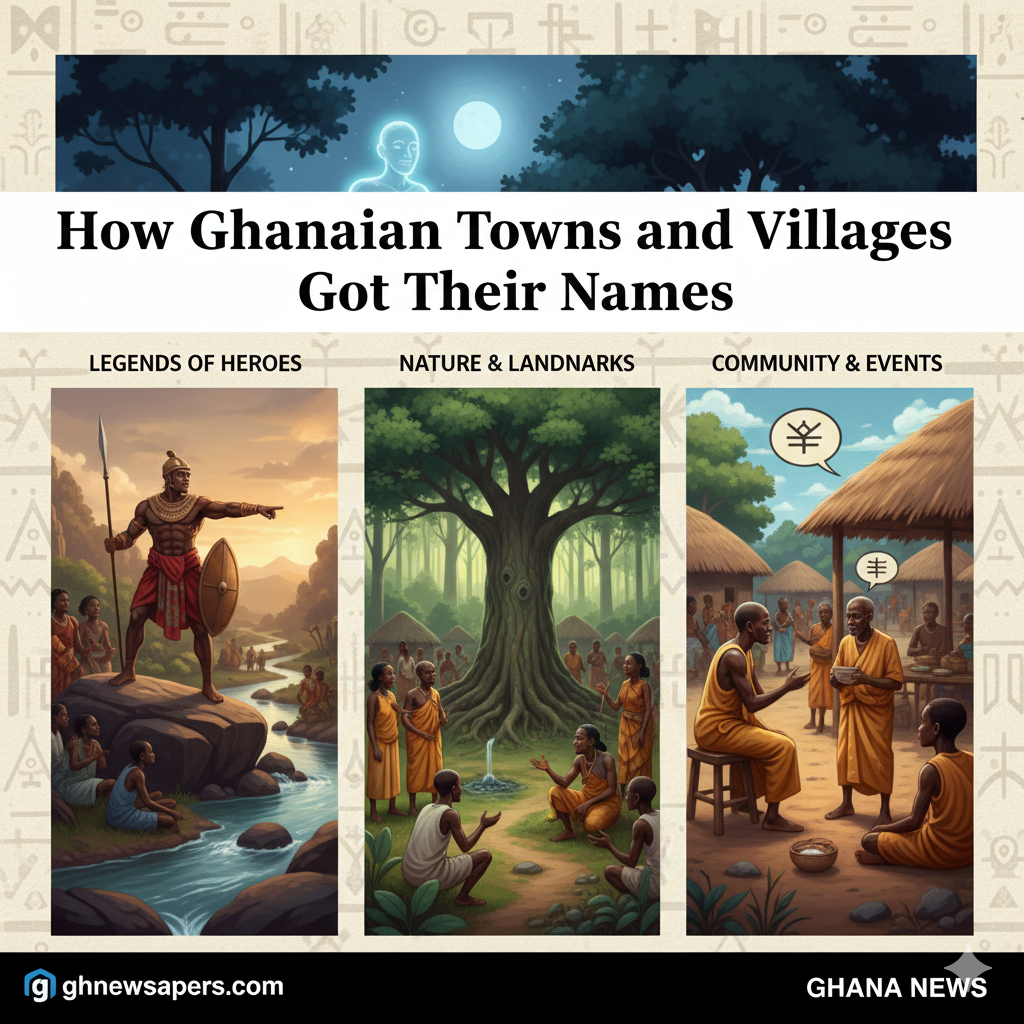
Many towns in Ghana derive their names from the first settler or founder of the community. A common naming pattern involves attaching the Akan suffix krom (town) to the founder’s name. For example, Oseikrom breaks down into Osei and krom, meaning “Osei’s town” or “the town where Osei lived.”
Several towns follow this same pattern, including Kwesikrom, Yawkrom, and Donkorkrom. In each case, the name preserves the memory of the original settler and anchors the community in its founding history.
Some towns named after founders do not use the krom suffix at all. Instead, they retain the full name of the founder. Examples include Kwasi Dede and Yaw Poku, where the settlement itself bears the personal name of its originator.
From Town to Nation: The Use of “Oman”
In some cases, founders envisioned their settlements not merely as towns but as nations or states. Such places were named using the Akan word oman. Thus, Danso’s nation became Dansoman, and Takyi’s nation became Takyiman. These names reflect political ambition and the hope that the settlement would grow into an important center of authority.
Names Inspired by Nature and Landmarks
Natural landmarks have also played a major role in naming towns and villages in Ghana. Rivers, trees, mountains, and other physical features often served as reference points for early settlers.
Some settlements were named after large or sacred trees. Odumase, for example, comes from Odum ase, meaning “under the Odum tree,” suggesting that a prominent Odum tree once stood at the site and served as a gathering or resting place.
Rivers are another common source of place names. Densuso refers to a town situated on the banks of the River Densu, while Nwiiso is a settlement located near the River Nwii. In these cases, the town’s name literally situates it within its physical environment.
Mountain ranges have also influenced naming. In Akan, bepo means mountain. For this reason, many Kwahu towns located on the Odweanoma mountain range are known as Beposo. Similarly, Abepotia, a town near Nkawkaw, translates as “short mountain,” likely referring to a nearby hill or elevation.
Names Rooted in Unique Features and Events
Some town names arise from distinctive physical features. The name Bukuruwa, etymologically derived from obo kuruwa, means “stone cup.” Local tradition holds that a waterfall in the area carved a rock formation resembling a cup.
Other names reflect everyday life. The Akan word sumina means refuse or garbage dump, while kɛse means big. Suminakese therefore refers to the larger of two settlements originally identified by refuse dumps.
Perhaps most fascinating are town names that take the form of statements or historical expressions. Brahabebome, which translates as “come here and beat me,” and Gyaemetanhunu, meaning “stop hating me without cause,” are names that clearly point to dramatic or memorable events in the past. While the full stories may not be widely known today, such names preserve fragments of local history and social memory.
Names as Living History
Ghanaian town and village names are not random labels. They are repositories of history, culture, geography, and collective experience. Each name tells a story—of migration, leadership, conflict, environment, or aspiration.
The next time you find yourself in a town with a curious or unusual name, take a moment to ask about its origin. In doing so, you may uncover a piece of Ghana’s rich cultural and historical heritage—hidden in plain sight on a roadside sign.