











The Akan constitute one of the major ethnic groups in Ghana, accounting for approximately 46 percent of the national population. They speak Twi, a language that is understood and spoken by nearly 90 percent of the country’s population. The Akan are made up of several subgroups, including the Asante, Fante, Akuapem (Akwapim), Akyem (Akim), Brong, and Kwahu.
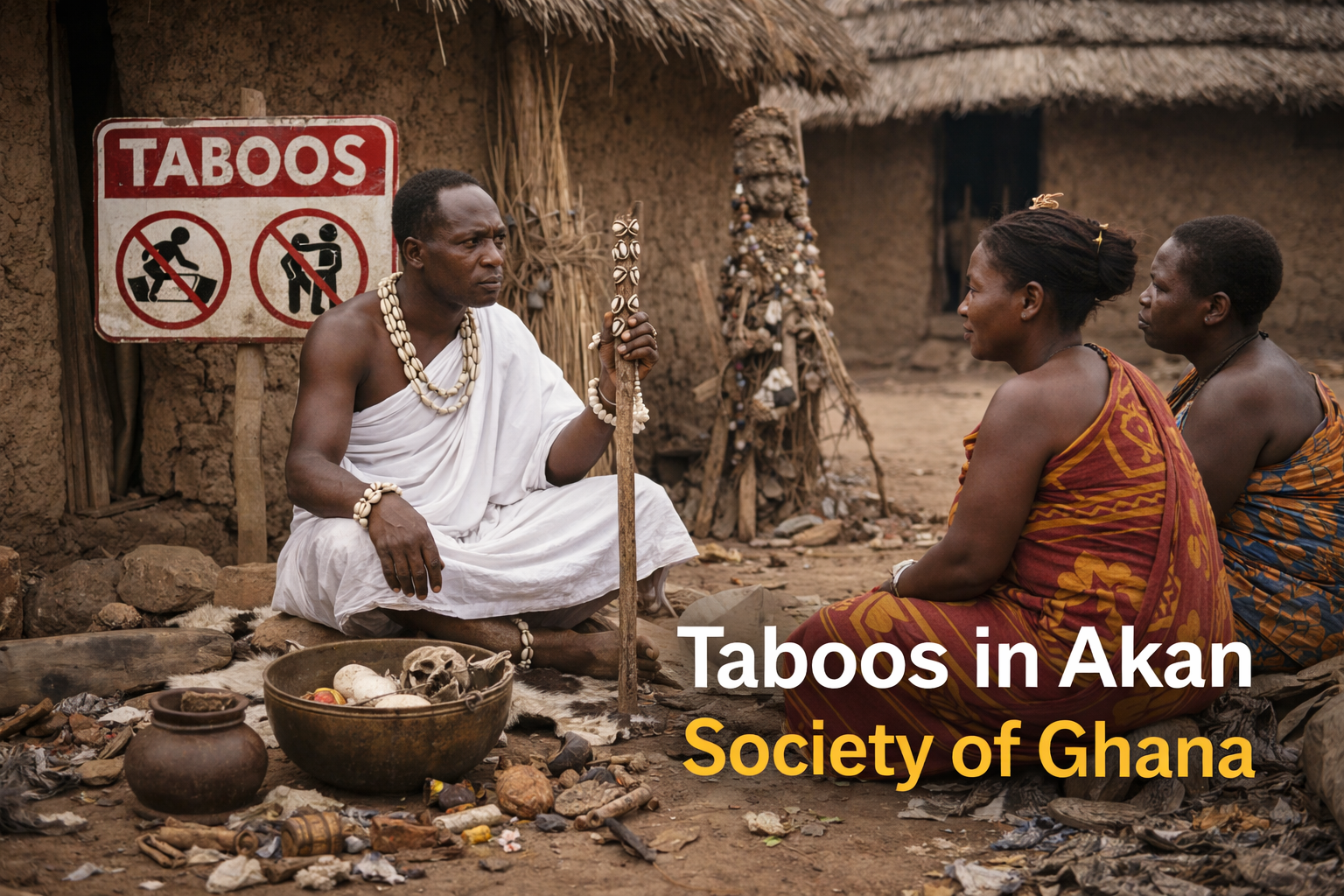
As a cultural group, the Akan observe numerous taboos, which serve as powerful moral and religious regulations governing social behavior. A taboo refers to a culturally prohibited act believed to offend the gods, ancestral spirits, or the moral order of society. Taboos are not merely social rules; they are sacred injunctions whose violation is thought to invite misfortune, spiritual punishment, or collective calamity.
Individuals who violate taboos are subject to serious sanctions. Depending on the nature and severity of the offense, offenders may be required to perform ritual pacification, often involving the presentation of a ram and schnapps. These items are used in sacrifices to appease the offended gods and ancestral spirits and to restore moral and spiritual balance within the community.
Some major taboos in Akan society include the following:
- Do not take your own life (suicide is strictly forbidden).
- Do not commit incest.
- Do not disrespect an elder.
- Do not disrespect a chief or other political authority.
- Do not urinate or defecate in water bodies, including rivers, lakes, and the ocean.
- Do not swear a false oath.
- Do not go to the bush on sacred Akan days (such as dabɔne or other calendrical days reserved for religious observance).
- Do not engage in sexual activity in the bush.
These taboos reinforce respect for life, authority, sexuality, nature, and the sacred, and they function as essential mechanisms for maintaining social order and spiritual harmony in Akan society.
Additional Akan Taboos
Life, Death, and the Human Body
- Do not shed human blood unnecessarily. Blood is sacred; wrongful bloodshed pollutes the land (asase) and angers the earth deity (Asase Yaa).
- Do not touch a corpse without proper ritual authority. Unauthorized contact with the dead is spiritually dangerous.
- Do not laugh, mock, or behave frivolously around a corpse or funeral grounds.
- Do not announce a death casually or publicly before elders and lineage heads are informed.
- Do not bury the dead improperly or without prescribed rites, especially elders or ritual specialists.
Sexuality, Reproduction, and Gender
- Do not have sexual intercourse during menstruation.
- Do not have sex on sacred days (dabɔne) or during major ritual periods.
- Do not commit adultery, especially with a chief’s wife or a lineage member’s spouse.
- Do not expose sexual organs publicly.
- Do not have sexual relations with close affines, even if not biologically related.
- Do not give birth in forbidden or ritually polluted places without purification afterward.
Respect for Authority and Social Order
- Do not insult the stool (chieftaincy institution).
- Do not sit on a chief’s stool or touch regalia without permission.
- Do not contradict or publicly shame elders in communal gatherings.
- Do not walk between a chief and his linguist while official communication is ongoing.
- Do not step over ritual objects, elders’ legs, or sacred paraphernalia.
Nature, Land, and the Sacred Environment
- Do not farm, dig, or build on sacred land without ritual consent.
- Do not cut trees considered sacred or associated with shrines.
- Do not whistle at night, especially near forests or graveyards (believed to summon spirits).
- Do not fish or bathe in sacred rivers on forbidden days.
- Do not spill palm wine or alcohol on the ground without libation, as the earth must be acknowledged.
Speech, Oaths, and Moral Conduct
- Do not invoke the names of gods or ancestors frivolously.
- Do not curse others lightly, especially using ancestral or divine names.
- Do not lie during ritual proceedings or judicial hearings.
- Do not break ritual silence during certain ceremonies.
Food and Domestic Conduct
- Do not eat before elders in certain ritual contexts.
- Do not eat specific foods on sacred days in some Akan communities.
- Do not throw food into fire or onto the ground carelessly.
- Do not sweep at night, especially toward the outside of the house (symbolically sweeping away fortune).
Conclusion
In Akan society, taboos function as informal mechanisms of social control. They regulate behavior without formal policing, criminal law, or incarceration. Violations are conceptualized not merely as personal wrongdoing but as cosmic offenses capable of bringing misfortune upon families, lineages, and entire communities. This is why sanctions emphasize ritual cleansing, restitution, and appeasement, rather than punishment alone.