









Witchcraft is commonly understood in Ghana as a supernatural power believed to be possessed by some individuals, enabling them to influence the behavior, health, fortune, or misfortune of others—either as victims or beneficiaries. Belief in witchcraft and witches remains widespread and deeply embedded in Ghanaian society.
Although no comprehensive national survey exists to measure belief in witchcraft, scholars and observers widely estimate that a large majority of Ghanaians—perhaps as many as nine out of ten—believe in the reality of witchcraft in one form or another. These beliefs cut across education levels, religions, regions, and social classes.
The Nature of Witchcraft Beliefs
According to popular Ghanaian beliefs, witchcraft is invisible and secretive. It is widely held that there is no reliable way to identify a witch through ordinary social interaction. A person may appear kind, religious, or harmless during the day but still be suspected of witchcraft activities carried out secretly.
Witches are commonly believed to be nocturnal, meaning their activities occur mostly at night. Many Ghanaians believe witches travel spiritually after dark to attend meetings known as witch covens. These journeys are often described as flights through the night sky, sometimes imagined as giant balls of fire.
Good Witches and Bad Witches
In Ghanaian belief systems, witches are often divided into two broad categories. A “good witch” is believed to use supernatural powers to protect family members, help loved ones succeed, or advance personal interests. A “bad witch,” by contrast, is believed to use witchcraft for harmful purposes.
Bad witches are often accused of causing illness, infertility, accidents, business failure, mental illness, or death. Car accidents, sudden deaths, and unexplained illnesses are frequently attributed to witchcraft, especially when no clear medical or mechanical explanation is available.
Some beliefs go further, describing witches as spiritually anthropophagous—that is, spiritually cannibalistic. In this worldview, witches are believed to kill their victims spiritually and feed on their blood or life force.
Who Gets Accused—and Why
Despite the lack of scientific evidence for the existence of witchcraft, accusations are common. Importantly, not everyone is equally likely to be accused. In practice, accusations disproportionately target elderly women, poor women, widows, the childless, and sometimes children.
Physical features are often used as “evidence” of witchcraft. Elderly people with stooped posture, reddish or yellowish eyes, frailty, or social isolation are frequently suspected. Childlessness, poverty, or lack of family protection can also make individuals vulnerable to accusation.
These accusations are not based on scientific proof but on fear, rumor, misfortune, and social tension.
Violence and Human Rights Abuses
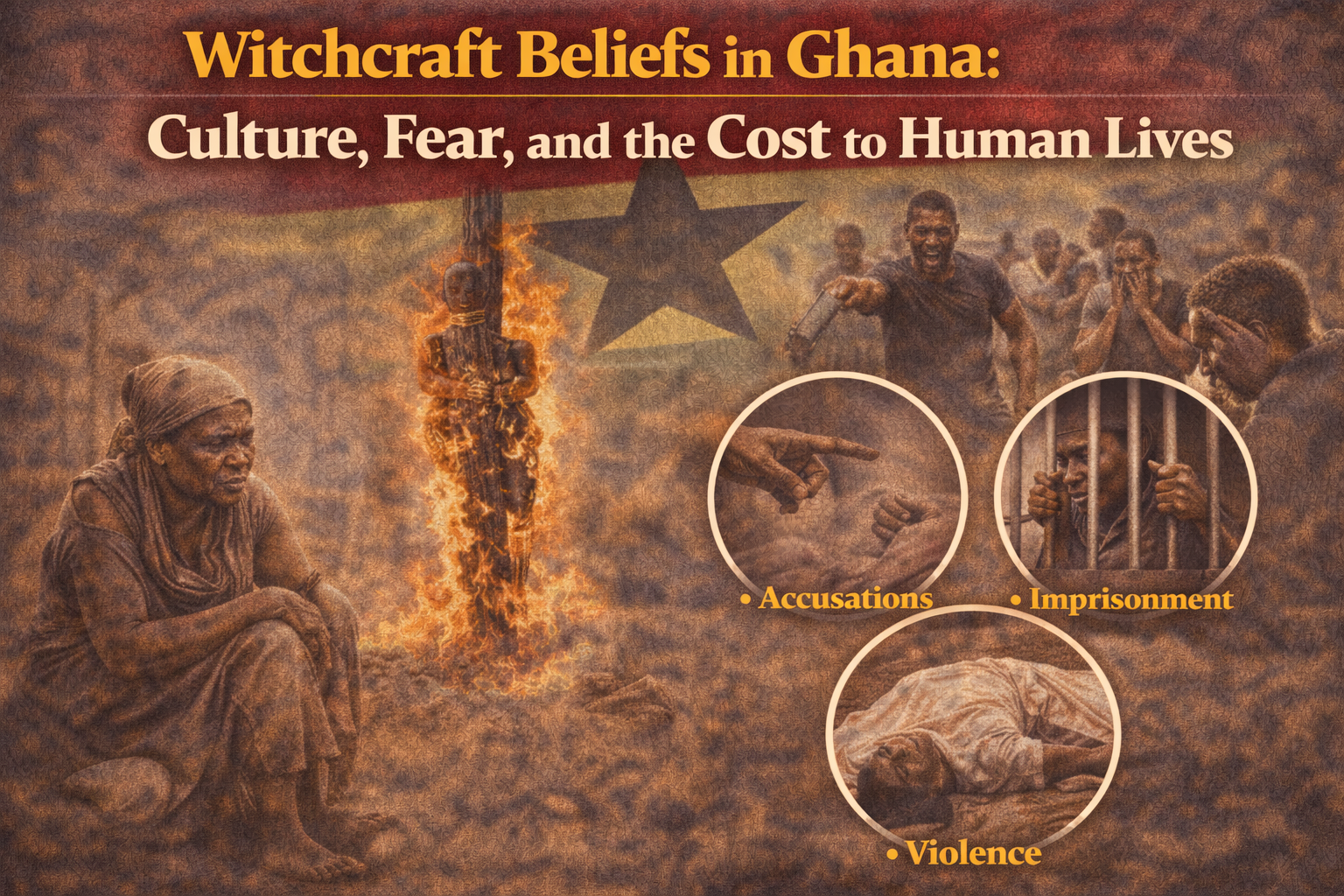
Although Ghanaian law clearly prohibits assault and murder, witchcraft accusations have led to severe human rights abuses. In some cases, accused persons are beaten, banished from their communities, or even killed by mobs acting outside the law.
So-called “witch camps” in parts of northern Ghana emerged as places of refuge for accused women, though they also reflect a failure of society to protect vulnerable citizens within their own communities.
The Legal Response
Recognizing the harm caused by witchcraft accusations, Ghana’s Parliament in 2023 passed a bill seeking to criminalize witchcraft accusations. The bill aimed to make it a criminal offense to accuse someone of being a witch, given the proven link between accusations and violence.
However, the bill was not signed into law by the President, preventing it from coming into force. Civil society organizations, human rights advocates, and traditional leaders continue to push for renewed efforts to pass and enforce such legislation under the current administration.
Belief Versus Evidence
It is important to note that there is no scientific method to prove the existence of witchcraft and no scientific way to identify a witch. Modern medicine, psychology, and social science explain many of the events attributed to witchcraft—such as illness, infertility, mental health challenges, and accidents—through natural and social causes.
Yet belief persists, sustained by tradition, fear of misfortune, religious interpretations, and uncertainty in the face of suffering.
Conclusion
Witchcraft beliefs remain a powerful cultural force in Ghana, shaping how people interpret misfortune and human behavior. However, when belief turns into accusation, stigma, violence, and death, it becomes a serious social problem.
As Ghana continues to develop, there is an urgent need for public education, legal protection, and community dialogue—not to ridicule belief, but to protect human life and dignity. No society can justify the punishment, exile, or killing of its most vulnerable members based on fear without proof.
The challenge for Ghana is to find a way to respect cultural belief while upholding human rights, the rule of law, and scientific reasoning.