










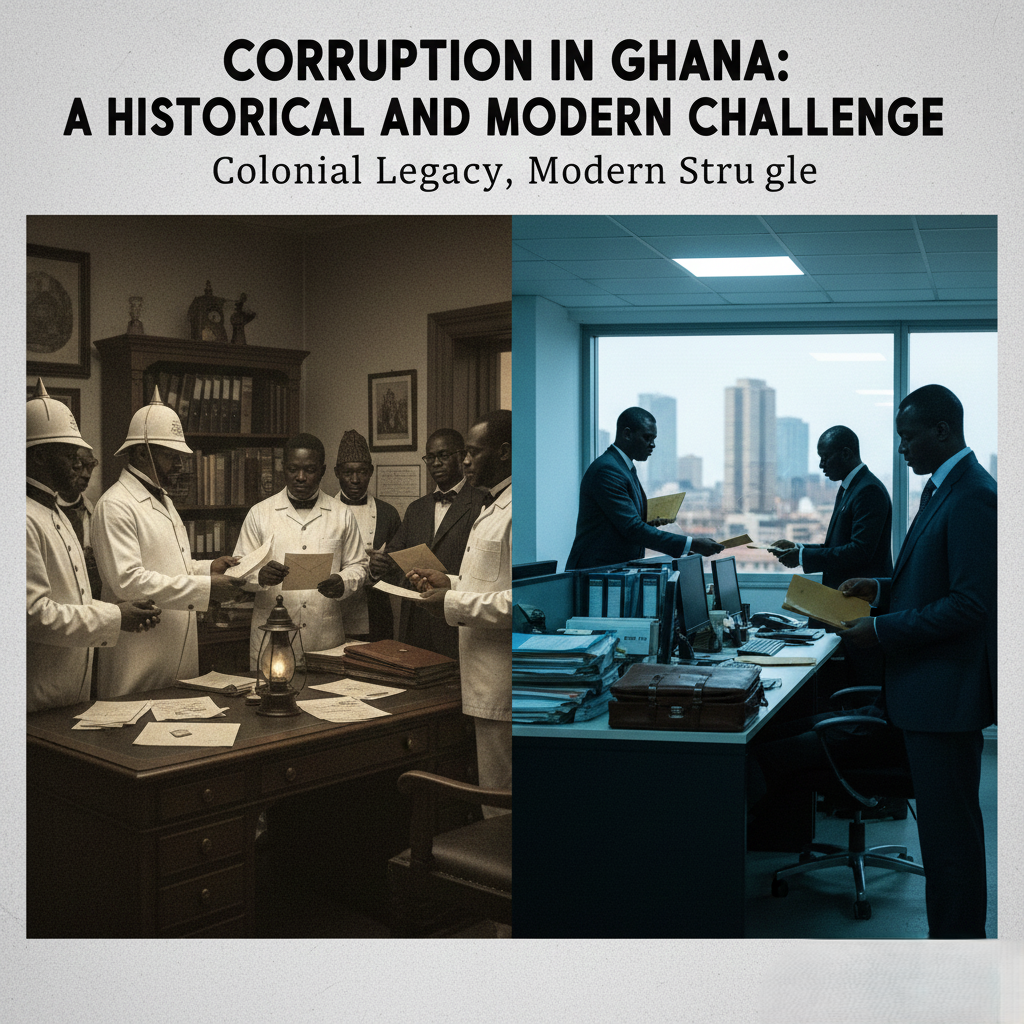
Corruption remains one of the most enduring social challenges confronting Ghana. Its roots stretch back to the colonial Gold Coast era (1821–1957) and continue to influence governance, public trust, and national development today. Understanding this long history is essential to appreciating why corruption has proven so difficult to eradicate.
Corruption During the Gold Coast Era (1821–1957)
Formal British colonial administration of the Gold Coast began in 1821, when the British Crown assumed control from private trading companies. By the late 19th century, especially after the British declaration of the Gold Coast as a Crown Colony in 1874, corruption had become embedded in colonial governance structures.
Colonial officials depended heavily on local chiefs, clerks, court interpreters, and tax collectors to administer justice, collect taxes, and regulate trade. This system encouraged bribery, favoritism, and manipulation of colonial authority for personal gain.
Historical records show that:
- court cases were sometimes influenced by bribes,
- customs officials altered duties for traders, and
- Some chiefs abused colonial backing to seize land or impose illegal levies.
Although the colonial government officially condemned corruption, enforcement was inconsistent and often ignored abuses that supported imperial economic interests, particularly in cocoa production and mineral extraction during the late 1800s and early 1900s.
Independence and Early Nationhood (1957–1966)
When Ghana gained independence on 6 March 1957, expectations were high that African self-rule would dismantle corrupt colonial systems. Under Dr. Kwame Nkrumah (1957–1966), the government pursued rapid industrialization and state-led development.
However, concentration of power, weak oversight, and politicization of state institutions contributed to allegations of mismanagement and favoritism. These concerns played a role in the 1966 military coup, which justified its intervention partly as a response to corruption and abuse of power.
Military Rule and Political Instability (1966–1992)
Between 1966 and 1992, Ghana experienced multiple coups and alternating military and civilian governments. Each regime promised to “clean up” corruption, yet the problem persisted.
Key periods include:
- National Redemption Council (1972–1978)
- Armed Forces Revolutionary Council (1979)
- Provisional National Defence Council (1981–1992)
While some efforts were made to discipline public officials, lack of transparency, economic hardship, and authoritarian rule often worsened corruption rather than eliminated it.
The Fourth Republic and Contemporary Ghana (1992–Present)
With the introduction of constitutional rule in 1992, Ghana established democratic institutions aimed at accountability, including Parliament, the Commission on Human Rights and Administrative Justice (CHRAJ), and later the Office of the Special Prosecutor (2018).
Despite these reforms, corruption continues to manifest through:
- procurement fraud,
- inflated public contracts,
- bribery in public services, and
- political patronage.
Reports by Transparency International consistently rank corruption as a major public concern in Ghana, despite the country’s reputation for democratic stability.
Why Corruption Has Persisted
The endurance of corruption in Ghana can be traced to:
- colonial administrative legacies,
- weak enforcement of laws,
- economic inequality,
- political interference, and
- social tolerance of “informal payments” as survival strategies.
Corruption has thus evolved from a governance problem into a deeply rooted social issue affecting everyday life—from healthcare and education to land administration and justice.
Looking Forward
The fight against corruption in Ghana is ongoing. Investigative journalism, civil society activism, digital transparency, and youth-led advocacy are increasingly challenging impunity. Understanding corruption’s historical roots from the Gold Coast era provides critical insight into how lasting reform can be achieved.
Key Historical Sources & References
- Kimble, D. (1963). A Political History of Ghana: The Rise of Gold Coast Nationalism. Oxford University Press.
- Rathbone, R. (2000). Nkrumah & the Chiefs: The Politics of Chieftaincy in Ghana. James Currey.
- Austin, D. (1976). Politics in Ghana 1946–1960. Oxford University Press.
- Transparency International. Corruption Perceptions Index Reports (various years).
- National Archives of Ghana – Colonial Administrative Records.
Watch Full Video on YouTube – https://youtu.be/EV4UZ3y1UKs