



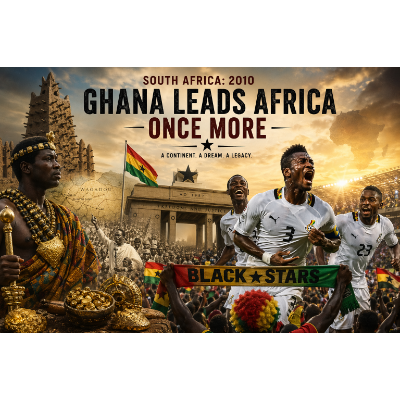
History is rarely linear. It moves in cycles—of rise, dispersal, memory, and resurgence. In July 2010, under the floodlights of Soccer City in Johannesburg, a moment unfolded that seemed to collapse centuries into ninety minutes (and then one hundred and twenty). Ghana’s Black Stars stood on the brink of becoming the first African team to reach a FIFA World Cup semi-final. Yet beyond the heartbreak that followed, that moment symbolized something far deeper: a reawakening of a long historical pattern—Ghana, or the lands that now bear its name, once again standing at the forefront of African representation on a global stage.
To understand why that moment resonated so profoundly across the continent, one must travel back—not merely to colonial or postcolonial eras—but into the deeper currents of precolonial West African history.
Long before the term “Ghana” referred to a modern nation-state, it was associated with the legendary Empire of Ghana—known in Soninke parlance as Wagadou. The title “Ghana” itself meant “Warrior King”, a political and spiritual authority that symbolized unity and power. Though geographically distinct from modern Ghana, this empire represented one of the earliest known centers of political organization, wealth accumulation, and trans-Saharan trade in West Africa between the 8th and 13th centuries.
The deeper significance lies not in direct lineage but in symbolic inheritance. The peoples inhabiting the region of present-day Ghana were shaped by centuries of migration, exchange, and cultural synthesis. By the 14th to 16th centuries, traders from the Mande world and Hausa states were already interacting with communities in the forest and savannah zones, exchanging gold, kola nuts, and ideas. These interactions embedded a long-standing identity of the region as a crossroads of influence—a place where Africa met itself and projected outward.
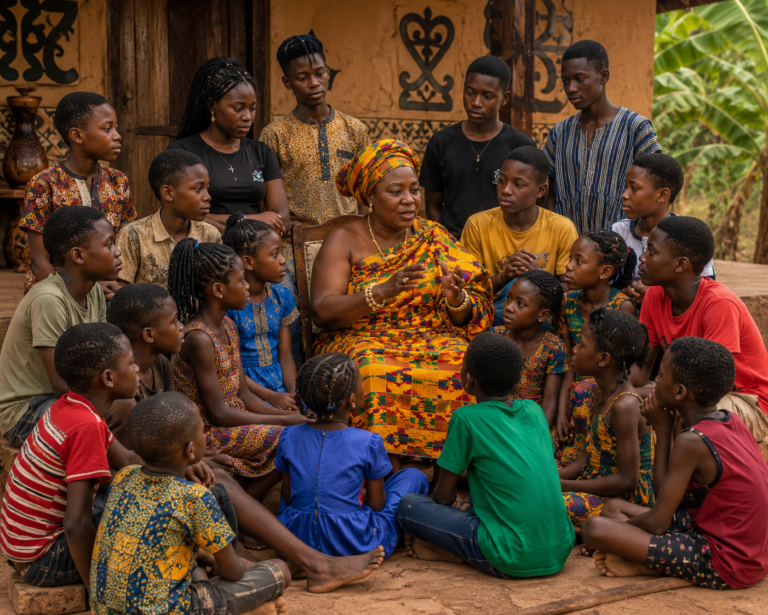
Among Akan-speaking peoples, concepts like “Sankofa”—literally meaning “go back and fetch it”—emerged. It is both a linguistic and philosophical expression urging societies to reclaim their past to build the future. In many ways, Ghana’s performance in 2010 felt like a living embodiment of Sankofa: a retrieval of continental pride rooted in deep historical memory.
Fast forward to the late 19th and early 20th centuries, the Gold Coast (as Europeans named it) became one of the most economically vibrant regions in colonial Africa due to gold and cocoa. But even before colonial consolidation, powerful states like Asante had already demonstrated sophisticated governance, military organization, and economic systems. These societies reinforced a recurring pattern: the region’s capacity to organize, lead, and inspire beyond its borders.
This historical tendency did not vanish with colonial disruption. It transformed.
When Ghana gained independence in 1957 under Kwame Nkrumah, it became the first sub-Saharan African country to break colonial rule, igniting a wave of liberation movements across the continent. This was not accidental—it was consistent with a longer trajectory of symbolic leadership.
Thus, by the time we arrive at 2010, the stage was already set—historically, psychologically, and culturally.
The 2010 FIFA World Cup in South Africa was itself a monumental event—the first time the tournament was hosted on African soil. It carried immense symbolic weight: Africa was no longer just participating in global narratives; it was hosting them.
Yet, as the tournament progressed, African teams fell one by one. Cameroon, Nigeria, Algeria, Ivory Coast, and even host South Africa exited early. What remained was Ghana—the youngest team in the tournament, yet the last hope of a continent.
Their journey was not merely athletic. It was civilizational in symbolism.
After defeating the United States in the Round of 16, Ghana advanced to the quarter-finals, becoming the sole African representative at that stage. In doing so, they carried not just a flag, but the aspirations of over a billion people.
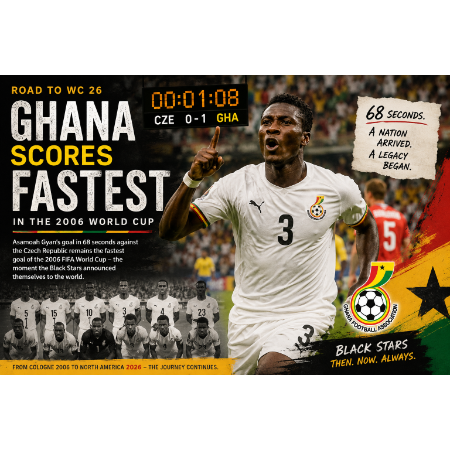
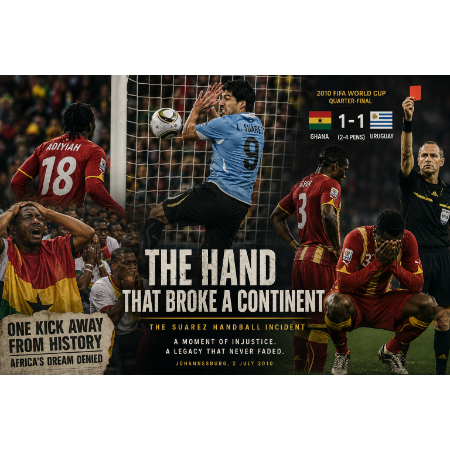
The quarter-final match against Uruguay has since entered global sporting folklore. With the score tied 1–1 deep into extra time, Ghana stood seconds away from history. A header from Dominic Adiyiah was destined for the net—until Uruguay’s Luis Suárez stopped it with his hand on the goal line.
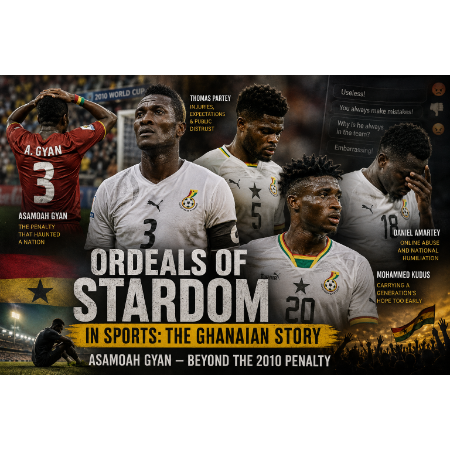
The act was both illegal and strategic—a modern echo of ancient warfare tactics where survival justified transgression. In Akan thought, there exists the proverb: “Ɔkɔtɔ nwo anoma” (the crab does not give birth to a bird), suggesting that beings act according to their nature. Suárez acted according to the competitive logic of his context. But what followed—the missed penalty by Asamoah Gyan—transformed the moment into tragedy.
Ghana eventually lost on penalties.
Yet history is not only written in victories. Across Africa, the reaction was not merely disappointment—it was collective mourning. Drums fell silent, but narratives grew louder. Ghana had come closer than any African nation ever had to reaching a World Cup semi-final.
In that moment, Ghana once again “led Africa”—not by conquering territory or establishing empires, but by embodying continental possibility.
This leadership echoes older patterns. Just as precolonial Ghana (Wagadou) stood as a beacon of wealth and organization, and modern Ghana sparked political liberation in 1957, the 2010 Black Stars reignited a different kind of unity—emotional and symbolic unity.
There is also a linguistic layer worth noting. The name “Black Stars” itself draws from Marcus Garvey’s Black Star Line, a Pan-African shipping enterprise meant to connect African descendants globally. The symbol thus merges diaspora aspirations with continental identity. In Akan cosmology, the star (nsoromma) is often associated with destiny and guidance.
Thus, when Ghana took the field in 2010, it was not merely a team—it was a convergence of histories:
- Precolonial trade networks and statecraft
- Colonial resistance and independence movements
- Pan-African ideology and diasporic dreams
In conclusion, the phrase “Ghana leads Africa once more” is not hyperbole. It reflects a recurring historical rhythm. Across centuries, the region and its people have repeatedly emerged at critical moments—economically, politically, and symbolically—to stand at the forefront of African identity.
The tragedy of 2010 does not diminish this pattern—it reinforces it. For in many African traditions, including Akan thought, failure is not final; it is formative. As the proverb goes: “Nsa baako nkura adesoa”—one hand cannot lift a heavy load. Ghana lifted as much as it could, but the weight it carried belonged to an entire continent.
And for a brief, unforgettable moment in 2010, that continent saw itself—not in defeat, but in possibility.