









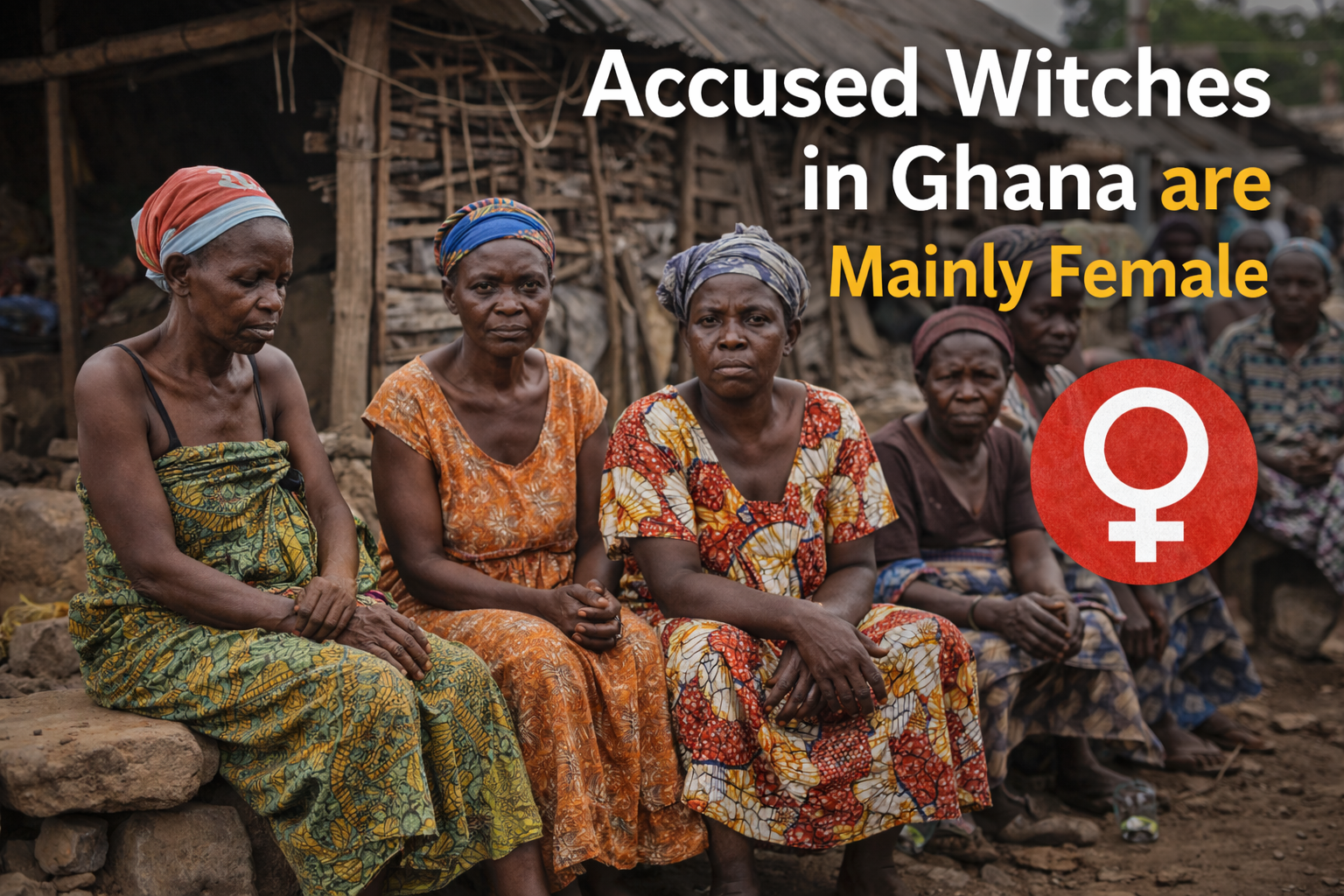
In Ghana, the overwhelming majority of people accused of witchcraft are women and girls. Nearly all victims killed during witch hunts are female. In the so-called “witch camps” or “outcast homes” in northern Ghana, it is rare to find a man among the residents. The population is almost entirely women—elderly women, widows, divorced women, poor women, socially isolated women.
This is not accidental. It is structural.
Witchcraft accusation in Ghana is profoundly gendered.
In many cases, the accusers are men. The attackers are frequently men. The perpetrators of lethal and sublethal violence—beatings, banishment, lynching, humiliation—are overwhelmingly male. It is, in blunt terms, men in a patriarchal society making allegations against women in a patriarchal society.
The question, then, is not whether women are inherently more “witch-like.” The real question is: Why are women more vulnerable?
First, Ghana remains deeply patriarchal in structure. Property ownership, lineage authority, political leadership, and control over resources are still largely male-dominated spheres. Women who step outside prescribed gender expectations often attract suspicion. When men do not like what women are doing, the label “witch” becomes a convenient weapon.
Second, social success by women can provoke backlash. When girls outperform boys academically, some male classmates accuse them of using witchcraft. When women are outspoken, assertive, or challenge male authority, they may be branded witches. When women achieve financial success or supervise male subordinates, accusations sometimes emerge. The allegation functions as a leveling device—a cultural mechanism to discipline ambition.
Third, elderly women are particularly vulnerable. Widowhood, poverty, childlessness, or social isolation remove layers of protection. An elderly woman without strong male defenders can easily become the scapegoat when tragedy strikes—whether a child dies, a business fails, or illness spreads. In moments of communal anxiety, blame is feminized.
Fourth, witchcraft beliefs are intertwined with reproduction and domestic life—domains culturally associated with women. When misfortune affects fertility, childbirth, or children, suspicion often falls on other women. Thus, women become both symbolically and socially positioned as likely culprits.
It is also important to observe that accusations are rarely about evidence. They are about power, control, resentment, jealousy, inheritance disputes, and unresolved conflicts. The language of witchcraft masks underlying social tensions. The accusation becomes a culturally legitimate way to punish, silence, expel, or eliminate a woman.
This is why witch hunting in Ghana can, in many respects, be described as woman hunting.
None of this is to deny that men can be accused. They can, and sometimes are. But statistically and socially, the phenomenon is overwhelmingly gendered. The victims of banishment are women. The victims of mob violence are women. The residents of the camps are women.
When a social problem disproportionately harms one gender, we must name it honestly.
Witchcraft accusation in Ghana is not merely about supernatural belief. It is about patriarchy, gender inequality, and the policing of female autonomy.
Until we confront those structural realities—until women’s economic independence, educational achievement, and public voice are no longer perceived as threats—the pattern will persist.
The label “witch” is rarely about magic. It is often about power.