



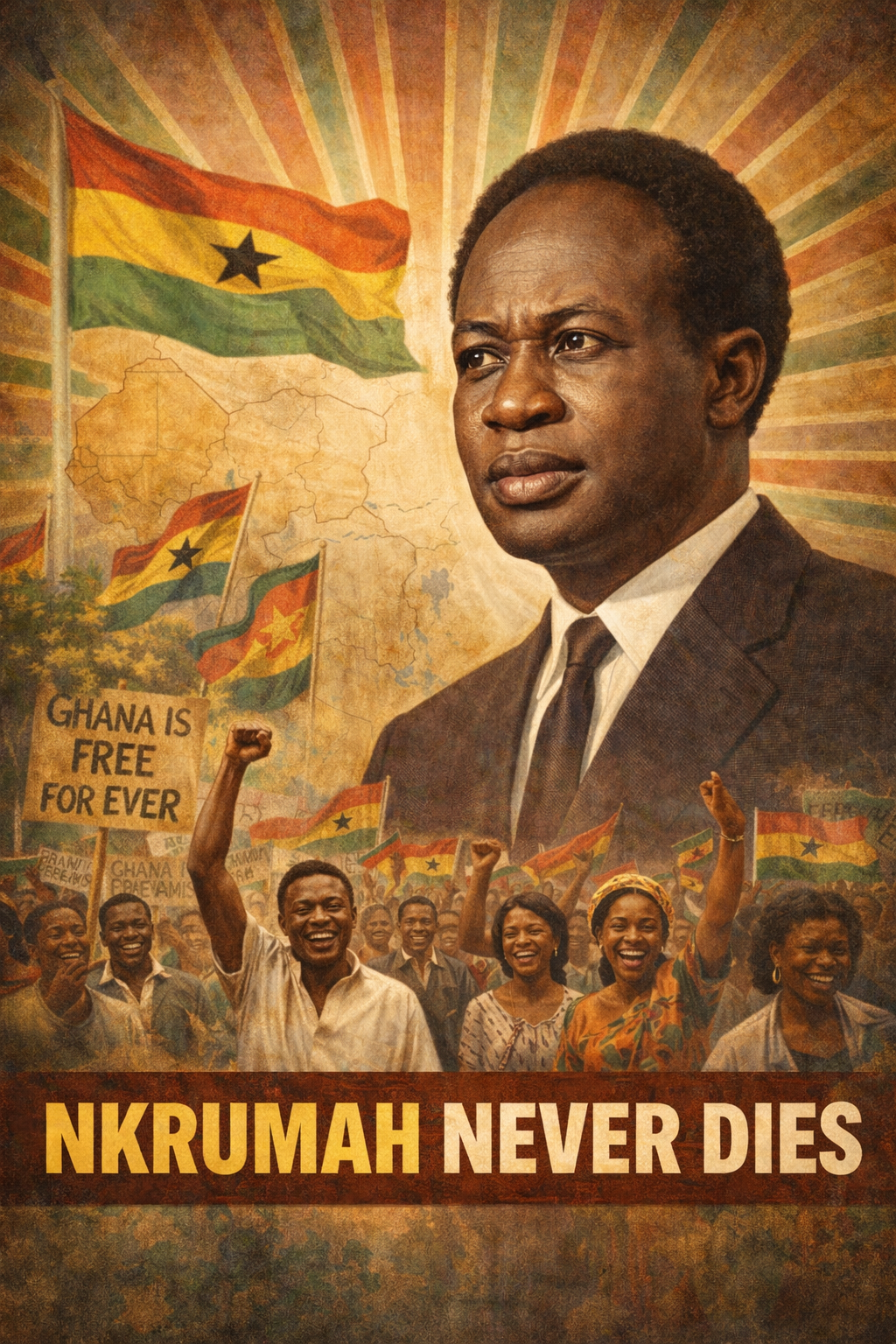
In the history of Ghana, few names command as much reverence and admiration as Kwame Nkrumah. More than half a century after his passing, the memory of the man who led the nation to freedom continues to inspire generations. His words echo in political discourse, his ideas shape national debates, and his legacy remains firmly embedded in the consciousness of the Ghanaian people. For many, this enduring influence explains why people often say: Nkrumah never dies.
The Hero of Independence
Nkrumah occupies a special place in the hearts of Ghanaians because he led the struggle that ended colonial rule and ushered the country into independence in 1957. As the leader of the Convention People’s Party, he mobilized ordinary citizens—workers, farmers, students, and traders—into a powerful movement that demanded self-rule. When Ghana finally became free from British colonial administration, Nkrumah emerged as the symbol of the triumph of African determination and courage. His leadership transformed the Gold Coast into Ghana, the first sub-Saharan African country to gain independence from colonial rule in the modern era.
Champion of Black Pride
Beyond political independence, Nkrumah sought to instill a deep sense of dignity and pride among people of African descent. At a time when colonial ideologies had attempted to portray Africa as inferior, he boldly proclaimed the greatness of African civilization and culture. His famous declaration that “the Black man is capable of managing his own affairs” resonated across the continent and beyond. Through speeches, policies, and symbolic acts, he encouraged Africans everywhere to embrace their identity with confidence and pride.
A Leader for All Africa
Nkrumah’s vision extended beyond Ghana’s borders. He believed strongly that the freedom of Ghana would be meaningless unless it was linked to the total liberation of the African continent. True to this conviction, he supported liberation movements in many parts of Africa. His government offered assistance to nationalist leaders who were struggling against colonial domination in their own countries. Because of this commitment to African unity and freedom, Nkrumah became one of the foremost champions of Pan-Africanism and a respected figure throughout Africa.
Education for National Development
At home, Nkrumah embarked on an ambitious program of national development. Education stood at the center of his agenda. He introduced free and compulsory basic education in Ghana, opening the doors of learning to thousands of children who might otherwise never have entered a classroom. Under his leadership, many schools were built across the country, creating opportunities for ordinary citizens to acquire knowledge and skills that would help build the new nation.
Building an Industrial Nation
Industrialization was another pillar of Nkrumah’s development strategy. He believed that political independence must be accompanied by economic self-reliance. His government therefore established numerous factories and state corporations designed to produce goods locally and reduce dependence on foreign imports. Although not all these initiatives survived in the long run, they reflected his bold determination to transform Ghana into a modern industrial nation.
The Writer and Thinker
Nkrumah was not only a political leader but also an intellectual and prolific writer. Kwame Nkrumah authored several influential books that articulated his political philosophy and his vision for Africa. Works such as Africa Must Unite and Neo-Colonialism: The Last Stage of Imperialism continue to be read and debated by scholars, students, and political thinkers around the world. Through these writings, his ideas continue to shape discussions about African development, unity, and sovereignty.
Promoting National Unity
Equally important was his constant emphasis on national unity. Nkrumah believed that Ghana’s strength lay in the ability of its diverse ethnic and cultural groups to come together as one people with a common destiny. His message of unity sought to transcend tribal divisions and foster a shared national identity.
A Legacy That Lives On
Today, statues, institutions, and public monuments commemorate the life of Kwame Nkrumah. Yet his most enduring memorial lies not in stone or bronze, but in the collective memory of the nation. His words continue to inspire, and his achievements continue to provoke reflection about the path Ghana should take.
For this reason, many Ghanaians repeat a powerful phrase whenever his name is mentioned: Nkrumah never dies. His physical body may be gone, but his vision, his ideas, and his influence live on. In the hearts and minds of the people, Nkrumah indeed never dies.