











Rules, Laws, and Social Order
All human societies are governed by rules. These rules regulate behavior by defining what individuals may do and what they must refrain from doing. Without such rules, social life would be chaotic, unpredictable, and ultimately unsustainable. Rules make social interaction possible by creating order, stability, and mutual expectations among members of society.
In everyday life, people often follow rules without consciously thinking about them. From greeting elders properly to observing funeral etiquette, individuals are constantly guided by socially established expectations.
Norms in Sociological Perspective
In sociology, these rules are referred to as norms. Norms are the shared expectations that guide behavior within a society. They tell people what is considered appropriate, acceptable, or desirable in a given social context.
Norms are learned through socialization—within families, schools, religious institutions, and communities. For example, in many Ghanaian societies, children are taught from an early age to greet elders respectfully, often by using specific gestures such as bowing slightly or avoiding direct eye contact in certain contexts.
However, not all norms carry the same weight. Sociologists distinguish between different types of norms based on their importance and the seriousness of their violation.
Folkways: Everyday Norms
Folkways are norms that govern everyday behavior but are not considered morally significant. They are customary ways of doing things—habits, routines, and conventions that people follow in daily life.
In Ghanaian contexts, examples of folkways include appropriate dress for different occasions, eating with the right hand rather than the left, or observing polite forms of greeting. While these practices are important for smooth social interaction, their violation does not usually provoke severe reactions.
If someone violates a folkway—for instance, by dressing inappropriately to a public event—they may be laughed at, criticized, or considered disrespectful. However, such violations rarely lead to serious punishment. The sanctions are informal and relatively mild.
Mores: Morally Significant Norms
Mores (pronounced mo-rays) are norms that are regarded as essential to the moral order and well-being of society. They reflect deeply held values and ethical principles. Because of their importance, violations of mores are taken very seriously.
In Ghana, mores include norms against stealing, incest, and disrespecting elders in grave ways. Accusations of witchcraft also fall within the realm of mores because of their potentially devastating social consequences.
When mores are violated, the reaction is often strong and emotionally charged. Sanctions may include public condemnation, ostracism, or even violence in extreme cases. For example, individuals accused of murder in some communities may face banishment or physical harm, illustrating the severity attached to norms governing the sanctity of life.
Sanctions as Indicators of Importance
One way to determine the importance of a norm is to examine the sanctions attached to it. Sanctions are the consequences—either positive or negative—that follow from conformity or deviance.
Mild sanctions, such as laughter or mild disapproval, typically indicate a folkway. Severe sanctions, such as exclusion, stigma, or violence, indicate a more. In Ghanaian society, failing to greet an elder may attract a rebuke, but committing theft or engaging in taboo sexual relations may result in serious social and moral condemnation.
Thus, sanctions serve as a useful sociological tool for distinguishing between different types of norms.
Types of Norms: Prescriptive and Proscriptive
Norms can also be classified as prescriptive or proscriptive.
Prescriptive norms specify what individuals are expected to do. They guide positive behavior. Examples include caring for one’s children, participating in communal labor, and showing respect to elders.
Proscriptive norms, by contrast, specify what individuals are expected not to do. They prohibit certain behaviors, such as stealing, lying, engaging in incest, or falsely accusing others of witchcraft.
Affirmative and Negative Expressions of Norms
Prescriptive norms are stated in affirmative terms; they tell individuals what they ought to do. For example: “Care for your children,” or “Show respect to elderly people.”
Proscriptive norms are expressed in negative terms; they tell individuals what they must avoid. Examples include: “Do not steal,” “Do not drink and drive,” and “Do not accuse anyone of being a witch.”
These two forms of norms work together to structure behavior by providing both positive obligations and negative prohibitions.
From Mores to Laws
Not all norms become laws. However, when certain mores are considered so vital that their violation threatens the stability, safety, or survival of society, they are formalized into laws.
Laws are norms that have been codified and institutionalized by the state. They are written down, formally recognized, and enforced by official institutions. In Ghana, for example, norms against theft, assault, and murder have been transformed into criminal laws under the authority of the state.
The transition from mores to laws often reflects broader social concerns. For instance, increasing attention to witchcraft-related violence in Ghana has led to discussions about criminalizing witchcraft accusations, illustrating how deeply held social norms can become matters of legal regulation.
Crime and Legal Sanctions
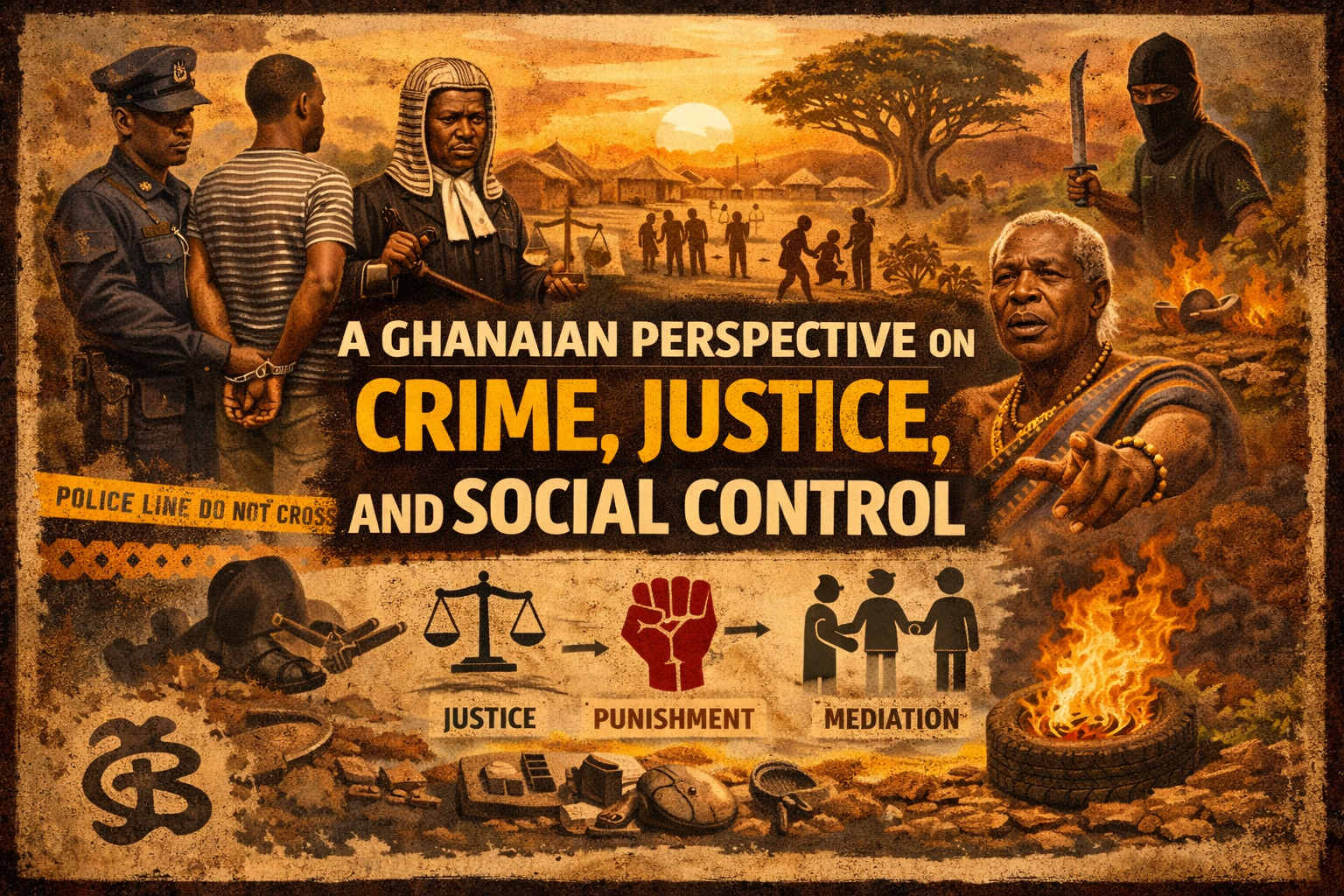
The violation of a criminal law constitutes a crime. Unlike informal norms, laws are enforced by formal agents of social control, such as the police, courts, and correctional institutions.
Because laws carry the authority of the state, their enforcement is backed by formal and often severe sanctions. These punitive sanctions may include fines, imprisonment, or, in some jurisdictions, the death penalty.
In Ghana, individuals found guilty of crimes such as armed robbery, fraud, or homicide face legal penalties determined by the courts. These sanctions are more systematic and institutionalized than the informal sanctions associated with folkways and mores.
Through this process, what begins as a social rule rooted in shared values may ultimately become a legally binding command, backed by the coercive power of the state. In this way, the boundary between culture and law is bridged, revealing how deeply social life shapes legal systems.